
The following is a guest post by Thomas Obel Hansen, who is is the Beatriz Galindo Distinguished Professor with the Department of International Law, Universidad Carlos III de Madrid; he has a research affiliation with the Transitional Justice Institute, Ulster University.
The following post follows up on my previous post here at Justice in Conflict last week, which explained why the Sánchez government in Spain is right to say “no to war” in Iran and is emerging as the strongest voice in the West for the universal application of international law. A key measure taken by Spain to give effect to its war objections involves denying the US the right to use Spanish military bases to execute Operation Epic Fury. These are exactly the types of measures that States can take to give meaningful effect to their international obligations.
In contrast, several countries in Europe – including the UK – have taken a fundamentally different approach, permitting the US to use their military facilities in support of the war on Iran. This post questions the legality and wisdom of doing so, focusing here on the UK’s approach.
Whereas the UK in the run-up to the present war on Iran took the position that it would not permit the US to use its bases for strikes on Iran, on 1 March British Prime Minister Keir Starmer reversed course. On the same day, the government published a summary of its legal position on “the legality of defensive action in respect of Iranian regional attacks”. That summary states that the UK will take a range of action, ostensibly acting in “collective self-defence of regional allies who have requested support”.
The legal note confirmed that the UK has responded positively to the US’ request for the use of UK bases, to help facilitate what is referred to as “specific and limited defensive action”. However, the government’s position as to what amounts to defensive action is extremely broad. Importantly, destroying Iranian “missiles at source – in their storage depots or the launchers which [are] used to fire the missiles”, is in the view of the British government, action that has a “specific and limited defensive purpose”.
At the same time, the British government has gone to great lengths to argue that the UK is not a party to the conflict and is acting “in accordance with international law”.
Both of these claims are of doubtful accuracy considering the circumstances.
Whereas simply permitting overflights or stopovers may not necessarily constitute a sufficient connection to the hostilities to make the relevant State a co-belligerent, it is generally understood (see e.g. here and here) that if a country permits another country to use its airbases “as a launchpad for specific hostilities against another state”, this makes the country giving that permission a co-belligerent in the relevant conflict.
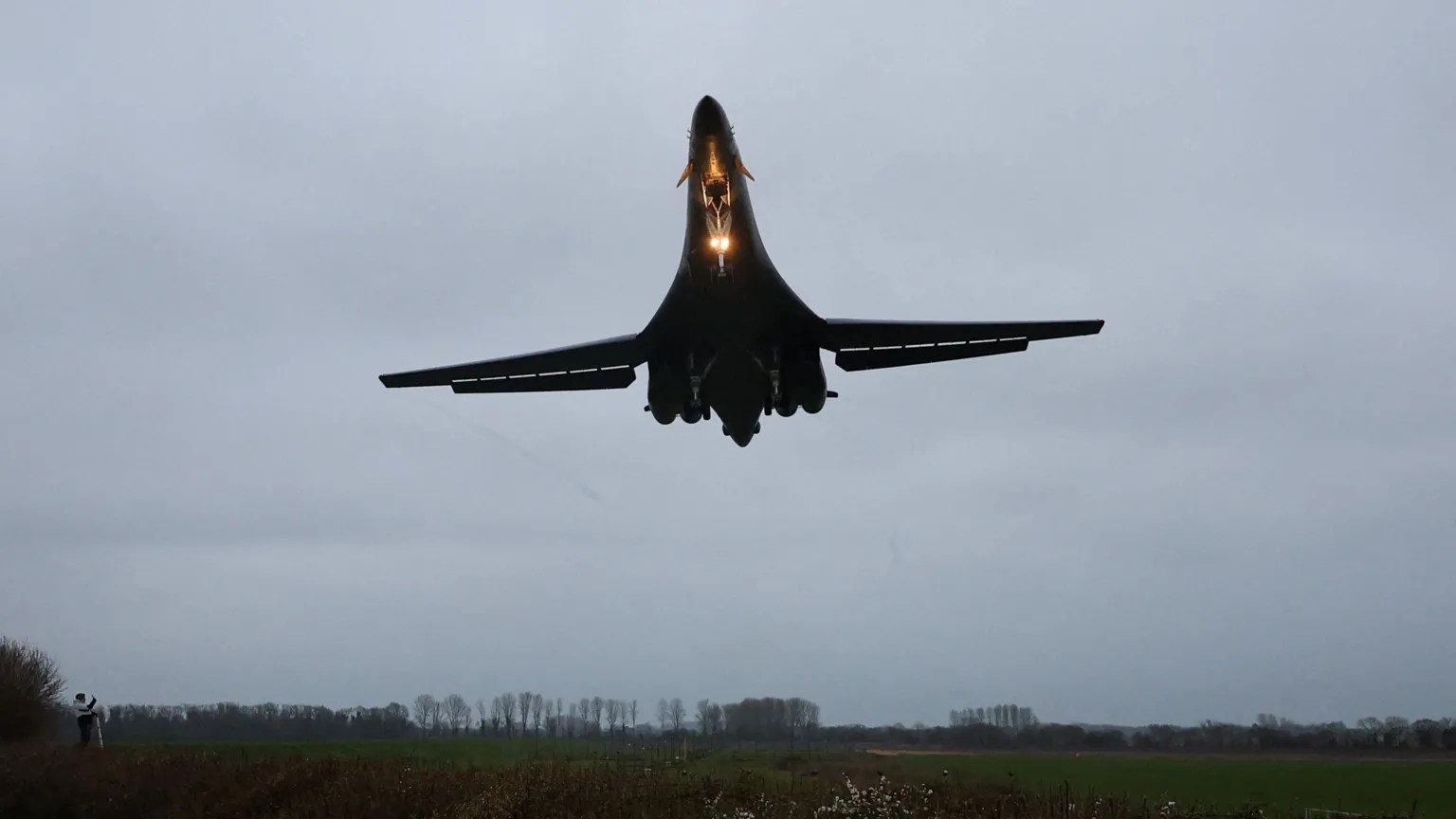
Media reporting strongly suggest that US military aircraft are planning to use British military bases precisely as a “launchpad” for massive strikes in Iran: the BBC reported on 9 March that US B-52 bombers had arrived at RAF Fairford in Gloucestershire, joining the B-1 Lancer bombers arriving days earlier. These bombers, capable of carrying considerable payloads, are considered key to facilitate the “surge” in strikes announced by the US – to punch “them while they’re down”, as US CENTCOM likes to phrase it. Secretary of Defence, Pete Hegseth, has explicitly stated that the US will use British bases to “dramatically” increase its strikes on Iran. The RAF Fairford base is reportedly the only airbase in Europe with a runway long enough for US heavy bombers.
In simpler terms, by permitting US heavy bombers to use its bases to launch strikes on Iran, the UK would not only make a significant contribution to the military campaign against Iran, but also one that is essentially offensive.
This would in my view, unmistakably, make the UK a party to the conflict.
And it will not be party acting in lawful self-defence – as the government has suggested it is – but rather a party that actively supports a war of aggression against Iran: As others have explained (see, e.g., here and here), it is questionable whether a country could claim to act in self-defence if in reality it is supporting the military campaign of a country that is responsible for launching the war of aggression in the first place. One needs to look at the concrete action taken: Permitting the use of British bases for US heavy bomber strikes in Iran can hardly be said to be an act of collective self-defence of countries in the region.
Given the circumstances, the correct reading of international law therefore is that in permitting US strikes by heavy bombers in Iran being launched from its bases, Britain will become a party to a military campaign that is manifestly illegal and illegitimate.
Whether the UK has opted for this as a result of US pressure and ridicule of its leaders, in some fraught attempt to maintain what Starmer continues to insist is a “special relationship” with the US, or for some other reason, it is both unlawful and unwise to permit the US the use of its bases as a launchpad for strikes inside Iran.
In doing so, the UK would be assisting an internationally wrongful act that gives rise to State responsibility. UK legal advisors are reported to have previously acknowledged exactly that.
Britain’s current path undermines the country’s claim to be a champion of international law – a claim already severely damaged not least due to previous involvement in US-led wars of aggression.
If strikes originating from British bases result in the unlawful killing of civilians or other breaches of humanitarian law, Britain could – depending on the circumstances – be seen to have helped facilitated these. This is a war characterized already by lack of respect for basic rules in humanitarian law (see e.g. here), with the US Secretary of Defence stating that “no stupid rules of engagement” apply.
It is not too late for Britain to change course – it would act wisely to follow Spain’s example and reject in no uncertain terms this war of aggression and withdraw any permission for the use of its military bases for its execution.

 Justice in Conflict
Most people who possess a shred of common decency would experience profound regret and sincerely express sympathy to the family and friends of the 160 Iranian school girls bombed far-too-prematurely into the world of spirit.
Some people now walking the Earth clearly display their total lack of common human decency; unfortunately, those individuals are in positions of command which make them capable of inflicting immense destructive power.
One might humbly suggest the wise preventive action is removing such indecent individuals from their positions of command over such immeasurably destructive power, – and facilitate their removal from power immediately.
B52s and Lancers carry huge payloads for carpet bombing. Civilian deaths are inevitable. Permission to allow such aircraft to utilise any British base for missions into Iran must be withdrawn unless the war is declared to be legal.