
The following is a guest post by Emma Breeze, Mark Drumbl, and Gerry Simpson, on their new co-edited book in honour of the late Professor Rob Cryer. Emma is an Assistant Professor in International Criminal Law at the University of Birmingham. Mark is the Class of 1975 Alumni Professor of Law at Washington and Lee University. Gerry is a Professor of Public International Law at the London School of Economics.

- Overview: Genealogy and Tapestry of this Project
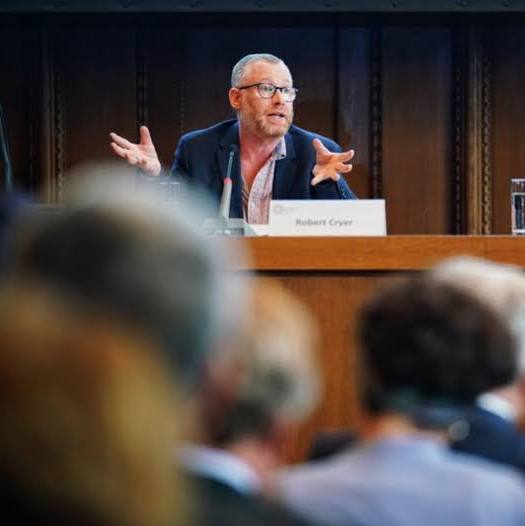
Professor Rob Cryer passed away from lymphoma at the age of forty-six on January 3, 2021. The new book, The Character of International Law: A Festschrift to Rob Cryer, is celebration of Rob’s life. It doubles as a memorial to Rob and as a distinctive and original contribution to those disciplines and sub-fields – international humanitarian law, international criminal law, legal theory, penal law, criminology, and public international law – to which Rob devoted much of his academic life.
This book’s title is a play on the word ‘character’. It refers, of course, to Rob’s own character, a character full of character we might say, and one who stamped his identity on the various fields in which and with which he engaged. Rob’s career coincided with the lifespan of contemporary international criminal law and a particular style of international law, which began in the halcyon immediate post-Cold War years. Character also refers to something general, perhaps elusive. When we talk about the ‘character of international law’ we gesture towards an indefinable quality associated with its overall effects on the world, its reputation, its dignity, and its grand projects. This is a book about the life of law and about a life in law that inspired many lives in law.
The book brims with themes of friendship, love, amity, conviviality, and conversation. As editors, we are guided in our own sentiments by the friendship between Dante and Virgil as unwrapped in The Divine Comedy. Dante, to be sure, treks from inferno to purgatorio and then to paradiso. Along the long and arduous slog, he encounters many souls and sights and sites. For much of the journey he is accompanied by Virgil, who acts as his guide. Virgil is nurturing and positive, supportive and leading, wise and never wobbly. The Divine Comedy is a tale of many things, and companionship is among them. Dante and Virgil journey side by side. Dante learns all along. But then, in Canto XXVII, they reach the top (the end) of purgatorio. This is the Earthly Paradise. Arriving here is the goal of all the lost souls in transit in purgatorio. Dante’s paradiso is a virtuous garden of beauty and grace and propriety. Upon reaching the end (the top) of purgatorio, Virgil slowly begins to part ways with Dante. It is time. The time has come. Virgil then bids Dante farewell:
When the stairway was all sped beneath us,
And we were upon the topmost step
On me did Virgil fix his eyes
And said: ‘Son, the temporal fire and the eternal,
Hast thou seen,
And art come to a place where I, of myself, discern no further.
Here have I brought thee with wit and with art;
Now take thy pleasure for guide’
God Bless you Rob! And thank you for your legacy of wit and art, of words and deeds, of laughter and love. We are all emboldened and enriched.
2. Roadmap of this Book
The book is an edited collection that grew out of a conference in Birmingham held in June 2023. It comprises 17 chapters constellated into 5 thematic Acts. The Acts are preceded by an introduction, obviously, and then by Gerry Simpson’s obituary for Rob.
- Act I: Discipline and Borders
This First Act is primarily about relationships, to wit, those between disciplines as well as those emerging beyond any such boundaries. As Adrian Hunt comments in his chapter, Rob was keen to be recognised as a Chair in international and in criminal law. Rob’s scholarship was deeply cross-disciplinary. Act I considers these fluidities and connections. Rogier Bartels begins by bringing us a discussion on the relationship between international criminal law and international humanitarian law, presenting the practical application of both and the need for precision and clarity. He also highlights the significant impact Rob had on the professional application and interpretation of international humanitarian law by the International Criminal Court from their own archives. Hunt then shifts the discussion into collective criminality, introducing the relationship between the domestic and the international. Finally, this Act closes with consideration of the application of international law within English law: Alexander Orakhelashvili offers a detailed analysis of the law of war in England and Wales.
- Act II: (Re)Imagination and Continuity
This Second Act unwraps the ways in which whole sub-fields of international law are brought into existence through acts of intellectual imagination, scholarly precision, and how Rob has influenced not only previous students and scholars, but how this work may continue to do so ‘by proxy’. Paul Roberts starts this Act by reflecting on the genesis and development of international criminal justice as a distinct disciplinary field by providing insight into Rob’s early teaching and practice. Raphael Oidtmann moves us forward as he reflects upon and engages in pedagogical discussion on the characteristics that make a superb legal educator. He ponders the experiences of Rob’s students, supervisees and mentees, and considers the concepts of intellectual guardian and role model. Marianne Wade provides an account of the re-imagining of a module impacted by the Covid-19 pandemic; whilst Rob’s role in this module was truncated by his death, the module prevailed, and Wade reflects on how these conversations continued long after Rob fell silent by imaging what he would be saying and thinking and feeling. Finally, Neil Boister concludes the Act by analysing the scholarship surrounding the International Military Tribunal for the Far East (IMTFE, or Tokyo IMT) and the ‘reigniting’ of interest in the ‘Tokyo’ trial. Boister and Rob co-authored several volumes on these trials.
- Act III: Violence and Reckoning
This Act weaves Rob’s scholarship through terrains of violence and the aspirations of reckoning. Act III begins with one of Rob’s signature critiques of ICL, namely, selectivity. Here, Elies van Sliedregt considers Rob’s early work on these sneaky selectivities and how these in turn inform and influence her own work. The Third Act is progressed by Shagufta Sen who addresses a current challenge for the crime of aggression, itself a focus of Rob’s work in selectivity, namely autonomous weapons systems. Stoyan Panov enriches the analysis of the crime of aggression as initiated by Sen. Panov focusses on Rob’s approach in his scholarship on seeking accountability through prosecuting leaders, and reflects upon how this knowledge-base may be applied to the Russia-Ukraine war. The Act is concluded by Javier Eskauriatza who unspools Rob’s approach to the jus post bellum as exemplified in Rob’s 2012 article on the topic. Eskauriatza analyses the debate over this aspect of reckoning, or resolution, and demonstrates a delightfully Cryeresque reading and critique of this topic.
- Act IV: Acoustics and Storytelling
This Act constellates thoughts about Rob as musician and Rob as raconteur. It begins by unlocking the place of music in Rob’s work and in law generally. As many souls who encountered Rob’s will recall, music was a significant personal passion for him. This Fourth Act starts with Agnieszka Jachec-Neale who explores the influence of music on Rob’s scholarly practice. Whilst finding few explicit references to music, Jachec-Neale shows how melody rings clearly throughout Rob’s work. Eoin Campbell carries this Fourth Act forward by ruminating about Rob’s work on the crime of aggression. Fusing the doctrinal aspects (as introduced earlier by Panov), Campbell assesses recent conflicts and considers how music, and the power of language, have been leveraged by all sides in promoting or rebuking the resort to war. Campbell riffs off the musical notes of anti-war songs to further unwrap the role of emotions in storytelling. The memory of Rob as storyteller and musician continues with two interlocutors imagining a trial that never was but should have been – of the US use of atomic weapons in Nagasaki – and place Rob’s scholarship intertemporally at the centre of their conversation. In this chapter — which is presented as a combined short-story, play, and epistolary diary — Mark Drumbl and Solange Mouthaan pivot to one of the central themes of this book, namely, the value of amity and share some ruminations about how we, as human beings, ought to be with each other.
- Act V: Friendship and Kindness
What would a ‘kind’ international law look like? How did Rob embody kindness in his friendships and in his friendly relations with the discipline itself? Are friendship and kindness partly communicated (along with sense of universal collegiality) through a textbook tradition, this being a mode in which Rob worked with panache and which led to profound results? This final, Fifth Act explores these ideas and queries what a law of friendship would look like. Emma Breeze and David Turns open the Act by returning to Rob’s 2002 article on the ‘Fine Art of Friendship’ and reflecting upon his call for considering our friends during episodes of armed conflict. Breeze and Turns import this discussion into contemporary conflicts, particularly Ukraine-Russia, and revisit Rob’s important work. The role of friendship and value of collegiality is furthered by James Lee who reflects upon the textbook tradition of academia. Lee highlights how Rob’s collegiality aided the development of textbooks far beyond the expected disciplines and analyses how the textbook and doctrinal traditions remain valuable for legal scholarship. This Act is brilliantly closed by Sergey Vasiliev. His chapter returns to Japan, and the IMTFE, specifically the judgment of Dutch Judge Bert Röling, who Rob has in his own scholarship described as a ‘dignified dissenter’. Vasiliev takes readers on a kaleidoscopic journey towards themes of fairness, humility and collegiality.
3. Conclusion
The Character of International Law is a mirror turned towards us as readers, writers, and thinkers. It surfaces the connections between technique and passion, memory and narrative, fact and fiction, the earthly and the mystical, time and movement, poetry and music, prose and law, authenticity and strategy, the possible and the feasible, encountering and gazing, closings and openings, as well as humour and justice. Rob in his work endeavoured to expand the epistemology of international law – namely from where do ‘we’ know what ‘we’ know about international law.
Assembling this book has been a joy. And here we are. Here we have it. Perhaps Rob himself put it best, while thinking about the 20th Anniversary of the ICTY, when at a legacy conference he ended his remarks with this off-the-cuff pearl in his own distinctive style:
‘And to finish off, I just simply want to say that what is written about is not forgotten.


 Justice in Conflict