
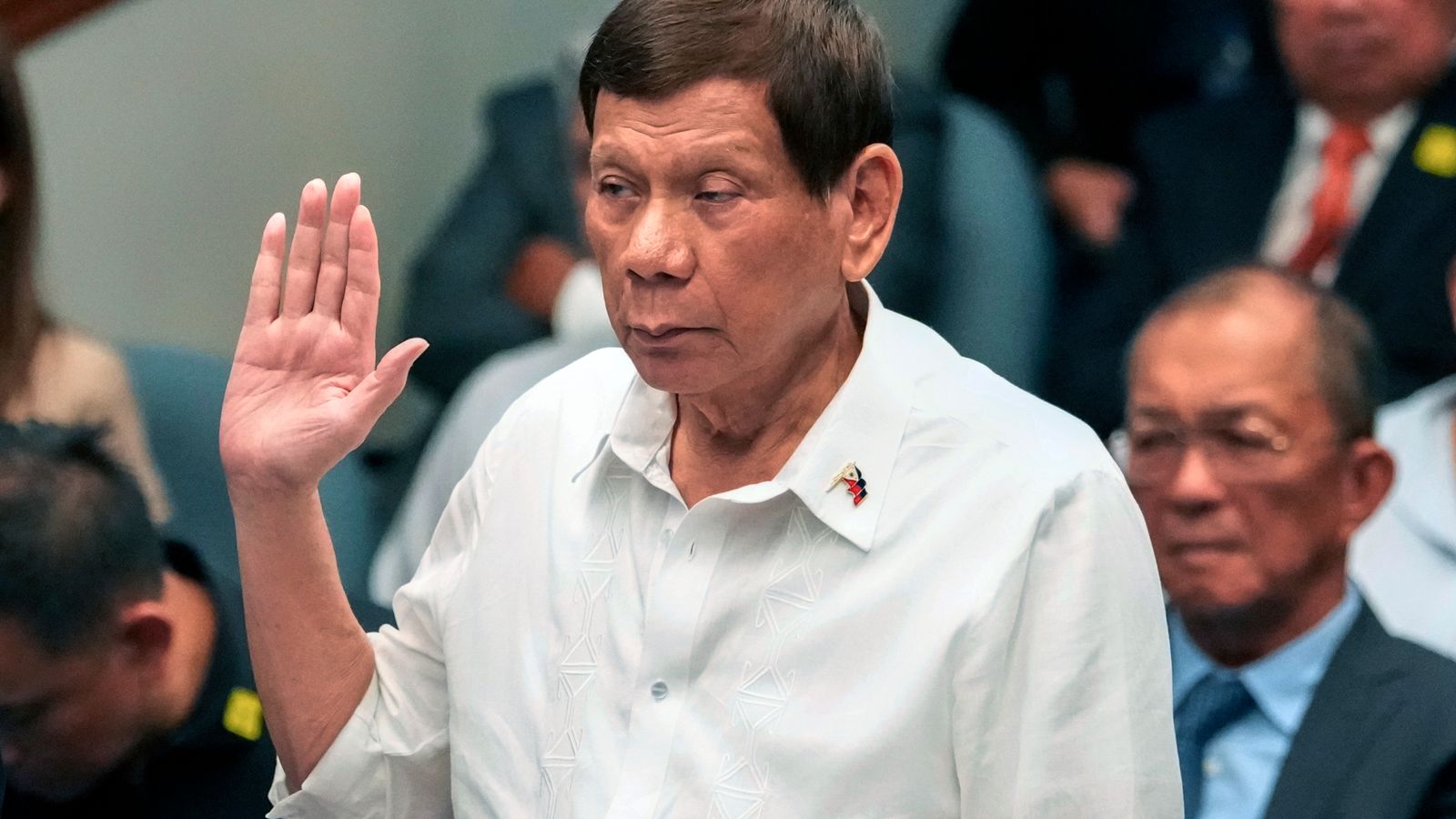
The brazen and brash former President of the Philippines, Rodrigo Duterte, has been surrendered to the International Criminal Court (ICC), where he faces charges of crimes against humanity, allegedly committed during his so-called “drug war”. A warrant for Duterte was issued under seal earlier this week and communicated to authorities in the Philippines, who subsequently arrested Duterte upon his return from a trip to Hong Kong.
According to the warrant against Duterte, he is charged with murder as a crime against humanity. The ICC judges who authorized the warrant stated that “there are reasonable grounds to believe” that the attack against civilians in the Philippines was a matter of policy under Duterte and “was both widespread and systematic: the attack took place over a period of several years, and thousands [of] people appear to have been killed”.
So, what does Duterte’s surrender mean and what happens next? Here are a few thoughts on this momentous development.
First and foremost, the arrest of Duterte is a vindication of what victims and survivors of Duterte’s “drug war” have insisted for many years: the former President is responsible for atrocity crimes and should face his day in court on charges of crimes against humanity. Duterte’s arrest is likewise a victory for the tireless and courageous human rights advocates and journalists who never stopped fighting to hold Duterte to account, despite the great risk to their personal safety and well-being. As the ICC’s Office of the Prosecutor has stated, it was the victims, survivors, witnesses and activists whose “strength, courage, and perseverance make these significant developments possible.”
Second, Duterte’s arrest is a timely win for an embattled ICC. It is no secret that the Court is facing a multi-pronged attack from the United States, Israel, and Russia, among others. Even its so-called friends have undermined the institution. In recent weeks, Italy – a member-state of the ICC – refused to cooperate with the Court and surrender an ICC suspect, wanted for atrocities committed against migrants in Libya, to The Hague.
At the same time, the Court’s docket has been drying up, and a court without cases is a court without purpose. Now, the ICC has a former head of state in its custody. If he goes to trial, Duterte will become only the second head of state – after former President of the Ivory Coast, Laurent Gbagbo – to face prosecution at the Court.
Third, the case against Duterte is the product of years of diligent and careful work by the institution’s exceptional investigators. They won’t be applauded openly because they do their work quietly, but they deserve a great deal of praise.
Notably, the case is based not only on the testimony of victims and survivors of Duterte’s alleged crimes, but on insider witnesses, and “people who were at the heart of the darkness of his death squads”. According to one analysis by Lisandro Claudio,
it appears that former members of the Davao Death Squad and police officers may be testifying for the prosecution, including, it is thought, hit man-turned-whistleblower Edgar Matobato and ex-Davao City police officer Arturo Lascañas.
We can also expect that the case against Duterte will be based partly on his own words. The number of times that he openly called for the murder of alleged drug dealers and substance users is staggering. The erstwhile Filippino leader even boasted of murdering alleged criminals when he was Mayor of Davao, saying: “In Davao I used to do it personally. Just to show to the guys [police officers] that if I can do it, why can’t you… I was really looking for a confrontation so I could kill.”
Still, it is important to be clear-eyed about the fact that the case against Duterte faces some hurdles. The Philippines (under Duterte) withdrew from the ICC in 2019. As a matter of law, the ICC retains jurisdiction over crimes committed while a state was a member of the Court. In the Filippino context, that covers much of Duterte’s alleged crimes. While the ICC’s Appeals Chamber allowed the Office of the Prosecutor to resume its investigation into Duterte’s “drug war” in 2023, they did not directly resolve all of the jurisdictional questions before them. As Paul Bradfield has helpfully articulated, there are issues that still require careful attention:
[The Philippines investigation] is the first time the Court has attempted to exercise jurisdiction where a state party has effectively withdrawn from the Rome Statute. Previously, the Court authorized an investigation in Burundi just before its withdrawal became effective.
The decision prompts numerous questions that the Court will inevitably have to confront, such as issues of legality, the proper construction of treaty interpretation, state consent, whether a departed state party has “ensuing obligations” to cooperate under Article 127, whether the Prosecutor’s Preliminary Examination can be considered “a matter under consideration by the Court” under the same article, thus preserving the ability to trigger jurisdiction, and the ability of former state parties to reassert primary criminal jurisdiction if they choose to do so.
Given this, it is important to remain sober and manage expectations. The surrender of Duterte to the ICC is a victory; there is justice in the active pursuit of justice. Ultimately, however, it is successful proceedings, based on fair trial standards, that will determine the success of the legal case against Duterte.
The transfer of Duterte to The Hague to face charges of crimes against humanity is yet another illustration that international criminal justice relies almost entirely on domestic political dynamics and machinations. The decision of law enforcement agents in Manila to arrest and surrender Duterte was only possible because of the dramatic falling out between the Philippines President Bongbong Marcos and his Vice President – and Duterte’s daughter – Sara. Duterte’s arrest will “shake up dynastic politics in the Philippines,” and is a palpable reminder that the arrest of others in the ICC’s crosshairs – Russia’s Vladimir Putin, Israel’s Benjamin Netanyahu, or the Taliban’s Hibatullah Akhundzada – will happen when domestic realities and politics align, and not just because an international court desires it.
Still, Duterte’s arrest does send a message to the world. To those leaders and states who defend perpetrators of international crimes or who themselves commit atrocities, remember: those facing charges of crimes against humanity can be arrested.


 Justice in Conflict