
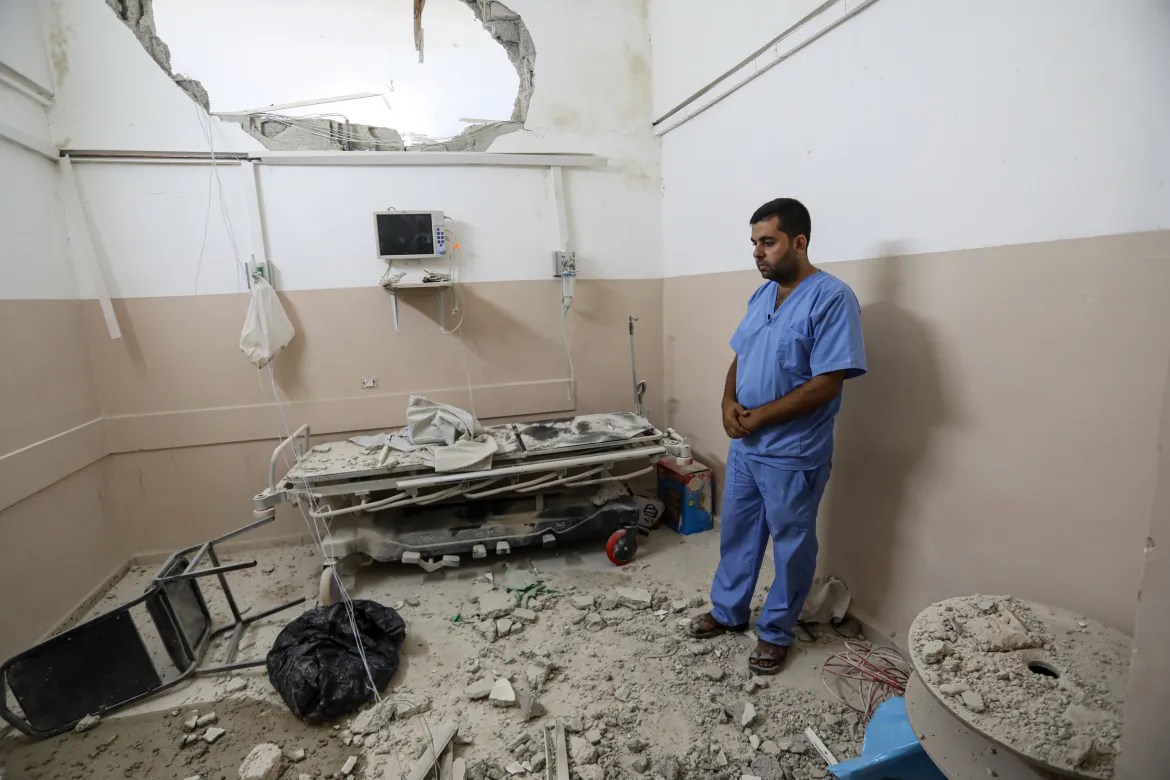
The doctors assumed that a well-marked hospital would be safe, especially since the warring parties in the region were informed of its existence and its life-saving operations. But they were wrong, and the attacks came in waves. When it was over, the hospital walls were charred, the windows were shattered, and its roof had collapsed. Two dozen patients were killed, and many more were injured. The facility, its staff and the patients inside of the hospital were supposed to be protected from attack. At least that’s what international humanitarian law – the rules that govern conduct in war – says. But on that day, law offered no protection and those responsible for its violation escaped accountability.
The above is not a summary of recent attacks on hospitals in Gaza, Ukraine, Sudan, Iran, or Israel – though readers could be excused for assuming otherwise. It’s what happened in the early hours of 3 October 2015, when an American gunship attacked Kunduz hospital, in Afghanistan, run by Médecins Sans Frontières. The official U.S. military response to its bombing of the hospital was that the attack was a “mistake”. No justice followed. Instead, the events led to the “Not A Target” campaign, aimed at ending attacks on hospitals. As important as it is, that campaign has not worked. In recent years, attacks on medical facilities – by Russia, Israel, Sudanese armed forces, and Iran – have become an almost daily occurrence. That the wounded, sick, and disabled, as well as newborn babies, are increasingly the targets of deadly, indiscriminate attacks demands more than rhetorical condemnation. It demands accountability.
The list of hospitals and medical facilities attacked by in Sudan, Ukraine, Gaza, Israel, and Iran is disturbingly long. An accounting of each attack is beyond the scope of this article, but the numbers are staggering. In Gaza alone, it is estimated that 94% of hospitals have been damaged or destroyed by the almost 1,900 attacks waged by Israeli forces on health-care facilities.
Each attack has been met with similar shock and anger victims from victims, humanitarians, and human rights activists. Recently, the residents of Beersheeba, Israel, where Iranian missiles struck the Soroka hospital, were dismayed – and rightfully so. One doctor at the hospital said: “I never thought something like this could happen. Never.” Following military strikes on the al-Mujlad Hospital, which straddles the front lines between the Rapid Support Forces and Sudanese Armed Forces, World Health Organization chief Tedros Adhanom Ghebreyesus exclaimed: “We cannot say this louder: attacks on health must stop everywhere!”
While people are naturally appalled when hospitals in communities they live in or care most about are attacked, persistent, unrelenting attacks against medical facilities across contexts suggests that such attacks are a part of an ongoing pattern that has normalized the targeting of medical care facilities in war. It may seem all too obvious, but to break that pattern, there must be actual, real, and tangible consequences.
That starts with independent and impartial investigations. Those authorizing attacks on hospitals, clinics, and medical staff cannot be trusted with their insistence that their conduct is lawful. In the wake of bombardments and the destruction of medical facilities, officials in Russia, Israel, and Iran never allow independent international investigators to assess the legality of their actions. What are they hiding?
These states also continuously engage in gaslighting. Few examples stick out as blatantly as the Israeli Defence Forces execution of fifteen Palestinian Red Crescent medics in Gaza. Israeli officials lied repeatedly about the killings until incontrovertible evidence of the crime – video discovered on the cellphone of one of the medics murdered – was found in the shallow grave where his body was buried.
This raises the question: why do these states commit such atrocities against those seeking medical support as well as the health officers who provide it?
One answer is simple: Because they can do so, without facing consequences.
A second answer is because healthcare professionals bear witness. They confront concrete evidence of mass atrocities. They see the sniper wounds, the starving children, and the mothers fleeing with their newborns. They do the amputations without anesthetic, clean the bullet wounds, and see first-hand who is in their facilities. It is widely known that it was medics who provided the International Criminal Court (ICC) with testimony that helped build the cases against Israeli Prime Minister Benjamin Netanyahu and former Defence Minister Yoav Gallant on charges of war crimes and crimes against humanity.
A third reason is that authorities in Iran, Russia, and Israel clearly – and openly – believe in collective punishment, the assumption that their adversaries are not just military and political leaders, but the entire citizenry of states. In this calculus, where no one is seen as innocent – not even babies, nothing is off the table and anyone and anything can be targeted: schools, maternity wards, refugee camps, apartments, and of course hospitals.
A fourth, related, reason could be simply because the executioners of Russia’s, Israel’s, Iran’s wars see doctors and medics as enemies simply for providing medical care to their adversaries. They may likewise seek to target hospitals in order inspire a sense of control and terror among the population. If hospitals aren’t safe, nowhere is safe.
Some might say: but isn’t the real reason because hospitals and clinics are being used by enemy combatants and are therefore lawful targets?
As a rule of thumb, targeting hospitals is a war crime. The Geneva Conventions make clear that a hospital may lose its protections under international humanitarian law if it is used to commit “acts harmful to the enemy”, i.e. if it is taken over by enemy combatants to launch military attacks. If this happens, the hospital may come under lawful attack. However, even if it becomes legal to engage in military operations in a medical facility, the civilians – doctors, nurses, and patients, including injured persons previously involved in hostilities seeking medical care – remain protected, and cannot be targeted. All of the other rules of international humanitarian law – precaution (to minimize civilian death) and proportionality (to balance any military gains versus the civilian toll) – continue. If civilians and protected persons are targeted, that is a war crime.
Moreover, while warnings prior to attacks are crucial, they must also be effective. If patients and doctors cannot leave (for example due to being injured) or choose not to leave (for example to take of the injured), they cannot be targeted. If any effective warning cannot be given, an attack should not proceed. Indeed, if there are buildings that are simultaneously used by militants and civilians (so-called dual-use objects), humanity surely demands that the emphasis of decision-makers be on protecting civilians first and foremost, and not securing military advantages at any cost.
It is hopefully obvious, in stating these basic rules, that launching missile attacks that reduce entire wings of hospitals to rubble would amount to a war crime. As Leonard S. Rubenstein and Feroze Sidhwa write: “No misuse of a hospital could justify a wanton assault that destroys the entire facility, forces it to close, or undermines its proper functioning, let alone a systematic attack on Gaza’s entire health-care system.”
This raises the question of what accountability looks like and who should pursue it. The answer is deceivingly straightforward: anyone and everyone with the capacity to do so.
The beleaguered ICC has a role to play, especially in relation to targeting those most responsible for war crimes and crimes against humanity. Individual states too can play a role. Not only should they end any support – including financial and military aid – that is used to bomb hospitals, but they can open investigations into individuals who engage in such attacks. They should do so in an indiscriminate manner blind to the nationality, race, or colour of those doing the bombing or those being killed.
At the same time, companies involved in supplying weapons, logistics, software, or anything that is necessary for states to kill doctors, medics, and patients should be investigated for their complicity, and for aiding and abetting war crimes.
In short, accountability avenues are endless for the simple reason that they have never adequately been pursued.
There is an old East African saying that when elephants fight, it is the grass that suffers. When powerful regimes with strongmen go to war, it is civilians who pay the price. The targeting of hospitals must end and those who ignore this basic tenet of humanity should be held accountable. After all, it is doctors and healthcare professionals who ensure that the grass grows.


 Justice in Conflict
Pingback: A Reminder that Targeting a Hospital is a War Crime - Opinio Juris