
The following essay examines the relationship between the ICJ and the ICC, at a time when both courts have increasingly found themselves seized of the same situations of mass atrocity crimes, including in Gaza, Myanmar, Ukraine and Afghanistan. It was published as part of PKI Global Justice Journal’s Special Issue on Human Rights and the International Court of Justice — Challenges and Opportunities, which also features insights from human rights and global justice scholars, including Michael Lynk, Ardi Imseis, Heidi Matthews, Bill Schabas, Faisal Bhabha, Payam Akkavan, Sara Seck and Penelope Simons, Christopher Campbell-Duruflé, as well as the organizers of the Special Issue, Alex Neve and Sharry Aiken. The volume is open access, and focuses on, inter alia, the following questions: Is the International Court of Justice becoming, in some fashion, a human rights court? If so, what does that mean? What are the strengths and weaknesses of viewing the ICJ as a human rights court? What are the challenges it faces in playing such a role? Are there opportunities to take that further? What of the relationship between the ICJ and the ICC? As Neve and Aiken write: “The time for examining these questions is both opportune and pressing.”
Introduction
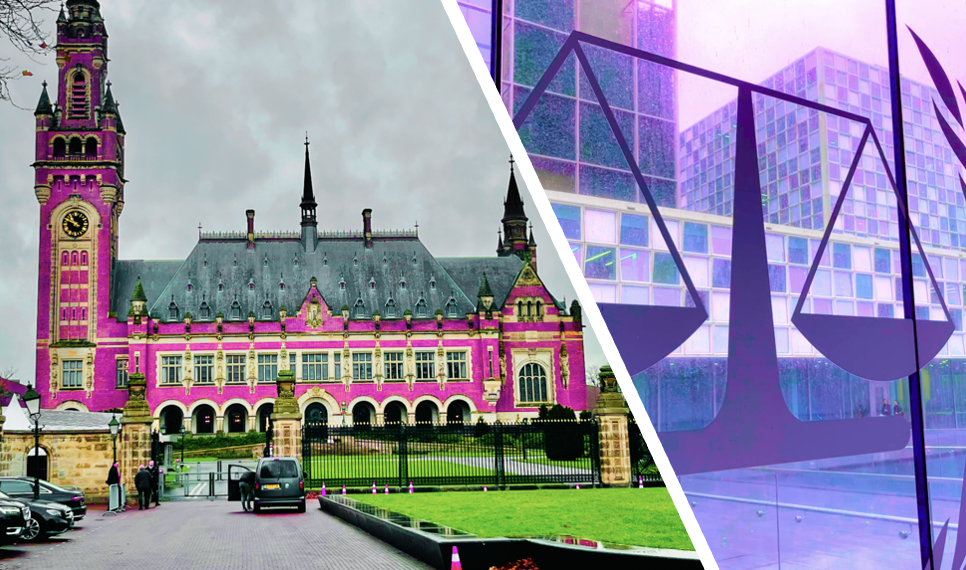
In recent years, several wars and mass atrocity events have come under the scrutiny of not just one international court, but two. Situations like Russia’s war in Ukraine, Israel’s ongoing war in Gaza and occupation of Palestinian territories, atrocities against the Rohingya people of Myanmar, as well as the Taliban’s persecution of women and girls, have fallen under the purview of both the International Criminal Court (ICC) and International Court of Justice (ICJ). Observers of international law are accustomed to these Hague-based institutions being confused for each other in media portrayals. This confusion is unlikely to abate given the increasing overlaps between the atrocity events that have come under each court’s jurisdiction.
Few have attempted to articulate the consequences of this new dynamic or the relative strengths and weaknesses of each institution as venues to address the perpetration of international crimes, let alone their potential to work constructively and together to deliver a proverbial one-two punch of accountability for mass atrocities. With both institutions coming under increasing strain and with each susceptible to wider attacks on whatever remains of a rules-based order, such an assessment seems timely and is therefore the focus of this essay.
Before proceeding, it is important to briefly lay out the similarities and differences between the ICC and ICJ. Both are international courts based in The Hague, The Netherlands. However, the ICJ is an organ of the United Nations and deals exclusively with disputes between states. Created in 1945, the ICJ’s ambit is wide—much wider than international crimes. It covers, inter alia, territorial and boundary disputes between states, the lawfulness of certain kinds of nuclear weapons tests, reparations owed between states over breaches of international laws and, most recently, the obligations of states to address climate change. The ICJ can be asked to issue both advisory opinions, which carry legal authority but are not binding on states or, in so-called contentious cases, it can issue binding opinions in disputes where states accept to be bound to its rulings. Sometimes referred to as the “World Court,” the ICJ deals with state responsibilities and therefore instructs state, rather than individual, behaviour.
While the ICC has a relationship with the United Nations and may, in some cases, be asked to investigate situations of mass atrocities by the UN Security Council, it is an independent body and institution established by its member-states. It is created by the acceptance of states of its founding treaty, the 1998 Rome Statute of the International Criminal Court. Established in 2002, the ICC is mandated to investigate and prosecute core international crimes—war crimes, crimes against humanity, genocide, and the crime of aggression—in the territories of states that have acceded to the Rome Statute and by citizens of its member-states. It can also investigate in situations referred to it by the Security Council and in states that have voluntarily accepted the jurisdiction over the Court. The ICC has 125 member-states and has numerous ongoing investigations occurring in situations such as Ukraine, Palestine, Georgia, Libya, Darfur, the Philippines, the Democratic Republic of Congo, the Central African Republic, and Afghanistan. It has prosecuted numerous individuals, including both state- and non-state actors. The ICC can only investigate and prosecute individuals and is therefore exclusively focused on individual criminal responsibility for the core international crimes under its jurisdiction.
While the key difference between the ICC and ICJ is their respective emphasis on individual versus state responsibility, one can nevertheless appreciate that such legal differences are not always apparent to certain constituencies. While the legal distinction between state and individual responsibility is clear, some will inevitably view the pursuit of individual responsibility for international crimes against government and state leaders as implicating the state itself, and judgements against certain states for violations of international law as implicating individual state leaders. For this reason, and even more so because both the ICC and ICJ are engaged in determining unlawful conduct in relation to the same situations of mass atrocities, a richer understanding of the relative strengths and weaknesses of these institutions’ engagement in this area is of use to scholars, advocates, diplomats, and policymakers.
Overlapping courts
As noted above, the overlaps between the ICC and ICJ include contexts where international crimes and serious breaches of international law have been committed: Ukraine, Palestine, Myanmar, and Afghanistan. Additional overlaps may be forthcoming in contexts like Azerbaijan’s expulsion of the Armenian population of the Nagorno-Karabakh enclave. Put simply, there are and will continue to be situations where both courts exercise their jurisdiction at the same time. The overlap between courts examining both state and individual responsibility is not entirely new, with atrocities committed in the Balkans during the 1990s also triggering cases under international criminal law, at the International Criminal Tribunal for the former Yugoslavia (ICTY), as well as the ICJ. However, measured by the number of situations under consideration by the ICC and ICJ, the intensity of these overlaps has grown in recent years. This suggests that advocates of international law, many of whom work on both public international law before the ICJ and international criminal law matters before the ICC, may not see an unenterable firewall between what the ICJ does and what the ICC does. Indeed, why not double down and seek to address both state and individual responsibility for international crimes like genocide (as in the cases of Ukraine, Palestine and Myanmar) and such severe forms of discrimination against women and girls that it may amount to gender persecution (as with the Afghan cases)? After all, the perpetration of these kinds of atrocities requires both individual perpetrators as well as that of the state.
Amidst expanding overlaps, certain trends stick out. One is that allegations of genocidal violence have been far more common in ICJ cases than at the ICC. Indeed, in none of the above situations—Ukraine, Myanmar, or Palestine—has the ICC pursued charges of genocide against individual perpetrators, although investigations into each context are ongoing and we cannot prejudge their outcomes. In general, the ICC has been reluctant to prosecute genocide, issuing only one arrest warrant in relation to the crime, for former Sudanese President Omar al-Bashir who was likewise charged by the Court with war crimes and crimes against humanity.
What remains to be seen is whether the ICC and ICJ enter into any form of constructive dialogue in relation to overlapping subject matter. If, for example, the ICJ eventually comes to a determination that Israel or Russia have committed genocide in Gaza, Myanmar, or Ukraine, will that compel the ICC into issuing warrants for the likes of Israeli Prime Minister Benjamin Netanyahu, Russian President Vladimir Putin, or Burmese Acting President Min Aung Hlaing on allegations of genocidal conduct? If so, would the ICC rely on findings of the ICJ in doing so?
It seems probable that affirmative findings by the ICJ would place significant pressure on the ICC. Indeed, it would be odd if the ICJ determined that a state bore responsibility for violations of the 1948 Genocide Convention yet the ICC declined to act against individuals responsible for planning and perpetrating genocide. A more likely situation would be what transpired over genocidal violence committed by the Serbian army in Srebrenica in 1995; both the ICJ and the ICTY addressed the genocide, the former finding the Serbian state responsible for failing to prevent genocide and the latter in relation to the individual responsibility of perpetrators over genocide, including senior Serbian officials Radko Mladic and Radovan Karadžić. A notable determination of the ICJ’s case was also that it found Serbia had wrongfully failed to cooperate with the ICTY in punishing the individuals who committed the genocide. Similar findings seem likely in future cases relating to breaches of the Genocide Convention where the ICC has concurrent jurisdiction.
The growing coincidence of the ICC and ICJ over the same conduct underlying mass atrocities raises questions about the very relationship between state responsibility and individual responsibility. As suggested, if a state is found to be liable for genocide, it should follow that individuals are liable too. After all, and to paraphrase the famous judgement of the 1946 Nuremberg Tribunal, it is men and not the abstract entity of states that commit crimes against international law.
The costs and benefits of ICC and ICJ addressing international crimes
Insofar as cases at the ICJ and investigations conducted by the ICC coincide, it is helpful to assess their relative strengths and weaknesses. In what follows, I do so in relation to three parameters: (i) their ability to galvanize state support and engagement; (ii) their ability to withstand political interference; and (iii) the enforcement of their decisions. The analysis is far from exhaustive and does not touch on some key issues (such as the selectivity in cases before each institution). However, I hope it can represent an overture for a more sustained dialogue about the role of these courts against the backdrop of unrelenting attacks on the international rule of law.
(i) Galvanizing state engagement and support
Both the ICJ and ICC appear to have galvanized collective engagement and support (as well as their share of opposition) for their work in responding to atrocity crimes. This is evidenced by the coalitions that have either instigated or offered compelling support for specific cases. Such engagement and support have had significant symbolic and legal impacts, as evidenced by the following examples.
Prior to the 24 February 2022 invasion of Ukraine by Russia, the ICC had jurisdiction in Ukraine despite it not being a member-state of the Court, because of Kyiv’s decision to voluntarily submit itself to the jurisdiction over the ICC under Article 12(3) of the Rome Statute. A limiting factor in the scope of the ICC’s jurisdiction, however, was that the Prosecutor would require the approval of judges of the Pre-Trial Chamber to open an official investigation into the situation in Ukraine, a potentially cumbersome process. That changed on 2 March 2022, when thirty-nine states jointly referred Ukraine to the ICC. An official investigation into international crimes committed in Ukraine was commenced that very day. Since then, multiple arrest warrants have been issued for Russian authorities, most notably against President Vladimir Putin on charges of the war crime of forcibly transferring children from Ukraine into Russia and Russian-held territory.
The ICC’s work on the situation in Palestine also enjoyed multilateral state support when, on 17 November 2023, Bangladesh, Bolivia, Venezuela, Comoros and Djibouti jointly referred the situation in Palestine to the Court. Unlike in Ukraine, this joint referral was a largely symbolic demonstration of support for the ICC; the Prosecutor had already opened an investigation in 2021, prior to the atrocities committed on 7 October 2023 and in its wake.
In the context of the ICJ, states have also come together in support of its cases. The case at the ICJ over the alleged commission genocide against the Rohingya people by Myanmar was brought by The Gambia. However, it is important to note that Banjul brought the case with the full backing of the fifty-seven member-Organization of Islamic States. In addition, seven states – Maldives, Canada, Denmark, France, Germany, the Netherlands, and the UK – have joined the case against Myanmar as intervenors.
The ICJ’s case over the legal consequences of Israel’s illegal occupation of Palestinian territories likewise received the support of many states. Indeed, the case was brought to the ICJ as a result of 98 United Nations member-states requesting the Court’s opinion on the occupation via a UN General Assembly resolution. In the proceedings against Russia over its alleged breaches of the Genocide Convention in Ukraine, some two-dozen states have filed to intervene alongside Ukraine.
Of course, the express support of states for certain cases before the ICJ and investigations by the ICC does not invariably translate into support for specific outcomes. Moreover, some cases, particularly those relating to atrocities committed in Palestine, continue to generate opposition from certain quarters, most loudly from the United States. There are thus varying levels of support and engagement across certain cases and contexts, illustrative of geopolitical differences, tensions, and divergent commitments to the international rule of law. This is certain to continue, and it remains an open question as to whether differences in opinions among states will promote or fracture commitments to the courts’ work and whether they will remediate or exacerbate double standards in the application of international law.
(ii) Withstanding political interference and pressure
An important attribute of international courts is their capacity for resilience and therefore their ability to weather political storms instigated by state responses to their jurisdiction over politically sensitive subjects, such as genocide and war crimes allegations. On this count, both courts thus far appear robust, albeit with one facing far graver threats than the other. The ICC has had to prove its ability to resist concerted attempts to undermine it by states, and faces an unprecedented, even existential, campaign of political coercion from the United States, one that the Court’s President has said may “jeopardise its very existence.”
As its workload touches on the geopolitical interests of powerful states, particularly the United States, Israel, and Russia, the ICC has faced repeated attempts to interfere with its work. In 2023, it faced a serious cyberattack(almost certainly the doing of Moscow), one that has cost it millions of dollars to address. In 2024, repeated and long-standing attempts by the Israeli intelligence service Mossad to threaten and coerce ICC staff were revealed by journalists. And in 2025, the Trump administration took aim at the Court, passing legislation that would permit it to sanction not only ICC staff, but the institution itself.
To date, the Court has survived these attempts to interfere with its operations and mandate. It has continued its work undeterred, and even secured the arrest of former President of the Philippines Rodrigo Duterte over charges of crimes against humanity, a remarkable achievement for an embattled institution. Nevertheless, whether the ICC can withstand ongoing pressures and attacks on its operations and survive in its current configuration remains an open question, especially as conducting its work undeterred by external threats may lock the institution into a cycle of escalation with the United States.
Despite operating in the same theatres, including in Ukraine and Palestine, the ICJ appears to have been largely impervious to similar attempts to interrupt and interfere with its work. This may be in part because the vast majority of states accept its jurisdiction and typically choose to engage directly with the Court, even when facing serious charges relating to genocide and other international crimes. Of note here, both Myanmar and Israel participated in proceedings at the ICJ in relation to violations of the Genocide Convention (although Israel did not participate in proceedings related to the legal consequences arising from its unlawful occupation of Palestinian territories).
However, as the ICJ engages more regularly in questions of genocide, implicating and frustrating the perceived interests of major powers like the United States (via its ally in Israel) and Russia, it may very well come under increased scrutiny and even attack. Recent years and even more recent developments have taught advocates of international law that it is foolhardy to take hard-fought gains reflected in the post-WWII and post-Cold War rules-based order for granted.
(iii) Enforcement of decisions
Are ICJ or ICC decisions more likely to be enforced? The answer to this question is unclear, as both have struggled to have judgements in relation to the situations canvassed in this essay enforced. This fact should galvanize consideration as to how these courts may relate.
The ICC has no police force and therefore is incapable of enforcing the warrants it issues itself. Indeed, a truism demonstrated repeatedly over the history of the institution’s life is that it is domestic political machinations and shifting dynamics that lead to the Court’s arrest warrants being enforced. In the Duterte example, his arrest by police in Manila and surrender to The Hague pursuant to the ICC’s warrant for him was only possible because of the collapse of the political alliance between Filipino President Bongbong Marcos and Duterte’s daughter, Vice President Sara Duterte. In another example, that of Ivory Coast, former President Laurent Gbagbo was only surrendered to the ICC after he lost power to Alassane Ouattara, and the new government felt it advantageousfor Gbagbo to be transferred abroad (he was later acquitted and returned to the Ivory Coast).
None of these kinds of shifts have transpired in the situations where the ICC is seeking to prosecute crimes concurrently with ICJ proceedings: Ukraine/Russia, Israel/Palestine, Afghanistan, or Myanmar. No person targeted with an arrest warrant in any of these contexts has been detained, let alone transferred to the ICC. On the contrary, and as noted above, the lack of enforcement is not to say that the ICC’s work struggles for relevancy; there is indeed justice in the pursuit of justice itself. But the enforcement record of ICC decisions in these contexts remains dismal.
The ICJ has had only nominally more success. It is important to note here that none of the cases regarding alleged breaches of the Genocide Convention by Israel in Gaza, Russia in Ukraine, or Myanmar in relation to the Rohingya people have been concluded. However, the Court’s record in having its preliminary orders enforced is weak. Violence by all parties facing charges of genocide continues. In the context of the alleged genocide in Gaza, Israel has only clearly complied with a single order issued by the ICJ: to report to the Court on its conduct in relation to the ICJ’s orders. Some of the ICJ’s orders, particularly in relation to ensuring that adequate aid gets to a starving and suffering population, have been openly and repeatedly violated, with the denial of food, medicine, and energy supplies being used by Israeli authorities as a weapon of war and leverage in peace negotiations.
The decisions of both the ICC and ICJ are, of course, not only aimed at the particular state authorities under scrutiny but also the wider international community. In this respect, enforcement of decisions also remains paltry. All member-states of the ICC are under obligations to enforce the Court’s arrest warrants, but some have refused to do so, including Mongolia, which hosted Vladimir Putin in September 2024. Others, like South Africa, have declined to allow Putin to visit. In relation to the warrant for Israeli Prime Minister Netanyahu, numerous ICC member-states—including France, Germany, and Poland—have claimed they would not enforce it and surrender Netanyahu to The Hague.
Some of the ICJ’s decisions are also intended to be enforced by third parties. The Court’s Advisory Opinion on the legal consequences of Israel’s illegal occupation of Palestinian territories, for example, told all states (as well as financial institutions and banks) to end any activities or relations with Israel that would further the continued occupation of Palestine and not to recognize the situation of Israel’s unlawful occupation of Palestinian territories as legal. It does not appear that states have changed their behaviour significantly since the release of the Court’s Opinion.
In short, then, both the ICC and ICJ continue to face obstacles in having their orders and arrest warrants enforced. This fact should embolden further conversations on how the two might operate, if not in cahoots, than in a more constructive and coherent manner when addressing the same situations of mass atrocities.
Courts in conversation: ‘All hands on deck’
A common refrain among international lawyers when the ICJ and ICC come up is to bemoan that they are insufficiently distinguished and differentiated; if I had a dollar for every time I heard a law professor or professional bemoan a mistaken new story by saying “that’s the ICC, not the ICJ!”, I’d be a much wealthier man.
But the apparent firewalls in our treatment of and thinking about these courts and their roles in addressing situations of mass atrocity crimes may no longer be so sustainable. They are different courts; but there are open questions as to how they can simultaneously contribute to addressing the perpetration of international crimes. The overlaps in subject matter between the ICJ and ICC are growing, and there is no reason to believe the trend will be reversed. Scholars, advocates, and policymakers should think through what this means and how the two courts might speak to each other in ways that foster greater accountability for international crimes.
Speaking to the fact that the ICJ and ICC are examining the conduct of the Taliban towards women and girls, Alex Neve recently stated that having both courts in play is “consequential, it’s historic, and it’s groundbreaking.” What likewise would be remarkable is if, by way of conversation, cooperation, and mutual respect, the work of each court strengthened the work of the other. With the perversion of the rules-based order and the seemingly relentless commission of mass atrocities, this moment calls for all hands—and therefore both courts—on deck.


 Justice in Conflict