
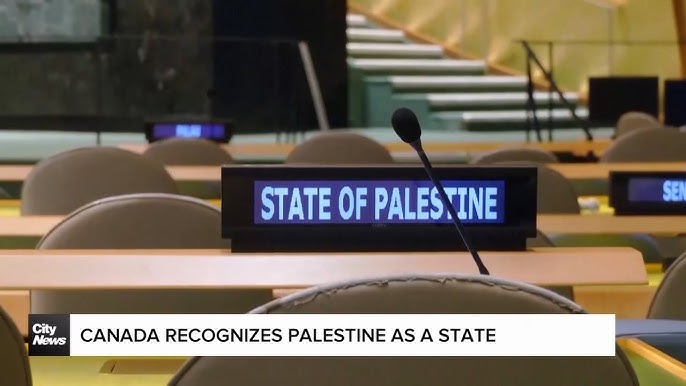
Amidst the atrocities, annexation efforts, and ignored warnings to stop both, it became impossible to defend the status quo. So, on 21 September 2025, Canada joined 150 other states – including erstwhile Israeli allies, France and the UK – that recognize Palestinian statehood. But what, if anything, will recognition change? On some issues, quite a bit. On others, not much. Ultimately, recognition alone cannot save Palestinian lives or end the war; only concerted and collective action can.
Canada has long insisted it supports a two-state solution. Yet it refused, until now, to actually recognize two states. Instead, it lent increasingly right-wing and anti-Palestinian governments in Israel and the United States an effective veto over Palestinian human rights, self-determination, and statehood. It has long been obvious – to advocates, states, Israelis, and Palestinians – that any proclaimed interest from Washington and Tel Aviv in working towards a two-state solution is not in good faith; it’s not kicking the can down the road, if you just kick it to the curb.
The Israeli government’s outright opposition to a prospect Palestinian state is finally obvious to Western authorities too. In announcing Canada’s recognition of Palestine, the Prime Minister’s Office accepted that “the current Israeli government is working methodically to prevent the prospect of a Palestinian state from ever being established…. It is now the avowed policy of the current Israeli government that there will be no Palestinian state.”
Recognition will have some impact inside Canada. Israel’s war on Gaza and its moves to annex the West Bank have played out in our political landscape and matter to Canadians. The government will be keenly aware of the consequences of recognizing Palestine within Canadian communities, including its electoral base. But what about the impact of recognition in the international arena and on Palestine itself?
First, and foremost, recognizing Palestine puts Canada among those willing to do the morally and legally right thing. As pointed out by almost 200 former Canadian ambassadors and diplomats, recognition of Palestine flows from basic human rights law, and specifically the right to self-determination, enshrined in multiple international rights treaties.
Recognition is completely in line with international law’s criteria for statehood. It is not about “rewarding” terrorism or Hamas. By conflating the self-determination of Palestinians with the interests of a terrorist organization, such arguments betray an intention to exact collective punishment on all Palestinians for the crimes of Hamas.
At the same time, Canada’s recognition does not make Palestine a state – because it already is a state under international law, recognized by the majority of the world as well as international organizations, including the United Nations General Assembly and the International Criminal Court (ICC). However, Ottawa’s recognition means that it will now have to view the war between Israel and Palestine as a war between two states, with one having effectively invaded and occupied another. There can now be no difference in how the annexation of Crimea by Russia and the West Bank by Israel are treated.
Recognizing Palestine also means that Canada must drop its opposition to the ICC’s investigation into Palestine, as well as its arrest warrants against Israeli Prime Minister Benjamin Netanyahu on charges of war crimes and crimes against humanity. Canada’s political ambivalence towards the ICC’s work in Palestine has exposed double standards in how Ottawa views the international rules-based order. But its legal opposition was always based on the fact that Canada did not recognize Palestine as a state, and therefore the ICC could not have jurisdiction over it. That changes with recognition.
Any impact of Canadian recognition will also be felt through Canada’s allies. Ottawa was quick to condemn Israel’s recent strikes targeting Hamas negotiators in Qatar, though fell short on spelling out any consequences for this serious breach of the UN Charter and international law. It has also been a long time since Canada played the role of an ‘honest broker’ on the Israel-Palestine war, and it has little clout in the region. But being on the right side of the recognition question holds some potential to establish pathways to re-engage in crafting and fostering peace in the region. Doing so could open avenues for stronger regional and bilateral relationships and improving Canada’s reputation in bodies like the UN, where Ottawa has lost multiple elections for a Security Council seat and where it is currently vying for a spot on the Human Rights Council.
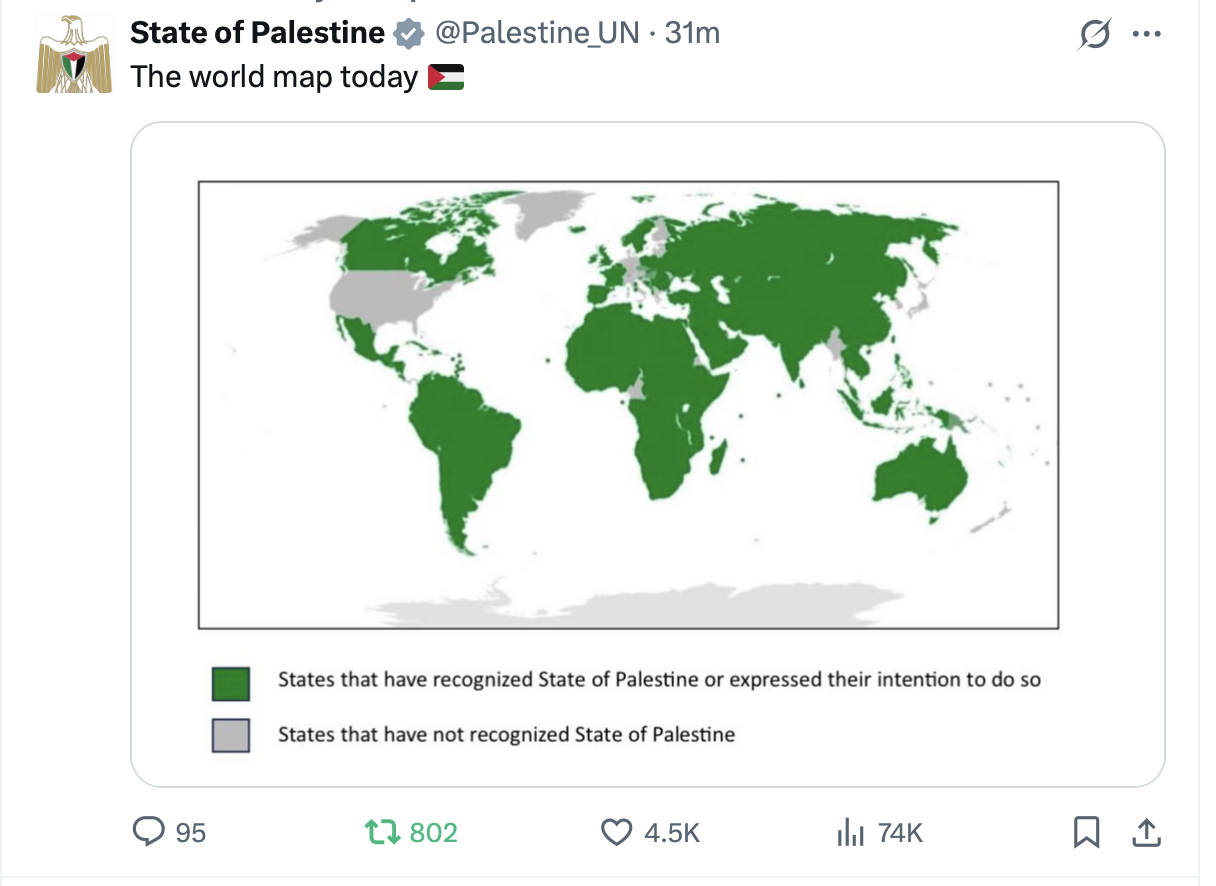
The move to recognize Palestine will not, however, end violence in Israel, Gaza or the West Bank. It won’t change negotiations to broker a ceasefire and end the war. If it could, the recognition of 150 states would have been enough. Instead, as former Canadian Ambassador to Israel Jon Allen says, recognition is “about sending a message of hope and commitment to Palestinians and sending a clear message to Israel and others that simply managing the conflict, Israel’s policy for the last 17 years, is not an option and never was.”
This sense of hope has also been raised by others, including the Mayor of Jenin, Mohammed Jarrar, who welcomed recognition despite ongoing atrocities and annexation efforts:
It confirms the fact that the Palestinian people possess a state, even if it is under occupation. I know that this recognition will lead to [greater] occupation of the West Bank. But even so I believe recognition is more important, because it will shape the future of the Palestinian people, and the international community will be called on to defend their rights.
For real change on the ground, more is needed, including from Canada: flooding Gaza with food and aid (without putting civilians in danger), a full arms embargo, a suspension in trade relations, sanctions and accountability for all senior figures responsible for genocidal acts and war crimes, and consideration of a multi-lateral “protective force” to enforce peace (something the Canadian government has now expressed interest in). Put simply, recognition alone won’t give starving Palestinians more to eat and cannot stop what is increasingly understood – by international, Palestinian and Israeli institutions and experts – as a genocide.
Canada insists that Palestinian Authority must also be held accountable, and is required “to fundamentally reform its governance, to hold general elections in 2026 in which Hamas can play no part, and to demilitarize the Palestinian state,” although what is meant by the latter is unclear. There is no doubt that Palestinians deserve better governance, but recognition of statehood should not conditional. Human rights are not conditional, and therefore neither is the right of Palestinians self-determination.
Predictably, Israeli PM and ICC suspect Netanyahu has said that the UK, Canada and Australia and “those leaders who recognise a Palestinian state after the terrible massacre on October 7 – you are giving a huge reward to terrorism… and I have another message for you – it will not happen. A Palestinian state will not be established west of the Jordan River.” Moreover, in the past, Canada and other Western states have stayed silent in the face of such serious accusations made against them by Israeli authorities, and it remains unclear whether they will accept such threats from Netanyahu now.The challenge will be to prove Netanyahu wrong, but doing so will require more than statements or symbolic gestures. As Marc Lynch and Shibley Telhami write,
If formal recognition becomes substitute for defending primacy of international law and addressing core realities of Palestinian suffering, it would be at best a hollow gesture—and at worst an epic misallocation of scarce international political capital.
Time will tell if recognition therefore leads to any changes on the ground or with the policies of Western states like Canada that could have a meaningful impact in paving the way towards peace. But time is not something many Palestinians have. The Canadian government accepts that they are being intentionally starved by Israel as a “weapon of war” and that the annexation of Palestinian lands is patently unlawful. Canadians increasingly accept that genocide is being committed by Israel in Gaza, though Canada’s incoming Ambassador to the UN, David Lametti, says the government needs more evidence or verdicts from the ICC or International Court of Justice before calling the killing in Gaza a genocide.
While Canada has finally done the right thing in recognizing Palestine, it is concrete, collective, and courageous action to protect Palestinians and their rights that is now needed. If not, what will be left of Palestine to recognize?
********************************
A version of this article first appeared on Open Canada.


 Justice in Conflict