
The following is a guest-post on the afterlife of international criminal tribunals, written by Maria Elander, Rachel Killean and Mark Drumbl. Maria is an Associate Professor and the Associate Dean, Research and Industry Engagement in the La Trobe Law School. Rachel is a Senior Lecturer and the Associate Dean (Student Life) at the University of Sydney School of Law. Mark is the Class of 1975 Alumni Professor of Law at Washington and Lee University.
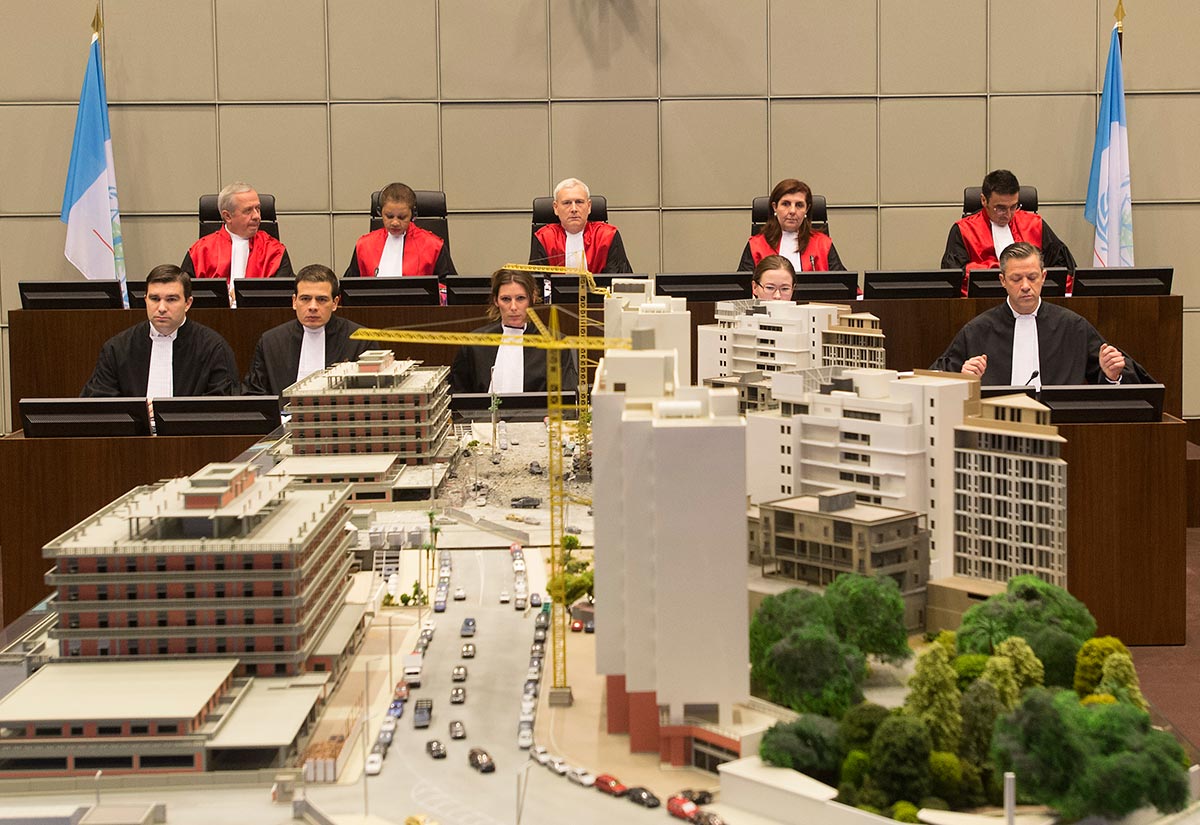
When the Special Tribunal for Lebanon (STL) closed its doors in 2023, the tribunal faced a stark problem: without money to maintain its servers or staff, its entire digital presence — with thousands of sensitive legal records, including audiovisual materials, transcripts, and filings — was at risk of disappearing. With its website scheduled for shutdown and no residual mechanism to safeguard its archives, the STL’s evidentiary and historical record hung in the balance.
Stanford University’s Virtual Tribunals initiative stepped in. It worked with the STL to urgently preserve and transfer more than 15,000 files into the Stanford Digital Repository. This task was completed earlier this year. The rescue ensured storage and continued public access to materials that might otherwise have been lost.
Yet the solution raises questions: After the closure of a temporary court, how should sensitive documents like legal records be managed? Where, and by whom? These are not just administrative determinations but deeply political questions that relate to the roles of affected communities and national stakeholders in the justice process.
How to manage the archive also ties into a larger question: What happens when atrocity tribunals end? Over the last year or so, we have been exploring this question, separately and together. Following our recent experience of presenting these ideas at the International Association of Genocide Scholars’ annual conference, we are hoping to assemble a group of scholars to explore these issues further, and will be publishing a call for papers in the new year. Here, we set out some of our current musings, in the hope that it might spark thoughts in others.
Afterlives
In the broader schemata of international criminal justice, tribunal closure is almost like a misnomer. A tribunal is established to fanfare, indictments are issued, trials held, judgements are written, appeals exhausted. But even if there is a small ceremony to mark a closure, it is treated like a technical footnote with little thought to the tribunal’s afterlife.
The concept of ‘afterlife’ has in recent years appeared as a useful device in transitional justice, law and humanities, art history, and ‘ghost criminology’ to explore how institutions designed to be temporary leave enduring residues in political, social and legal life.
The afterlife of tribunals, their lingering commitments, responsibilities and legacies, remains one of the most understudied and least understood aspects of the international justice project. And yet, the process through which tribunals manage closure may prove crucial in shaping how tribunals have long-term meaning for victims, societies emerging from conflict, and international criminal law itself.
Residual mechanisms
Some tribunals set up ‘residual mechanisms’ or enter a ‘residual phase’ when they close. These mechanisms, such as the International Residual Mechanism for Criminal Tribunals (IRMCT), the Residual Special Court for Sierra Leone (RSCSL), and the residual structure for the Extraordinary Chambers in the Courts of Cambodia (ECCC), inherit what might be called the unfinished business of justice.
Their functions typically include: supervising sentences; protecting victims and witnesses; maintaining, opening and curating archives; handling ongoing reparations orders; engaging in outreach and public education; and tracking remaining fugitives. They often inherit the expectations to contribute to deeper transitional justice goals such as truth-telling, memorialisation, rule-of-law reinforcement, and even reconciliation. At the same time, the residuals may experience the brunt of donor fatigue, leading to pressure that they be as ‘small, temporary and efficient’ as possible, or to accusations of trying to keep alive what should be laid to rest for the sake of personnel remaining in what can be lucrative positions.
In reality, we know remarkably little about whether residual mechanisms are living up to expectations, what challenges they encounter, or how societies perceive their value. This gap is particularly striking as new tribunals are being discussed or pursued for Syria, Ukraine, Liberia, and Myanmar—and as the Kosovo Specialist Chambers moves towards closure and the Special Criminal Court for the Central African Republic continues its work. Understanding what remains after tribunals conclude is no longer a matter of academic curiosity; it is a matter of practical, urgent importance.
Take the Residual Special Court for Sierra Leone. The institution is tasked with supervising sentences and responding to legal requests, but its contribution goes far beyond those technical functions. The grounds of the former tribunal now host a Peace Museum and Memorial Garden, which provide an anchor for public memory of the conflict and the Special Court’s work. Yet the court itself has fallen into utter disrepair, its premises inhabited by squatters, and the mechanism’s influence over public memorialisation is constrained by political and resource limitations.
Or consider the residual structure of the Extraordinary Chambers in the Courts of Cambodia, which is reshaping itself as a civic and educational institution. With only one surviving convicted individual and no further prosecutions anticipated, its mandate now centres on archive access, dissemination of information through its self-proclaimed ‘Extraordinary Bus’, and various educational initiatives. Cambodia’s history of political constraints makes these responsibilities significant, but this residual mechanism had initially promised far more victim-centred initiatives, thereby resurrecting old debates about whether and how the ECCC has furthered ‘justice’ for victims.
Together, these examples show that residual mechanisms are not simply administrative appendices. They can become important engines of memory, education, and justice. They have the potential to influence how societies interpret past atrocities, how victims engage with justice processes years later, and how future generations learn about violence they did not personally witness.
The Practical and Political Considerations of Tribunal Afterlife
In a way, residual mechanisms are the literal embodiment of institutional afterlife: They remain when the court itself is gone, holding the memories, records, and responsibilities that persist. But in this afterlife, the residuals linger like spectres of the tribunals; they are both the same and different, yet they assert their relevance in potentially unexpected ways.
Focusing on the afterlives of tribunals has practical implications. In a period marked by political polarisation and the rapid circulation of misinformation, archives and outreach are essential to countering denial and preventing revisionist accounts of atrocity. For victims, ongoing engagement — whether through reparations monitoring, archive access, or public education — shapes the meaning of justice long after courtrooms fall silent. For states and donors, understanding the long-term functions of residual mechanisms is key to designing efficient and sustainable institutions.
Residual mechanisms sit at the intersection of law, memory, and politics. They ensure continuity between the moment of judgment and the slow, generational work of reckoning with atrocity. They hold the institutional memory upon which future tribunals will rely. They remind us that justice does not simply conclude. It evolves, lingers, droops, stoops, shoots, and takes new forms.
The rescue of the STL archives illustrates what is at stake. Irrespective of plan or strategy, the closure of a tribunal provides no firm finality or ending. When a tribunal closes without a plan for its afterlife, its memory risks scattering. When a residual mechanism is thoughtfully designed and resourced, the impact of justice can endure. The future of international criminal law depends not only on the tribunals that are built, but also on the legacies that are sustained. Residual mechanisms are one place where those legacies live.


 Justice in Conflict