
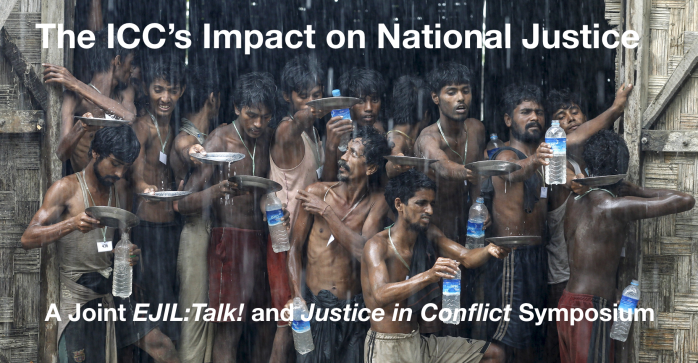
(Photo: Reuters / Soe Zeya Tun)
This post introducing JiC’s joint symposium with EJIL:Talk! was written by Dapo Akande and Mark Kersten. Dapo is Professor of Public International Law, Fellow of Exeter College (since April 2018) and Co-Director of the Oxford Institute for Ethics, Law and Armed Conflict (ELAC). He is also the founding editor of EJIL:Talk! and a member of the Africa Group for Justice and Accountability.
While investigations by the International Criminal Court (ICC) have received the lions’ share of attention and scrutiny from scholars and observers, there has been a growing interest in the impact of the ICC’s preliminary examinations. The preliminary examination stage requires the ICC Prosecutor to ascertain whether alleged crimes fall within the Court’s jurisdiction, whether the crimes are of sufficient gravity to warrant investigation, whether there are ongoing proceedings related to those alleged crimes, and whether an investigation into alleged atrocities would be in the “interests of justice”. If the answer to each is ‘yes’, then the Prosecutor can seek an official investigation.
There are currently ten open preliminary examinations across four continents: Afghanistan, Colombia, Guinea, Iraq/UK, Nigeria, Palestine, the Philippines, Bangladesh/Myanmar, Ukraine, and Venezuela. But what have the political and legal impacts of these preliminary examinations been? Have they galvanized greater interest in achieving accountability? What lessons can be drawn from preliminary examinations to date in order to improve the prospects of justice?
To answer these and other questions, EJIL:Talk! and Justice in Conflictare delighted to host a discussion of the Human Rights Watch report, Pressure Point: The ICC’s Impact on National Justice – Lessons from Colombia, Georgia, Guinea, and the United Kingdom, and of ICC Preliminary Examinations more generally.
The symposium coincides with the Assembly of States Parties (ASP) to the ICC, which begins its annual session this week. One of the highlights of the ASP will be the release of the Office of the Prosecutor (OTP) 2018 Report on Preliminary Examination Activities. The report will summarise the activities of the Office with regard to situations which are under preliminary examination by the Prosecutor.
In its Report, HRW examined four situations under preliminary examination in order to evaluate whether and how the ICC Office of the Prosecutor (OTP) can use its influence to move relevant national investigations and prosecutions forward. The report concludes that expectations about what the OTP can achieve need to remain realistic — the odds for success will often be stacked against justice – but in each situation HRW identifies positive steps that are at least partly attributable to the OTP’s engagement. Some of these are simply the result of the existence of the preliminary examination and some are the product of the OTP’s deliberate choices in its engagement. HRW recommends that the OTP sharpen up its engagement with national authorities, seek to move more quickly through the initial phases of the examinations, and bring greater transparency to its work, and that other international actors—particularly rule-of-law assistance donors—look to see how they can add to the OTP’s efforts.
The symposium will include contributors with experience in civil society, academia, national governments, the UN as well as the ICC OTP itself. The opening post (which will appear on both blogs) will be an introduction to the HRW report by Elizabeth Evenson, Balkees Jarrah, Elise Keppler, Juan Pappier and Param-Preet Singh, all of HRW. We will then have contributions fromNelson Camilo Sánchez León (University of Virginia Law School); Marieke Wierda (Ministry of Foreign Affairs, The Netherlands); Carsten Stahn (Grotius Centre, Leiden University); Thomas Obel Hansen (Transitional Justice Institute, Ulster University, Belfast) and Polina Levina Mahnad (Office of the High Commissioner of Human Rights). Emeric Rogier who is the ICC’s Head of the Situation Analysis Section, in charge of preliminary examinations, will provide a response (in his personal capacity) on both blogs. The discussion will then conclude with a rejoinder from Evenson, Jarrah, Keppler, Pappier & Singh of HRW. We hope readers will join the discussion by posting comments on the blogs, or by engaging on Twitter.
Posts published as part of this symposium:
The ICC’s Impact on National Justice Can the ICC Prosecutor Catalyze Domestic Cases?, by Elizabeth Evenson, Balkees Jarrah, Elise Keppler, Juan Pappier, and Param-Preet Singh
From the Sword of Damocles to Acupuncture Needles – A Commentary on Pressure Point: The ICC’s Impact on National Justice, by Nelson Camilo Sanchez-Leon,
Complementarity (in)action in the UK?, by Thomas Obel Hansen
The ICC and National Justice: Pressure Point or Tipping Point?, by Marieke Wierda
A Complementarity Toolkit?, by Polina Levina Mahnad
The Times They Are A-Changin’: Why the ICC Should Re-Visit Strategies on Preliminary Examination, by Carsten Stahn
The Ethos of “Positive Complementarity”, by Emeric Rogier
Response: Strengthening Justice for Victims Through Complementarity, by Elizabeth Evenson and HRW


 Justice in Conflict
Pingback: The ICC’s Impact on National Justice – A Symposium – Jehtro Lewis – Blog
Pingback: From the Sword of Damocles to Acupuncture Needles – A Commentary on Pressure Point: The ICC’s Impact on National Justice – Ben Lee
Pingback: From the Sword of Damocles to Acupuncture Needles – A Commentary on Pressure Point: The ICC’s Impact on National Justice – Jehtro Lewis – Blog
Pingback: Response: Strengthening Justice for Victims Through Complementarity – Ben Lee
Pingback: Response: Strengthening Justice for Victims Through Complementarity – Jehtro Lewis – Blog