
The following is a guest-post by Owiso Owiso and Doris Uwicyeza Picard. Owiso is an international lawyer, scholar and researcher whose primary interests and areas of specialisation include general public international law, international criminal law/justice, international arbitration and dispute settlement, law of international organisations, human rights, and transitional justice. Uwicyeza Picard is an international law scholar and researcher whose areas of research include public international law, the law of international organizations, third-party remedies in international law, international humanitarian law, peacekeeping, human rights and international criminal law. She currently serves as Chief Technical Advisor in the Ministry of Justice of the Government of Rwanda. Her views are made in her personal capacity and do not represent the views of the Government of Rwanda.
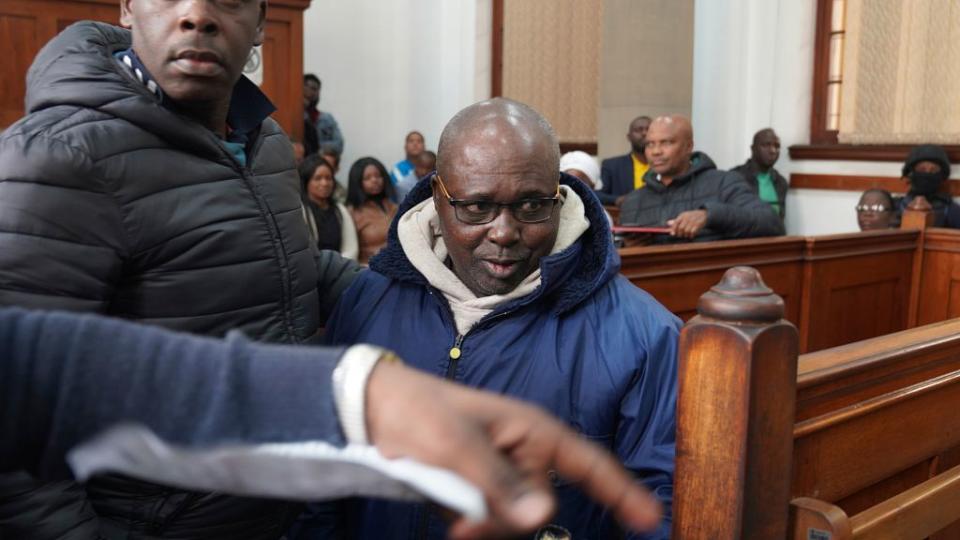
After nearly three decades on the run, Fulgence Kayishema was arrested on 25 May 2023 in a grape farm in Paarl, South Africa where he had apparently been residing and working as a labourer. Kayishema, a former senior police officer, is suspected of playing a prominent role in the Genocide against the Tutsi in 1994, particularly in killings in Kivumu commune in Kibuye préfecture, including the particularly notorious massacre of approximately 2,000 Tutsi civilians in Nyange Catholic Church. Kayishema was indicted by the International Criminal Tribunal for Rwanda (ICTR) in 2001, charged with genocide; complicity in genocide; conspiracy to commit genocide; and crimes against humanity. In this post, we explore what his arrest tells us about South Africa’s role in harbouring genocidaires and where Kayishema should be transferred and prosecuted.
South Africa’s complicated ‘relationship’ with suspected Rwandan genocidaires
Similar to questions that France faced in 2020 – but is yet to answer – when alleged genocide financier Félicien Kabuga was arrested in an affluent Paris suburb after nearly 26 years on the run, it is inevitable that many are wondering how Kayishema managed to live so long in South Africa unbothered by authorities. Indications are that South Africa knew of Kayishema’s presence long before his arrest on 25 May 2023. Addressing the UN Security Council in 2021, the Prosecutor of the IRMCT Serge Brammertz accused the South African government of stone-walling the search for Kayishema. The Prosecutor had earlier claimed that South Africa had initially acknowledged, as a reason for not arresting and extraditing Kayishema, that it had granted him refugee status, but later changed its position and pointed to legal difficulties in cooperating with the IRMCT. South Africa, however, changed its tune in 2022, ramping up cooperation with the IRMCT and establishing an operational task-team that eventually apprehended Kayishema.
South Africa’s dalliance with suspected genocidaires is not new; it goes back to Apartheid South Africa, which, alongside France, is reported to have been one of the main arms suppliers to the genocidal Rwandan regime in the years leading up to the Genocide against the Tutsi. Elements of the Apartheid regime ensured that the arms flow to Rwanda continued even after the official collapse of the Apartheid in South Africa, without much interference by the newly elected democratic South African government. It is no surprise, therefore, that many Rwandans fleeing the collapse of the genocidal regime found their way to South Africa. While Kayishema’s case has been the most prominent due to his indictment by the ICTR, he is reportedly not the only fugitive known to be residing in South Africa. Kigali has claimed that at least four other persons suspected by Rwandan authorities of involvement in the genocide eventually made their way to South Africa, and reside and work there to this day.
Where will/should Kayishema be prosecuted?
Apart from the reputational embarrassment of having hosted a suspected genocidaire, Kayishema’s arrest now raises another uncomfortable dilemma for South Africa, that is, where Kayishema will be extradited to. While Kayishema was indicted by the ICTR in 2001, in 2012 the ICTR referred his case, among others, to Rwandan authorities. In May 2014, the ICTR issued an arrest warrant for Kayishema, requesting States to arrest and transfer him to Rwanda for trial. With this referral, it follows therefore that Kayishema ought to be transferred to Rwanda for trial.
There is no reason to believe that the IRMCT Prosecutor will seek revocation of the referral to Rwanda. Even though the IRMCT press release following Kayishema’s arrest was rather vague on this question, the Prosecutor subsequently indicated in an interview with Rwandan media that the IRMCT would transfer Kayishema to Rwanda once South Africa hands him over. South Africa has not yet indicated in whose favour – Rwanda or IRMCT– the extradition request before the South African courts will be made, though a media statement by the South African Police Service stated that he was being held ‘pending his extradition to Rwanda’.
Kayishema made his first court appearance in Cape Town on 26 May 2023, but was remanded till 02 June 2023 to allow for further investigation. Due to the frosty state of diplomatic relations between South Africa and Rwanda, Pretoria may be reluctant to extradite directly to Rwanda. This situation echoes that of Ladislas Ntaganzwa, a genocide perpetrator whose case was similarly referred to Rwanda by the ICTR. Ntaganzwa was arrested in December 2015 in the Democratic Republic of the Congo (DRC), but the DRC was reluctant to directly hold extradition discussions with Rwanda. Instead, at the urging of the UN through UN Security Council Resolution 2256 (2015), the DRC concluded an extradition agreement with the IRMCT and then proceeded to extradite Ntaganzwa to Rwanda via the IRMCT in March 2016.
Transfer to either the IRMCT or Rwanda is not necessarily a straight-forward matter, considering complexities/ambiguities in South Africa’s extradition laws. As regards transfer to the IRMCT, South Africa’s extradition law, the Extradition Act, expressly addresses extradition to a State, and not necessarily to mechanisms such as the IRMCT. A proposed amendment – the Extradition Bill 2022 – which would have provided for extradition to ‘international entities’ such as the IRMCT is yet to be enacted. Extradition to the IRMCT may, therefore, face this legal challenge. However, UN Security Council Resolutions 955 (1994) and 1966 (2010) that established the ICTR and IRMCT respectively obligate States to ‘cooperate fully with the [ICTR/IRMCT] … including the obligation of States to comply with requests for assistance or orders issued by the [ICTR/IRMCT]’. Being international law instruments binding on South Africa, the obligation to comply with ICTR/IRMCT requests – including the obligation to transfer Kayishema – South Africa cannot therefore rely on the ambiguity/deficiency in its Extradition Act as a basis for refusing to surrender Kayishema to IRMCT.
As regards transfer to Rwanda, it is notable that South Africa does not have an extradition and mutual legal assistance in criminal matters treaty with Rwanda. That notwithstanding, the Convention on the Prevention and Punishment of the Crime of Genocide imposes an obligation on South Africa – a state party – to either prosecute or extradite persons suspected of committing the crime of genocide, and South Africa cannot cite deficiencies in its domestic legal framework to avoid performing its international law obligations. It is unlikely, therefore, that the lack of an extradition treaty will be an issue.
However, it is very likely that Kayishema will object to a transfer to Rwanda, citing fair trial concerns. Indeed, the IRMCT retains residual and monitoring authority over cases referred to Rwanda (art. 6.5 IRMCT Statute) and can, at any time before conviction or acquittal, revoke the referral order and request deferral to the IRMCT. However, this can only be done if it is demonstrated that fair trial conditions will not be met in Rwanda, or that the deferral will be in the interests of justice (art. 6.5 IRMCT Statute).
Rwanda has demonstrated its commitment to holding accountable perpetrators of the Genocide against the Tutsi that have been referred to it by the ICTR. Upholding fair trial standards, Rwanda successfully prosecuted Jean Uwinkindi, Ladislas Ntaganzwa and Bernard Munyagishari whose cases were referred to Rwanda by the ICTR. Kayishema’s case would be the fourth such prosecution under the referral regime.
In addition to cases transferred by the ICTR, the Rwandan High Court Chamber of International and Cross-Border Crimes has prosecuted genocide perpetrators extradited by foreign jurisdictions, mainly European States. Extraditions to Rwanda by European States always follow lengthy processes scrutinising the Rwandan judicial system’s capacity to conduct free and fair trial of genocide suspects. Armed with this experience, there is no reason to suggest that Kayishema’s case will be treated any differently. In any case, as mentioned above, the IRMCT will be at hand to monitor the prosecution at every step to ensure that fair trial standards are upheld. As Orina has argued when discussing the Kabuga case, there is a strong case to be made for trials in Rwanda not only as a logical completion strategy, but also seeing as “Rwanda has built capacity over the years and has effectively tried the cases referred so far”.
As regards the interests of justice, it cannot be in the interests of justice to deny the people of Rwanda an opportunity to hold Kayishema accountable before their domestic courts. It is trite that victims and survivors are likely to relate to accountability mechanisms that are physically, socially, culturally and psychologically closer to them.
Unfortunately, however, the international criminal justice project has and continues to suffer from a distance and elitism problem, remaining largely inaccessible physically, socially, culturally and psychologically from victims and survivors. As Mutua has observed regarding the ICTR, this mechanism ‘orbited in space, suspended from political reality and removed from both the individual and the national psyches of the victims’. This was partly because of the ICTR’s geographical location and highly technical and alienating procedures, and as Ndahinda has observed, the fact that the ICTR/IRMCT system ‘does not provide victims with an independent standing to participate in the process and seek reparations’.
The arrest of Kayishema presents an opportunity to ensure that the ‘distance’ problem of the ICTR/IRMCT is not repeated, and that Kayishema answers for his alleged crimes before the victims and survivors of these crimes. The interests of justice militate in favour of Kayishema being tried in Rwanda, at the locus of the crimes, and by the directly aggrieved community.


 Justice in Conflict