
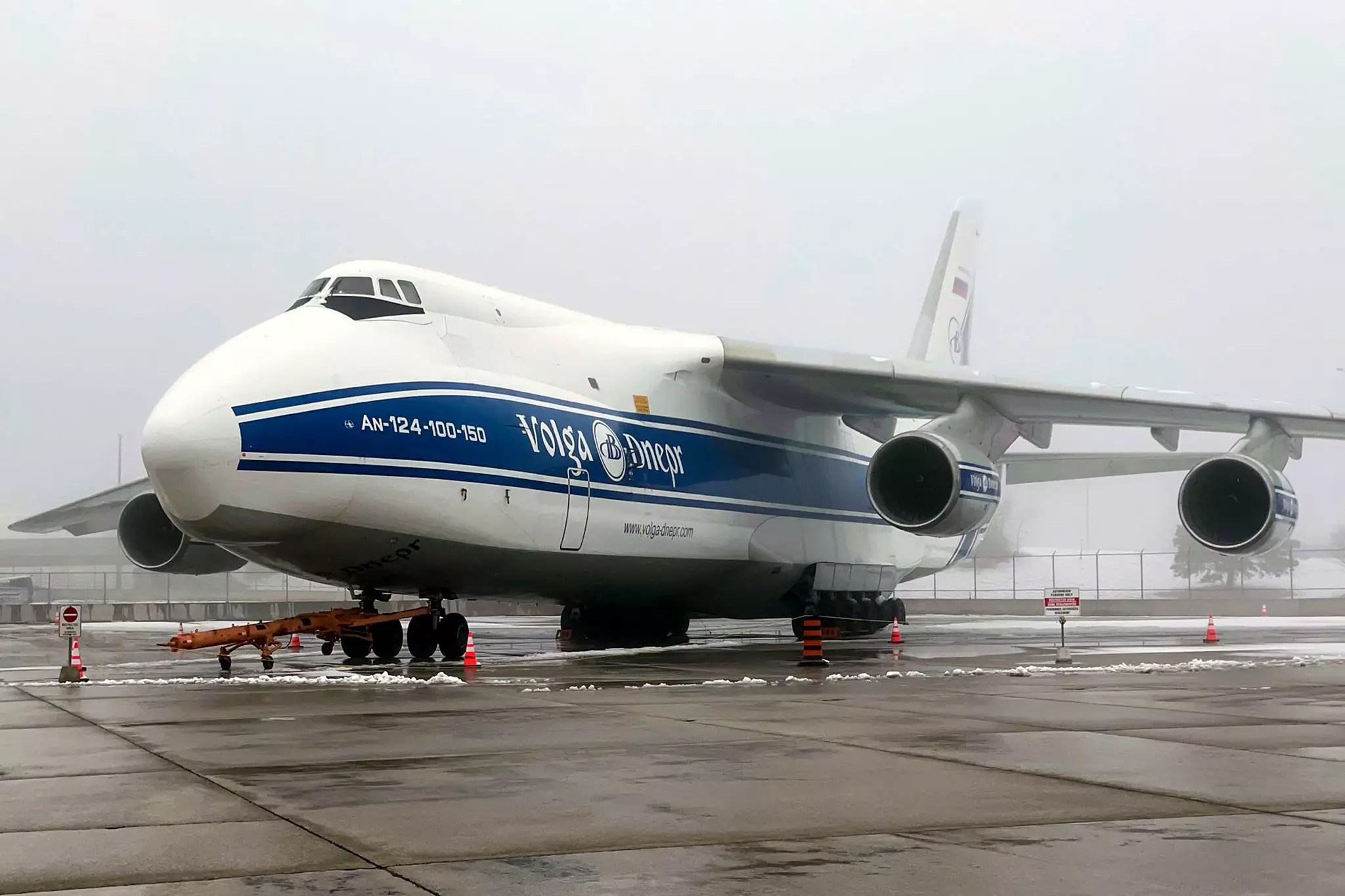
Pass through Toronto Pearson airport and you might spot a tired looking plane on the tarmac. No, it’s not another delayed Air Canada flight. The aircraft is the Russian-registered Volga-Dnepr, seized by Canadian authorities in February 2022. That plane is now likely to be forfeited, with the proceeds directed to Russia’s victims in Ukraine. But more is needed: Canada should lead an international effort to seize Russian assets and repurpose them as reparations for Ukraine.
Since Russia’s 2022 invasion of Ukraine, global accountability efforts have focused on prosecuting Russian war criminals. But going after their money is crucial too, for least three reasons.
First, it’s the right thing to do. World Bank estimates put the damage caused by the first year of Russia’s invasion at $410 billion – before the destruction of the Kakhovka Dam. Only Russia is responsible for those costs. As former Canadian Foreign Minister Lloyd Axworthy says, making Russia pay through the forfeiture of assets is “a Robin Hood proposition. You take from the Sheriff of Nottingham who was putting people in jail, and you give it to the people who were affected by this.”
Second, with the onset of fatigue among some populations over spending billions of dollars on a foreign war, redirecting Russian assets is the practical thing to do. Using Russian assets to help pay for Ukraine’s recovery could reduce the political costs of using taxpayer dollars to support the war and reconstruction effort.
Third, converting Russian assets into reparations can help address Russian atrocities. International crimes – like the war crimes and crimes against humanity Russia has committed in Ukraine – are lucrative. There exists an economy of human rights violations and international crimes. As I concluded in a recent study, atrocities often create opportunities for perpetrators to make money by plundering resources and creating profitable markets for the trafficking of drugs, precious resources, and even people.
Some of Ukraine’s allies are already exploring how to seize Russian assets to help Ukraine’s recovery. That includes Canada, which was the first to put in place laws that allow it to seize and forfeit assets of those involved in gross rights violations such as torture, extrajudicial killings, forcibly displacing people, and mass corruption.
In 2022, Ottawa announced it would use those laws to seize US$26 million from a company owned by oligarch Roman Abramovich and donate the proceeds to Ukraine’s reconstruction efforts. In 2023, the RCMP reported that over CAD$130 million had been “effectively frozen” through enforcement of the Canada’s Special Economic Measures Act.
Other countries are exploring similar actions. But given how globally distributed Russian assets are and how complex it can be to repurpose assets for reparations, a coordinated international effort is needed, one that can ensure due process standards are upheld and that the right people and institutions receive funds from seized and redirected assets.
That is why the United Nations General Assembly called for the creation of an international mechanism to compensate damages, loss and injury caused by Russia in Ukraine. Making such international mechanism would be essential to address thorny legal issues that may arise. There is a difference between seizing the assets of a private persons like Abramovich and seizing the assets of the Russian state. Lawfully seizing and selling the planes and yachts of private actors whose wealth was generated by grand corruption in Russia should be relatively simple.
Accessing Russia’s sovereign assets and wealth – such as the $300-$350 billion in Russian Central Bank funds that have been frozen – is more difficult. Doing so would require lifting sovereign immunity, which protects state property from being forfeited. But as proposed by the New Lines Institute, this could be justified via the international law on countermeasures: lawful retaliatory measures taken by states in response to the illegal acts of another state. Law professor Robert Currie has recently explained how this would be possible in compliance with international and Canadian law.
Rather than states doing piecemeal work in silos, an international legal effort could pay dividends. Are there risks? Of course. Russia could seize any remaining foreign mining, oil and gas, or other assets (which, frankly, should not be there). But as a recent plea from members of Ukraine’s Anti-Corruption Action Centre states: “If foreign partners are sincere in their pledge to help Ukraine rebuild, practical steps need to be taken today… to fully confiscate Russian assets.”
There is a final benefit to going after the wealth of Russian kleptocrats and atrocity perpetrators. At a conference I attended in Kampala, Uganda, a senior prosecutor declared that while criminals ‘hate losing their liberty, what they reallyhate is losing their stuff’.
We must remember: perpetrators of international crimes only commit atrocities because they have the means and because perpetrating crimes is lucrative. Going after Russian assets is a smart way to bring justice to their victims. Canada can and should lead an international effort to do just that.
*************
A version of this article first appeared in the Globe and Mail.


 Justice in Conflict
Extremely important issue.
It is not that simple as presented in the post, to seize and forfeit assets of oligarchs. Private doesn’t necessarily makes it easier. On the contrary. This is because, typically, one must establish and prove nexus between the oligarch activity or money making, and the state at issue (as sort of sender). Means, proving that the Oligarch, has made his money in the service of the state. As an agent of the state (Russia). This is not so simple, as seizing state properties. In case of the latter, one doesn’t have too many issues of facts. The property belongs to the state, that’s it. It is sufficient. Of course, there are questions of law. But, once the law is enacted and permits it, in most of the cases, not such big deal.
One may read hereby a ruling ( US federal court. Court of appeals, for the circuit of Columbia). In that case, the federal agencies, could establish, the nexus, between the asset of one Russian oligarch (Oleg Dripaska ) and the Russian state itself.
Here (only 5 pages by the way):
Click to access 21-5157-1940976.pdf
Thanks
If there are problems with the link to the ruling, left above by me, here to shorten one:
https://tinyl.io/8vfR
SOURCES OF INTERNATIONAL LAW THAT SHOULD HAVE RESOLVED CONFLICTS ETC.
In the ICTY machinery both Russian & Ukrainian judges/jurists had contributed towards strengthening international peace, resolving conflicts, etc. leading towards their contributions to Sources of International Law. Judges nominated by China, USA, Britain, France etc. & even LC Vohrah too, had made the world a better place in their own way.
https://www.icty.org/en/about/organization/chambers/judges
MY 2 Cents Worth :
In the spirit of the UN Charter, in reminding both Ukraine & Russia as Joint Founding Fathers of the UN being successors to the USSR, the engagement & pursuit of International Peace & Security inter alia other objectives of the UN Charter & other international legal instruments, must be prioritized towards saving both Russian & Ukrainian lives and properties and towards depolarizing a divided world.
Peace Must Be Given A Chance. Peace Must Be Our Only Option.