
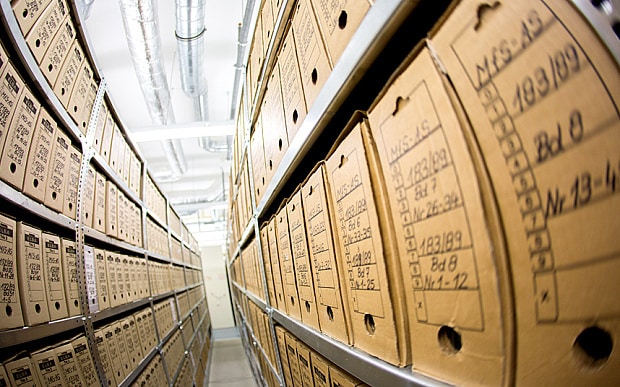
In a course that I run on responses to international crimes, I paint my students the following scenario: Canada is taken over by a brutal dictatorship that suppresses human rights. The regime lasts for twenty years before democracy is restored. During the dictatorship, one in every ten Canadians was an informant of Canada’s secret police. We do not know who they are. They could be our loved ones, co-workers, bosses, or the person who has made us our morning coffee on the way to work. Now, we have a chance to find out because the new government decides it is best to open the secret police’s records and let us find out.
Would you look?
The responses from students are fascinating not because any one of them is more persuasive than any other but because all and none of them are. Some students don’t hesitate. They are confident that they would absolutely check the files. They simply want to know. They seem convinced that the truth will set them free or bring closure by offering some critical tidbit of information that is necessary to move on. I respect their self-assurance, though I suspect that if the exercise were a little less abstract and they were staring down at an envelope which just might include the names of their mother or brother, the situation would look a little different. Imagining that moment is something like Schrödinger’s informant. Everyone is and everyone isn’t an informant – until the envelope is opened.
Other students are more anxious about the prospect of revealing who may have informed on them. They worry about what they might find and what information – what context and what truths – might be omitted. Might finding out ruin relationships that they once valued? How would it make them feel, and would it be worth it? One student believed that if someone they cared for informed on them during the dictatorship and they needed to know, then that informant would tell them.
Others wonder: what itch would knowing scratch and why do they have it at all? What can they do once they know? Rather than bringing closure, might finding out pieces of unsavoury and incomplete information only make that itch worse? Might the wounds of the past fester and undermine their healing once the scars have been picked at? Is there any place here for forgetting? Can we accept that sometimes forgetting may actually be a virtue, even if it runs contrary to the accumulated wisdom and insistence of transitional justice scholarship that all bad pasts must be confronted?
Of course, I don’t have the answers to give the students. The decision isn’t scientific or even fully rational; it is personal, and it is emotional. It is intimate. Knowing what to do is likely as difficult as it is to define what truth and reconciliation mean.
What the students demonstrate in these moments is a spectrum of reactions and feelings that would not be out of place in conversations among Eastern Europeans about whether or not to look into the secret police files of Communist regimes. I know, because I have been part of that conversation. I recall as a young adult listening to Polish people speak passionately about the files of informants from Communist Poland. Some spoke with the same confidence that I saw in some of my students. Others said it made no sense to look: how would they know if the informant informed thanks to the promise of a bonbon or a bullet in the brain? Some are naturally more reactive; others are more reflective. With time, I have found, reactivity is slowly governed by reflection, as those engaged in these conversations ditch simplistic answers for a subject that defies simplicity.
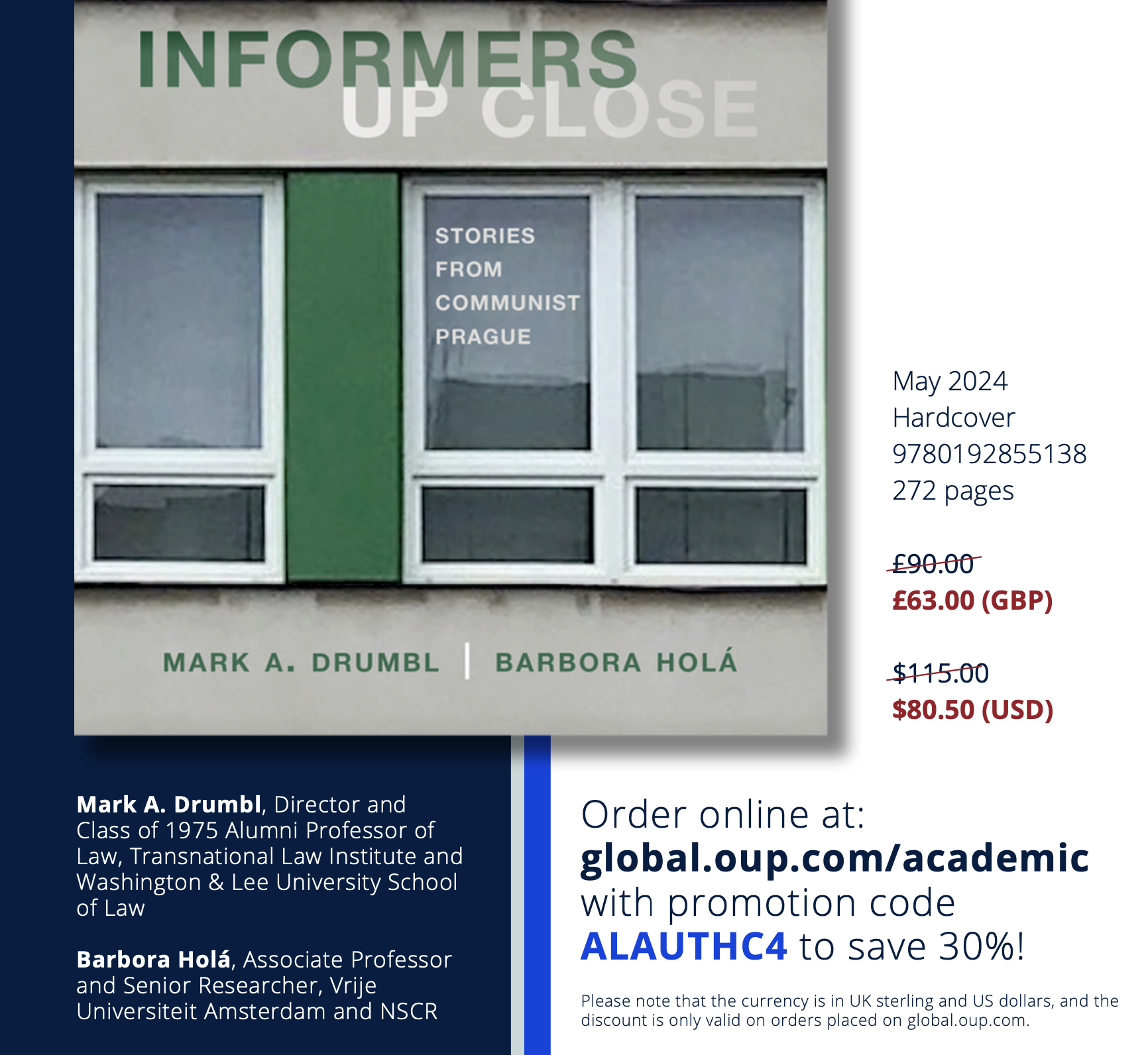
Whether to look or not defies simplistic answers, and certainly defies a blanket response. How people navigate and respond to this difficult terrain is the subject of a new book by Mark Drumbl and Barbora Holá, Informers Up Close – Stories from Communist Prague.
Justice in Conflict is honoured and excited to host a symposium throughout this week on Drumbl and Holá’s new book. With their characteristic combination of detailed research and exquisite prose, Drumbl and Holá bring us into the world of informants in a way that has never been so thoroughly – or humanely – assessed.
Over the next few days, posts will be published on these pages from: Cynthia Horne, Novak Vučo, Vladimir Petrović, Kiyala Jean Chrysostome, Emma Breeze, Irit Dekel, and Patryk Labuda.
Each post can be viewed from the following links:
- Disguise, Blur, Purr, and Nakedness: Mark Drumbl and Barbora Holá on Informers Up Close: Stories from Communist Prague, by Mark Drumbl and Barbora Holá
- As the past repeats we see the ‘other’ in us all – A review of Informers Up Close, by Emma J. Breeze
- Rethinking Informers in transitional justice in liberal times, by Jean Chrysostome K. Kiyala
- The Politics of Ambivalence: Revisiting the Communist Past with Drumbl and Holá, by Patrick Labuda
- Victims who Victimize – Understanding Informers, by Irit Dekel
- On the far-reaching relevance of Holá’s and Drumbl’s Study of Informers from Cold War Czechoslovakia, by Novak Vučo and Vladimir Petrović
- Lustration of Informers to Promote Trust, by Cynthia Horne
- To change the we as well as the me and the you: Concluding the Symposium on Informers Up Close, by Mark Drumbl and Barbora Holá
Readers can also purchase Drumbl and Holá’s book with a 30% discount from Oxford University Press using the promotion code: ALAUTHC4. The book can be purchased here.
Thank you as always to our readers and contributors, and we hope you’ll join us in reading and engaging with this timely, important, and exciting symposium!


 Justice in Conflict