
The following is Irit Dekel‘s contribution to JiC’s ongoing symposium on Mark Drumbl and Barbora Holá’s new book, Informers Up Close. Irit is an Assistant Professor of Germanic Studies and Assistant Professor of Jewish Studies at Indiana University, Bloomington. To see all of the other submissions to the symposium, click here.

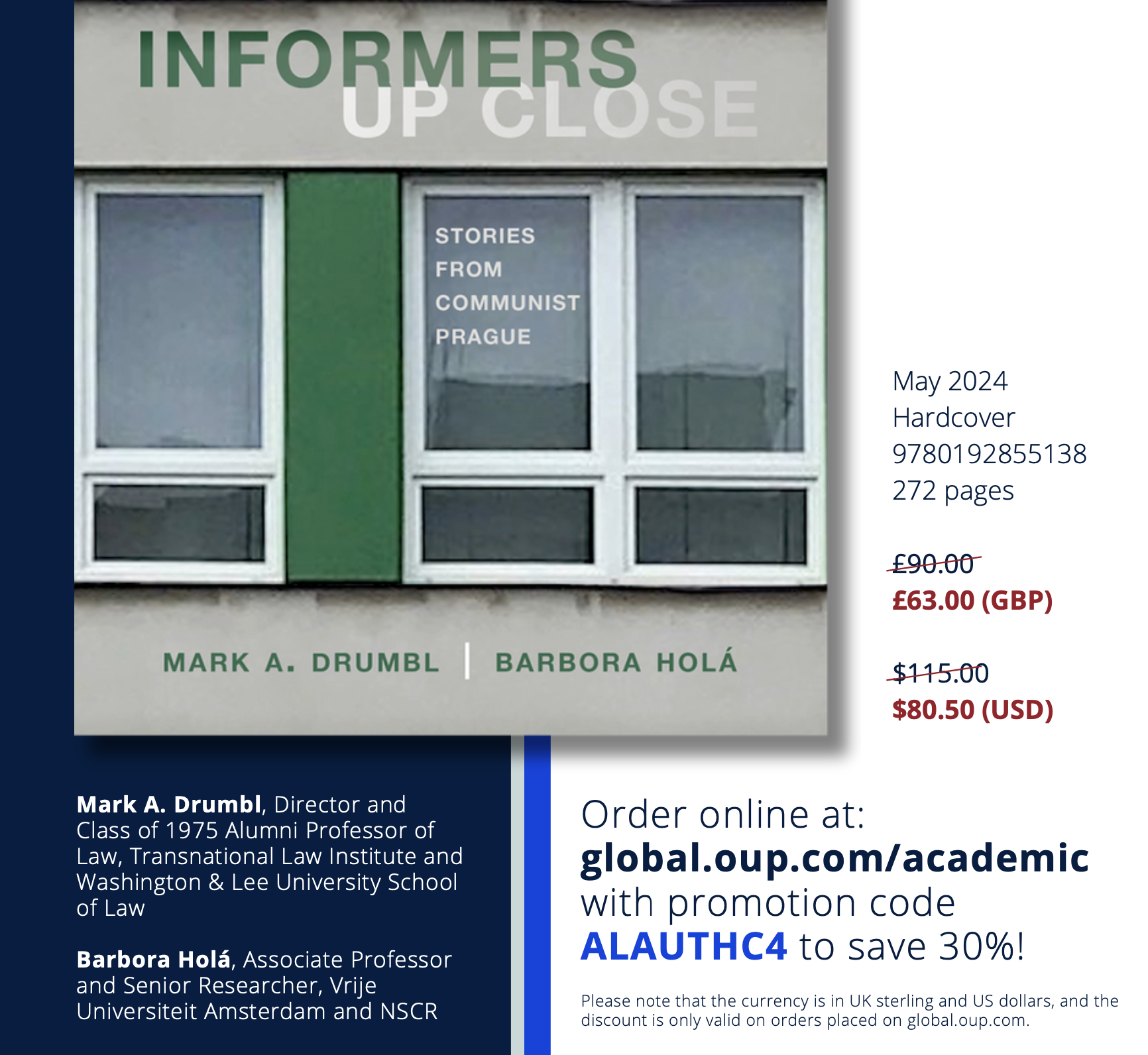
In Informers Up Close Mark Drumbl and Barbora Holá aim to understand both the act of informing and informers themselves. In this beautifully written volume, Drumbl and Holá make sense of what informers did and how subjective values of the Communist era in Czechoslovakia both affected informer worldviews and knowledge formation of informer actions. As its title promises, the book offers a microscopic analysis of Czechoslovak secret police (StB) files about informers and individuals they informed upon, their own writing, those of recruiters and bureaucrats, the state, and its operatives in what was given to or withheld from citizens in Communist Czechoslovakia. The authors use the most detailed elements of human experience and social mechanisms to draw a larger picture of how informing came to be and was sustained and how informers were caricatured and denounced after the regime ended. A central finding of the book is that informing dynamically takes shape as an intimate and relational act of social navigation. The authors conceptualize StB informers as victims who victimize.
Drumbl and Holá focus on ‘everyday collaboration’, such as denouncing a spouse or refusing to report on a close friend and still being useful to the state. Their sensitivity to detail enables them to paint a multi-faceted picture of informing and informers beyond their case study. While the archived StB files constitute the epistemological foundation of Informers Up Close, the authors helpfully incorporate extensive content from a robust array of secondary sources: accounts in the “Memory of Nations” oral history archive, academic literature, newspaper articles, informal discussions they have conducted, and literary works. For instance, reading the recruitment proposals the authors show, rather than tell, the salience of individual interpersonal connections amid the intricate structure of the bureaucracy. Understanding informers in this way, the authors shed light on multiple aspects of transitional justice after conflict or regime end. The book also opens space for future studies of the residual effect of authoritarian regimes, the lingering emotions that first moved the informers and sustained their actions; and after the regime’s end morphed into a shared disdain toward informers and their acts, and into the lingering distrust and anger toward that time.
As a sociologist and ethnographer who focuses on memory in contemporary Germany and on witnessing, my discussion of this fascinating book follows questions its authors encourage readers to consider: (1) What files do? (2) What to do with files? (3) The ‘memory’ of files: and how to understand with them, or the long- lasting impact of narratives built upon the figure of the informer for the post-communist societies.
1. What do files do?
The book presents informers’ files as authentic objects through forms, type or handwritten documents, and photos of informers from their files. These provide evidence of what the files stored along with their language and aesthetics. The authors tell what parts were probably discarded by the state. Drumbl and Holá are sensitive to how gender figured in stories of informers, who are presented as individuals who may exercise initiative and choice. By reading the files, the authors reconstruct how the authorities used family ties, parental relations, and infidelities to lure and manipulate informers and the population at large.
Drumbl and Holá describe informing as intimacy, co-constituted amongst state and individuals in secret relationships between informers and their handlers. They helpfully explore the human emotions of devotion, desire, resentment, and fear that catalyzed and fueled these interactions. A close reading of these files sets the ground to ruminations about the post-Communist transition. Whereas a system of complicity embedded in Czechoslovak society was denounced after the regime ended, blaming informers may have assuaged these endemic complicities. Specifically, lustration of the informers neutralized the influence of ‘yesterday’s heroes’, casting them as ‘today’s villains’ in a sweeping manner that didn’t consider the different ways informers collaborated with the state.
In looking at the granularity of an individual file of an informer named Věra, the authors claim in page 104 “Věra was also aware that her friends facilitated illicit emigrations by arranging the necessary paperwork, or by physically assisting people in covert border crossings. As if this were not enough, Věra and her friends also allegedly “listened to jammed foreign radio broadcasts from the West”. Reports of Věra‘s political activism against the regime merges with the reasons for and tools for state surveillance. Reading the language of the file, I could glean the frustration of the informer who gathered information about Věra– as they kneeled behind a closed door, or a wall. The authors describe what the StB file said about her recruitment meeting in which the collaboration was formalized: “According to the report, she left smiling and visibly happy (p. 105).” In distilling the language of the file from the StB, the authors show the system of oppression, its modes of self-justification, the ways it manipulated its citizens and cajoled informers.
We read the tone of the files, the logic of their compilation and what Drumbl and Holá think about this logic. I would like to know how all this corresponded with what Věra and other informers reported. The StB discarded many files, so this might have been impossible to reconstruct.
2. What to do with files?
Drumbl and Holá contend: “we read the StB files as texts of social performance and extract therefrom our perceptions of the emotions, sentiments, and motivations that catalyzed and fueled informing as a social practice”.
The authors read the files of 23 informers and focused on 6 in the book. They impressionistically present the emotions that animate informing. Emotions are produced and regulated by social systems. Our perception and expression of emotions are often guided by the cultural and economic frameworks within which we live, as Eva Illouz shows in her book Cold Intimacies: The Making of Emotional Capitalism. The authors use emotions as reflecting a state of mind of the informers, and indirectly of a social and moral mood of the time (through scolding on extramarital affairs, for instance). Only indirectly do they reflect on the social framework in which interpreting these emotions is embedded, as well as the emotions aroused while reading these files. In reading the files this way, one gets to witness and interpret how informers and their interlocutors described those moods and sentiments relationally.
As the readers encounter the files in their elemental detail, they see that often the StB’s primary interest drifted from penally punishable behaviors towards personal matters such as matrimonial life, financial dealings, irregular political viewpoints, and foreign connections. The connective nature of the relationship between informers and ‘their’ StB are discerned in threads of this bonding, friendship, caring, and solicitude throughout the files. The high resolution of reading the files reveals the StB ability to record. This is where the authors convincingly show how life and lives changed during Communist rule and how individual lives were connected to a form of political rule that embedded itself within the home and workplace.
Drumbl and Holá add to our understanding of the complexity of informing in describing how some informers wanted to be heard, to count for something, and to have an audience.
The authors juxtapose the information and evidence found in oral history databases vs. informers’ files. They helpfully compare the information found in oral history accounts, which sometimes depict a more benign recollection of life during the Communist years.
3. The memory of informers’ files and transitional justice
I here consider two ‘memory’ issues: how were the files represented in post-communist Czech society; and more generally, how do these representations affect transitional justice after the fall of the regime?
The book reflects on how transitional justice approached these informers, initially in post- Communist Czechoslovakia, and— following the dissolution of Czechoslovakia into two separate nation-states. The authors describe a process that endeavored to implement ‘an uncompromising politics of memory that strove to re-educate the nation about the ‘totalitarian past’, and concomitantly to reinforce the anti-Communist paradigm by promoting or producing anticommunist collective memory. Transitional elites seized the figure of the informer as a scapegoat. The names of alleged informers were revealed, their StB files were opened to the public, and they were excluded from public service functions through lustration.
Drumbl and Holá ask: should informers map onto transitional justice analysis, given that the assessment of their deeds is not reconciliatory? They develop a helpful heuristic that can help transitional justice become more sensitive and inclusive about informing.
The authors argue that it was convenient to portray informers as ideologues and loyalists rather than as petty, frightened, avaricious, apolitical, and grudging individuals. Sociologically, we might claim that this portrayal continues the ‘seeing like a state’ [after James E. Scott’s book] of the ancient regime, although, ironically, it just broke away from it, after its collapse. The authors compellingly claim that the process of re-building the state created the informers as scapegoats and thus continued schematic visions that blur complex interdependencies in the social role of the informer. They write: “We suggest that candidly recognizing the mélange of situational and dispositional elements presents a more accurate etiology of collaborative informing”. Because opening the files and what was documented in them was akin to tabloid journalism, the authors claim that transitional justice can unwittingly lead to cruelty in terms of harms and effect from the perspective of the informers, victims who victimize, but also their victims, relatives and others mentioned in the files.
Drumbl and Holá argue that the “reconciliatory, rehabilitative, and reintegrative goals of transitional justice interventions might be more suitable for informers in light of the social positionality informers tend to occupy during and after repression”. In this way, they open an important avenue to considering informing in ‘free’ societies such as at the time of the pandemic.


