
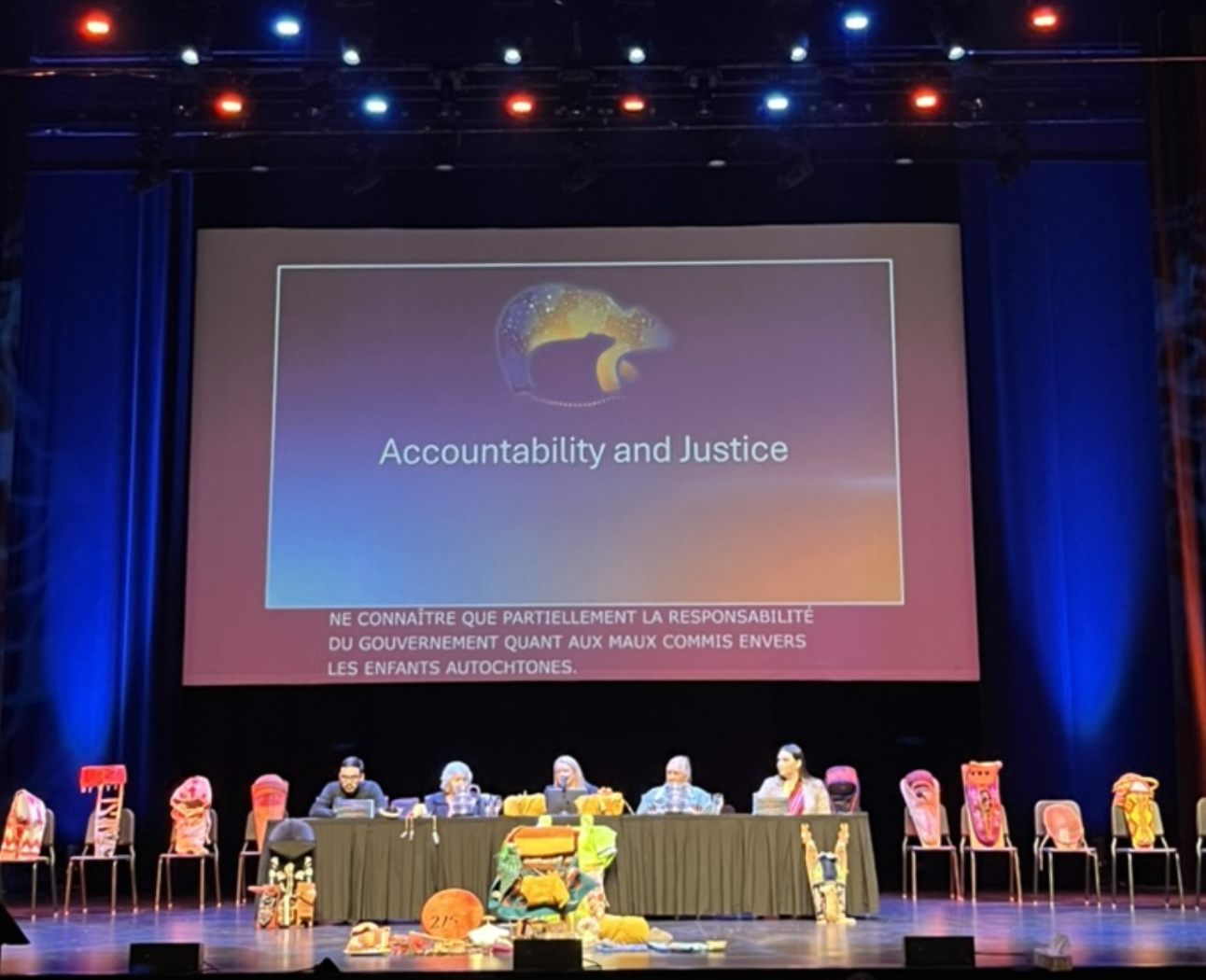
Last October, the Office of the Special Interlocutor for Missing Children and Unmarked Graves and Burial Sites associated with Indian Residential Schools in Canada released its final report. It called for Canada to refer itself to the International Criminal Court and to create an Indigenous-led commission with a 20-year mandate to investigate disappeared Indigenous children. Doing so, Special Interlocutor Kimberly Murray concluded, would help to combat the existence of a “culture of impunity” and “settler amnesty” in Canada over atrocities committed in the Indian Residential School System (IRSS). Some might be naturally ask: what does that mean? Others may wonder: Does Canada really have an impunity problem? The answer is yes.
As readers will know, I was honoured to work for the Special Interlocutor’s Office from 2022 to 2024, applying international criminal law and international human rights law to the horrors perpetrated against children in the Residential School system. Part of that effort sought to understand the particular form of impunity that exists in Canada and articulate how it operates to deny Indigenous Survivors and communities avenues for accountability. We did this by studying amnesty laws, and applying insights from the use and study of amnesties to the Canadian settler colonial context. What follows is based on those findings.
Canadians and people around the world increasingly know that the atrocities and human rights violations committed against Indigenous peoples were not sporadic or the result of ‘bad apples’; they were structural and systematic, committed by specific perpetrators along with the bureaucratic machinery of the Canadian state. There is a belated but growing acceptance of this reality. In 2022, the House of Commons unanimously accepted that the Residential School System constituted genocide – and not ‘only’ cultural genocide. Similar findings were made by the National Inquiry into Missing and Murdered Indigenous Women and Girls in 2019. The indignities and atrocities that children were subject to are increasingly taught in schools across the country. The space of denial has been shrinking.
But it is not just the atrocities against Indigenous peoples that is structural and systematic. Impunity – the lack of justice for these atrocities – has also been structural and systematic. While a small number of perpetrators were held to account for sexual and physical abuse at Residential Schools, none of those most responsible for IRSS atrocities have ever been investigated or prosecuted. The very systems that produced the Residential Schools are still in place; instead of transferring children into the institutions, Indigenous people are today transferred in grossly disproportionate rates into the child state care system and into Canadian prisons and jails, sometimes referred to as “the new residential schools”.
The federal government acknowledges some harms and has offered compensation to some classes of victims and Survivors. But it also fights them tooth and nail in the courts, at enormous expense to Canadian taxpayers.
Canada has likewise closed avenues for justice and accountability that might otherwise be used by Indigenous Survivors and communities. Consider the examples of genocide and enforced disappearances.
As the Genocide Convention was being negotiated in the late 1940s, Canada helped to ensure that the intentional destruction of a group’s cultural fabric was not prohibited as an act of genocide. Canada went so far as to threaten to vote against the adoption of the Convention as a whole if cultural genocide was included.
One consequence of this is that Truth and Reconciliation Commission (TRC) set up by Indigenous peoples (not the government of Canada) was unable to conclude that Canada had committed genocide against Indigenous peoples; that would have represented a legal finding and the TRC had no mandate to make legal determinations. Instead, in 2015 the TRC found that Canada had committed a cultural genocide, a non-legal finding deemed acceptable to many because, while bad, it was ‘not as bad as genocide’. Of course and as genocide scholars have pointed out, cultural genocide should be understood as an act of genocide. Yet it had been stripped of its place in the Genocide Convention by the very state engaged in perpetrating it.
The story does not end there. In 1970, Canada included parts of the Genocide Convention into its Criminal Code. When it did so, it cut out three acts that constituted genocide under the Convention. It kept killings as well as the imposition of conditions of life calculated to bring about a group’s physical destruction. But it deleted: causing serious bodily or mental harm to members of the group; imposing measures intended to prevent births within the group (such as forced sterilization); and forcibly transferring children of the group to another group – exactly what happened in the IRSS as well as the Sixties Scoop, to the mass removal of Indigenous children from their families and into the child welfare system and non-Indigenous families.
It was therefore unsurprising that when the National Inquiry into Missing and Murdered Indigenous Women and Girls concluded that Canada had committed genocide, some prominent Canadians and genocide experts denied that it could be genocide unless there were mass killings – an argument that defied basic genocide law.
Again, it doesn’t end there.
Many will be familiar with the 2021 coverage of unmarked burials at the site of a former Residential School in Kamloops, British Columbia. Since then, thousands of other grave sites have been identified across Canada, leading to ongoing searches for the children. But the Special Interlocutor concluded that the children forced into Residential Schools aren’t just missing. Some are victims of enforced disappearances as a human rights violation and a crime against humanity.
Enforced disappearances occur when a person’s liberty is deprived, and they are subsequently detained (or killed) by agents who refuse to acknowledge or who conceal the person’s fate or whereabouts. They were a common feature of the violence waged by South American dictatorships in the 1970s. Recently, the Canadian government has alleged that they have been committed by Russian forces in Ukraine. The are also prevalent in Gaza.
A notable feature of enforced disappearances is that relatives of the disappeared person are also considered victims. They can bring claims to human rights bodies. So, why haven’t Canadians heard about this before? Why have there been no court cases over the disappearances of Indigenous children? The reason is Canada’s de facto, blanket, and unconditional settler amnesty, expressed by a legal regime that denies of legal avenues for accountability. This is evidenced by at least three facts.
First, Canada has not signed or ratified the 2006 International Convention for the Protection of All Persons from Enforced Disappearance. It has refused despite telling other countries that they should do so and despite its allies – including G7 states – encouraging it to. No Canadian government has provided a rationale for this decision.
Second, when Canada implemented the Rome Statute of the International Criminal Court into its Criminal Code, via the 2000 War Crimes and Crimes Against Humanity Act, it cut out the crime against humanity of enforced disappearances. It also made sure that if a crime against humanity was perpetrated outside of Canada prior to 2000, it could be prosecuted; but if it happened inside the country – it could only be investigated if it was committed after 2000. The consequence of this is that, unless they are found to be continuous international crimes, any crime against humanity committed in the Residential Schools cannot be prosecuted, as the last institution closed in 1996.
Third, Canada has repeatedly refused to sign or ratify the American Convention on Human Rights or accept the jurisdiction of the Inter-American Court on Human Rights (IACHR). These regional human rights instruments have played a critical role in addressing enforced disappearances, including in relation to Indigenous peoples. In 2003 and 2005, a Senate committee told the government that there were no good reasons not to sign the Convention and accept the IACHR’s jurisdiction. They were ignored.
All of this – and more – is why the Office of the Special Interlocutor concluded that settler amnesty and a culture of impunity exists in Canada. That systemic impunity rests upon a series of acts and omissions which together stymie efforts to hold Canada or individual officials accountable for the well-documented atrocities committed in the IRSS.
To change that, Canada must accept the conclusions of the Special Interlocutor’s report and open avenues for accountability, including in relation to enforced disappearances. Will it do so? That will depend on the courage and integrity of those in power.
It would not tear Canada apart to truly commits to meaningful justice and accountability for Residential School crimes. Far from it. It would offer renewed hope for genuine truth and reconciliation, as well as the possibility of a genuine transition towards a new and better relationship between Canada and Indigenous communities.


 Justice in Conflict