
Dear readers,
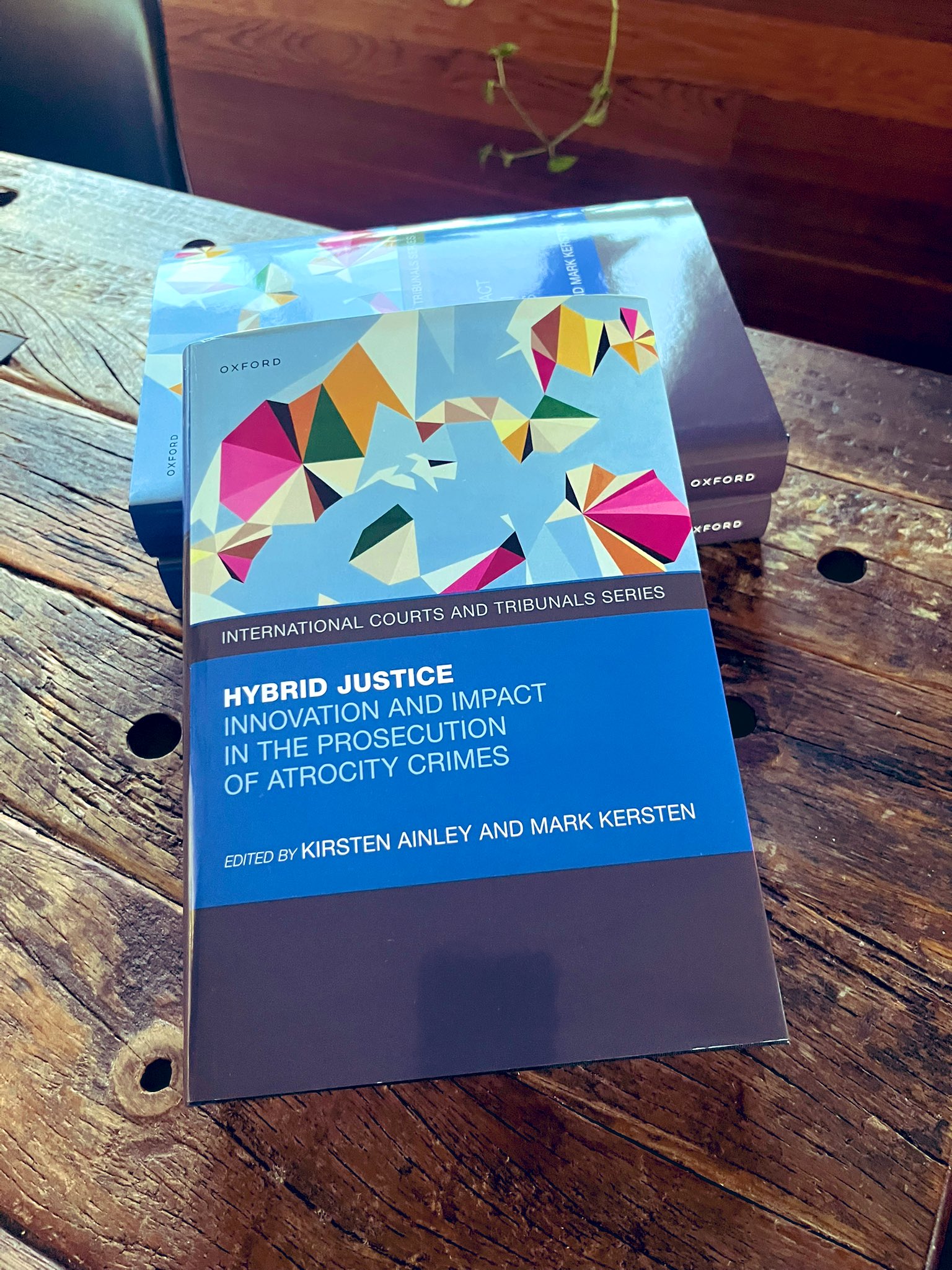
I am very happy and excited to announce the publication of a new book, co-edited by Kirsten Ainley and myself, entitled Hybrid Justice: Innovation and Impact in the Prosecution of Atrocity Crimes.
The volume is the product of the Hybrid Justice Project. Here is a synopsis of the book:
The last decade has seen the unexpected re-emergence of hybrid and internationalized courts, tribunals which operate with varying combinations of national and international law, procedure, and staff. The permanent International Criminal Court (ICC) should have made such hybrid mechanisms largely obsolete, yet hybrids have recently been established or proposed for crimes committed in Chad, South Sudan, Israel/Palestine, the Central African Republic, Kosovo, Syria, Sri Lanka, Myanmar, The Gambia, and Liberia, among others. One of the most pressing conversations in international criminal law is whether and how a hybrid tribunal can be set up to address Russia’s commission of the crime of aggression in Ukraine. Hybrid courts are often a response to the need to make justice more—albeit not entirely—local. They operate with differing degrees and elements of national and international law and staff. Some hold proceedings in the relevant situation country, others in third-party states, and yet others offer a mix of both. All contribute significantly to the broader ‘system’ of international criminal justice. This edited volume examines the resurgence of hybrids. The contributors—lawyers, academics, and activists—offer analyses of the ways in which hybrids have succeeded or failed to achieve their objectives and, in doing so, help to clarify what makes hybrids more or less likely to succeed in their mandates and impacts. The authors focus on hybrid courts and resilience: the resilience of hybrid mechanisms to withstand political and other pressures in order to deliver justice and accountability, and the potential contribution of hybrids to the resilience of affected communities. Chapters are grouped into sections on the fields, practices, innovations, and impacts of hybrid courts, to draw out lessons for the future of hybrid justice.
And here are the chapters and (fantastic!) contributors:
-
- 1 Hybrid Justice: Innovation and Impact in the Prosecution of Atrocity Crimes, by Kirsten Ainley and Mark Kersten
- 2 In Whose Name? Mapping the Constitutional Legitimacy of Hybrid International Criminal Courts, by Dennis R. Schmidt
- 3 Regionalized Hybrid Courts, by Elena Baylis
- 4 Securing Resilient Peace: From Hybridity to Polyvalence, by Shastry Njeru and Tyanai Masiya
- 5 Dissent in International Criminal Justice and the Creation and Re-emergence of the Hybrid Court, by Shannon Maree Torrens
- 6 Institutional Design and (Non)-Complementarity: Regulating Relations between Hybrid Tribunals and other Judicial and Non-Judicial Institutions, by Patryk I. Labuda
- 7 Valuing the Defence: A Comparative Analysis of the Hybrid Tribunals’ Stumbling Efforts Towards Giving Meaning to Defence Rights, by Sareta Ashraph
- 8 Victim Participation in Hybrid International(ized) Tribunals: No Longer Just a Feature ‘Nice to Have’, by Philipp Ambach
- 9 Striking the Right Balance: Impact of the Nationality of Judges/Staff on the Legitimacy of Recent Hybrid Tribunals, by Erica Bussey
- 10 Emerging Enforcement Practices of Hybrid Courts: Lessons Learned for Proposed Hybrid Mechanisms in Post-Conflict States, by Philippa Greer
- 11 A New African Pluralism in International Criminal Law: Sovereign Immunity and the Trial of Hissène Habré, by Kerstin Bree Carlson
- 12 Innovations in Hybrid Justice: Comparative Opportunities and Challenges of the Central African Republic’s Special Criminal Court and the Proposed Hybrid Court for South Sudan, by Elise Keppler
- 13 ‘Forced Marriage’: A Positive Development for International Criminal Law?, by Rosemary Grey
- 14 Hybrid Investigatory Mechanisms and Other Hybrid Justice Initiatives, by Nelson Camilo Sánchez
- 15 Hybrid Tribunals as a Mechanism for Reparative Justice, by Sarah Williams
- 16 Hybrid Justice and the Promise and Expectations of Outreach, by Olga Kavran
- 17 The Premise of Capacity Building in the Special Court for Sierra Leone, the Extraordinary Chambers in the Courts of Cambodia, and the Bosnian War Crimes Chamber, by Ezequiel Jimenez
- 18 Beyond ‘Fragmentation’: The Potential of Hybrid Courts to Restore Local Trust in International Justice through Prosecution of Economic, Social, and Cultural Rights Violations, by Alice Dieci
- 19 Conclusion: The Design, Function, and Evaluation of Hybrid Courts, by Kirsten Ainley and Mark Kersten
Kirsten and I owe a massive debt of gratitude to all of the authors, editors, and to our loved ones. Thank you for your care, devotion, and patience.
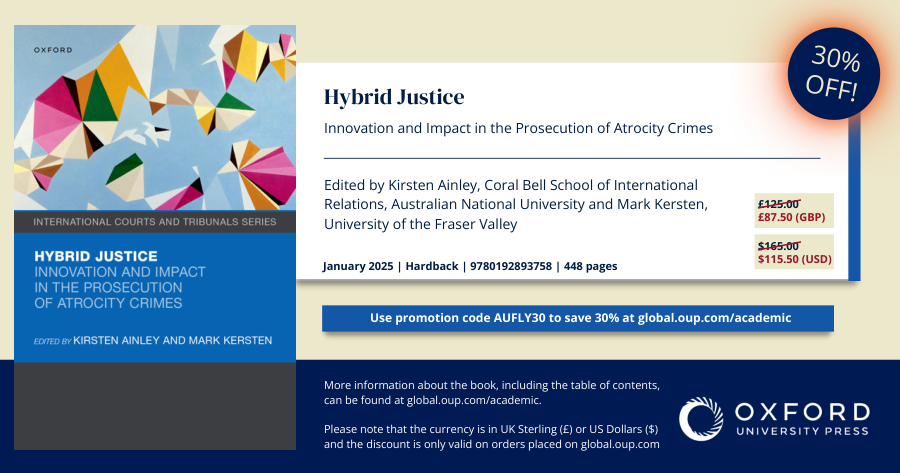
For anyone interested in copies of the book, Oxford University Press has provide a 30% discount code: AUFLY30, valid on orders placed via global.oup.com/academic. See more in the flyer below.


 Justice in Conflict
The Jerusalem Post story today about the Hannibal Directive and other stories from the press should be used to put an end to Leahy Act debate on terminated military aid or petitioning USA for warrants in the ICC.
No State can be allowed to murder its own soldiers to prevent them from becoming Prisoners Of War and ignore the prohibitions of the 3rd Geneva Convention. Even worse is the notion that any State can order its soldiers to murder its own civilians in violation of the common article 3 prohibition against “murder of civilians at all times and in all places”.
The question is why we are sanctioning the ICC here in the USA and giving billions of US dollars in weapons to that State? Our Constitution, the UN Charter that our government ratified, and our Leahy statutes prohibit it.
https://www.jpost.com/israel-news/defense-news/article-844008
https://www.abc.net.au/news/2024-09-07/israel-hannibal-directive-kidnap-hamas-gaza-hostages-idf/104224430?utm_campaign=abc_news_web&utm_content=link&utm_medium=content_shared&utm_source=abc_news_web