
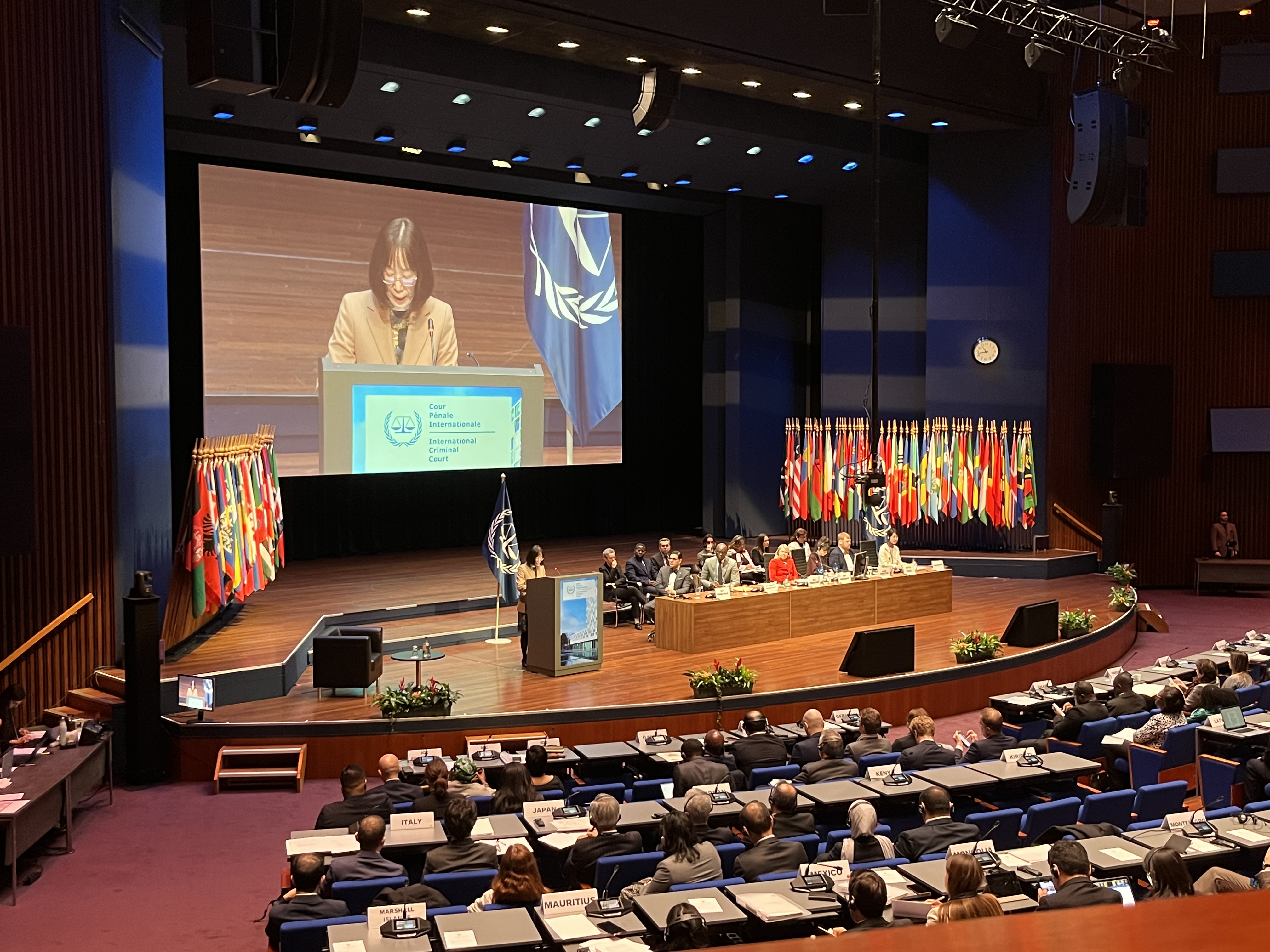
“We will continue our work undeterred.”
That was the message from senior staff and prosecutors at the yearly Assembly of States Parties (ASP) of the International Criminal Court. While admitting that times are difficult, ICC officials repeatedly emphasized that their resolve is unwavering and that, as much as possible, it is business as usual. Member states of the Court were likewise at pains to demonstrate that things were almost normal and offered what appeared to be a welcome and general consensus that the ICC was worthwhile defending.
But things are far from normal for and at the Court. What follows are some reflections of this year’s ASP – both the bad and the good.
While this year’s Assembly included multiple indications that most member-states are willing to back the ICC, the Court still faces grave, potentially existential, challenges on multiple fronts. American sanctions against the institution have upended the lives of multiple staff and judges. The effects cannot be understated. According to one sanctioned judge, French national Nicolas Guillou, “these sanctions affect every aspect of my daily life… Placing people under sanctions plunges them into a state of constant anxiety and powerlessness, with the aim of discouraging them.” Another, Kimberly Prost of Canada, has spoken about the psychological, emotional, and practical toll of the sanctions against her, noting that “it cripples you in our modern world.”
Neither the European Union nor those states whose citizens have been targeted, such as Canada, have invoked laws that would protect their ICC staff from these consequences. There is also the real possibility that the institution as a whole will come under sanctions for doing nothing more than fulfilling its mandate. If that comes to pass, it could sabotage the Court’s ability to fulfil its basic functions.
At the same time, states, staff and supporters of the Court are still waiting for the much-delayed report of the United Nations Office of Internal Oversight Services into serious allegations of sexual misconduct against chief Prosecutor Karim Khan. There is speculation over whether Khan might return to his post, depending on the outcome of the investigation. But until the report is released, no one knows what will happen. There wasn’t a person at the ASP who wasn’t frustrated that this process has been so drawn out. A gnawing sense of unease and uncertainty looms over the possible consequences of the investigation’s conclusions, both inside and outside of the Court.
While “universality” is a constant theme at ASPs, some states, like Hungary, have withdrawn from the Court, while a handful of Sahel states, run by juntas, have signalled their intent to do likewise. Together, these withdrawals would take the ICC’s membership down to 120 from 125. Meanwhile, the likes of Israeli Prime Minister Benjamin Netanyahu and Russian President Vladimir Putin remain fugitives, for the most part living freely and openly while negotiating ‘peace’ with the United States. The operatives of both have sought to intimidate and attack the Court. Tel Aviv and Moscow would no doubt love it if the U.S. sanctions did what they themselves cannot: destroy the ICC.
In response to this fire-alarm fire, many states made important points signalling their unwavering support for the ICC and the need for bolstered cooperation. There is a sense of optimism that states are collectively backing the Court, at least in words. This theme was picked up by Danya Chaikel: “I have never seen in 15 years in The Hague such camaraderie and alignment. Our differences are becoming less important because we know the whole Rome Statute system is being threatened. I sense this kind of wave of support and I’m more optimistic. I wasn’t a couple of months ago.”
At the same time, the ASP was striking for what was not said. Very few countries – and to my knowledge none on the first day of the Assembly – referred directly to the Trump administration. They spoke to ongoing “challenges” and the current “crisis”. But even when they mentioned sanctions, they were treated as if they came from some unidentifiable source – and not from the gravest menace to international law facing the world today, a regime more willing to sanction accountability advocates than atrocity perpetrators. By way of example, an otherwise welcome and important declaration adopted at the ASP expresses concerns over “threats and sanctions” against the Court, but fails to mention where they emanate from.
Moreover, some states not only avoided addressing the Trump administration’s sanctions directly, instead suggesting that the ICC’s opponents needed to be better understood. The UK delegation at the ASP, for example, stated:
We have been clear that we are concerned about the sanctions imposed in connection with the ICC’s work and the impact on individuals and the Court… We owe it to the ICC – and to those who work tirelessly to deliver its mandate – to do so. Engagement and dialogue with non-States Parties to understand their views is essential if we are to achieve this.
Understanding the views of non-state parties is no doubt valuable, but not if it comes at the expense of legitimizing or normalizing unwarranted and deplorable attacks on the Court.
Other states used the ASP floor to criticize each other. During a session on outstanding financial contributions to the ICC’s budget, the representatives of Venezuela and Argentina had a heated exchange, denouncing each other’s commitment to international law and justice. As it stands, neither are on good footing. Argentina was recently among three states – with Israel and the United States – to vote against a UN General Assembly resolution opposing the use of torture. There are also some who believe that Buenos Aires is considering a withdrawal from the ICC as a result of pressure from the Trump administration (and after its right-wing government received $20 billion in bailout handouts from Washington). As for Venezuela, it was announced at the launch of the Office of the Prosecutor’s Annual Report that the Court was closing its office in the country. Why? Because the Court has concluded that “no meaningful progress has been made by the national authorities” in Venezuela’s national justice systems towards accountability over alleged crimes against humanity committed in the country.
On the topic of closure, the investigation into the situation in Kenya is officially closed. While there remain two outstanding warrants of arrest for, effectively, obstructing the ICC’s investigations into the 2007-2008 post-election violence in Kenya, this marks the limp and lacklustre conclusion to a sad chapter in the Court’s history, wherein a combination of poor case construction and witness interference in Kenya combined to produce exactly zero justice and accountability.
The fiery exchanges such as that between Argentina and Venezuela should not be confused for an overly dramatic ASP. I have attended almost all ASPs over the last decade, and this year’s was the quietest and least well-attended. Fewer ICC staff were directly engaged in side-events. Fewer civil society organizations attended and those that were present sent smaller delegations. A number of U.S.-based NGOs also had to back out of events for fear of legal repercussions over Trump’s sanctions regime. Rumours had it that the U.S. legal advisor was circling the ASP halls to monitor who was in attendance, while Israeli representatives attended side events and took notes. If their purpose was to intimidate and cause unease, it seemed to work.

There were also some special and bright moments at the ASP beyond the apparent consensus that the ICC is worth defending. On the first day of the conference, the entirety of the Assembly erupted in applause when Ukraine was announced as the newest member of the Court. It was special to witness.
For the first time in the ICC’s history, the topic of non-cooperation with the Court (i.e. states failing to surrender ICC suspects) was an official agenda item at the Assembly. The ICC’s budget, a yearly headache and point of contention between states, civil society, and the ICC leadership, is likely to be passed with relative ease and result in a reasonable, if modest, increase to the Court’s coffers.
In his opening-day speech, Deputy Prosecutor Mame Mandiaye Niang announced that, while fragile, lines of communication had been established with authorities in Libya and Sudan. On that first day, ICC President Tomoko Akane shared that the surrender of a Libyan suspect was imminent. That very night, Khaled Mohamed Ali El Hishri was transferred from Germany into the custody of the Court – albeit over four months after he was first arrested. El Hishri is the first Libyan national to face trial at the ICC since the 2011 referral of the situation in Libya to the Court. His surrender was good – perhaps intentional – timing, demonstrating that the ICC had work to do and cases to prosecute.
During side-events on the situation in Palestine, the courage of Palestinian groups under U.S. sanction for doing nothing more than seeking justice for the slaughter of their people was both palpable and inspiring. Palestinian human rights and NGO leaders noted that the sanctions against them were intended to prevent them from engaging with the ICC, but they would not stop. One eloquently insisted that “Gaza must not be the graveyard of international law.” Deputy Prosecutor Nazhat Shameem Khan likewise said that the Court would not disengage with Palestinians nor stop building cases in Palestine: “the work has continued and the sanctions will not hold us back”. Of course, the proof of that will be in the pudding, such as with the official request of the long-anticipated warrants of arrest for Israel’s National Security Minister Itamar Ben Gvir and Finance Minister Bezalel Smotrich.
The ASP also saw two important policies – on cybercrime and environmental crimes – released by the Office of the Prosecutor. Two events that I participated in on behalf of the Wayamo Foundation – one on complementarity and support national justice efforts and one on accountability coalitions and the situation in Sudan – produced important and timely insights. It was also at the ASP that I learned of Ezequiel Jiminez’s new book, Governing the International Criminal Court The History and Practice of the Assembly of States Parties to the Rome Statute, the first-ever comprehensive study of the ASP (congratulations, Ezequiel!).

So, where to now?
The Court has important proceedings ongoing, like those for former Philippines President Rodrigo Duterte, the sentencing of Ali Muhammad Ali Abd-Al-Rahman next week, and now El Hishri. But the challenges the ICC faces are as likely to grow in intensity than they are to relent. The ICC should focus on what is in its control: its own conduct. It must ensure that its staff feel not only comfortable but inspired to work and positively compelled to produce results despite these turbulent times and an uncertain future. It must prove that it will continue its work undeterred, without fear of favour, across all contexts under its jurisdiction.
States must likewise find the courage to move beyond words and put into practice what is needed to save and support the institution that they created. Students of the US-ICC relationship will know full-well that the current clash between Washington and the Court was long-time in the making; if the ICC acted independently and outside of American control, this David v. Goliath moment was always coming. As it stands, there are clear signs from states and civil society that Goliath is winning; the sanctions are working. The Court and its senior officials are more isolated as a result. Every tool to counter these attacks must be used, without delay.
If the ICC and its champions are to do more than merely hobble their way through these next few years hoping that factors beyond their control will magically disappear, states in particular must double down on their practical support for the institution and its staff. If they won’t protect the ICC, its staff and its decisions now – with concrete, meaningful actions – then when will they? Member-states might not be able to put out all the fires burning around the Court, but only they can ensure the ICC isn’t left in ashes.


 Justice in Conflict
This a very accurate description. Thanks Mark. As a participant of the ASP24, I coincide with your assessment of the dynamics and attitudes at this session.
But an element that I would add to your post is that the shaping-force at the ASP24 was the overwhelming recognition that the relevance and legitimacy of the Court lies in its work for the victims. This was the message of the Principals and of a very large portion of delegations during the General Debate and the Plenary on Cooperation. This was also the message of victims from situations and CSO in the nearly 50 side events enriching the ASP. We are fueled by their demands and inspired by their trust in justice and resolve. For those victims is that indeed, we will continue our work undeterred.
Thank you for the thoughtful reply, Deborah. I’m grateful that you took the time to share your thoughts, and I appreciate your sense of resolve. I couldn’t attend as many side events as I wished, but I agree that there is a message from victims and survivors that they will not be deterred. Thank you again.