
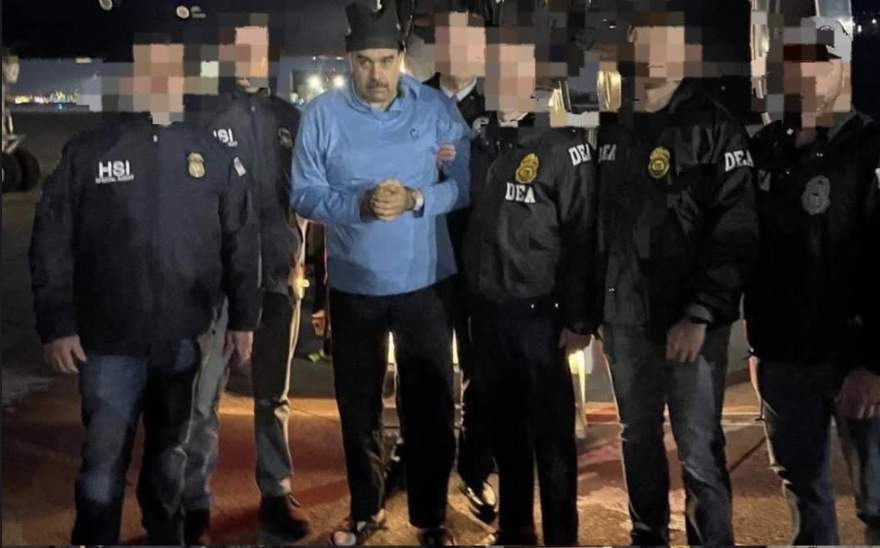
Many are wondering: could the International Criminal Court (ICC) conclude that the conduct of the United States in its attacks on Venezuelans, including suspected drug traffickers and other civilians, warrant investigation and prosecution as war crimes? But there’s another ICC-related question that deserves attention: what if the Court has a sealed arrest warrant for ousted president Nicolás Maduro?
The ICC continues to have jurisdiction over Venezuela. In 2018, a group of states – Argentina, Canada, Colombia, Chile, Paraguay, and Peru – jointly referred the situation in Venezuela to the Court. Two years later, Venezuela itself requested that the ICC investigate alleged international crimes perpetrated on its territory. The focus of the subsequent investigations by the Office of the Prosecutor (OTP) has been on crimes against humanity committed in the country, with a special focus on mass and arbitrary detention of Maduro’s opponents. Other crimes against humanity have been detailed, most recently by the Independent International Fact-Finding Mission on the Bolivarian Republic of Venezuela, and include “killings, arbitrary detentions, torture and sexual violence targeting protesters and opponents of President Maduro.”
For years now, and in line with the principle of complementarity, the ICC worked with Venezuelan officials in the hopes that national authorities would investigate and prosecute those responsible for these alleged crimes against humanity themselves. Chief Prosecutor Karim Khan visited Caracas on multiple occasions and even appeared on television with Maduro in 2024. The Court’s efforts came to naught: no one has been prosecuted for crimes against humanity committed in Venezuela. Impunity reigns.
Then came a barely reported but critical development early last December, at the annual Assembly of States Parties of the ICC: the Office of the Prosecutor announced it had decided that Venezuela wasn’t up to the task of investigating its own nationals. According to the OTP’s 2025 Annual Report, “a critical review of the viability of the complementarity efforts has been conducted, leading to the Office’s conclusion that no meaningful progress has been made by the national authorities. Consequently, in October 2025, the Office informed Venezuela of its decision to close its in-country presence by the end of 2025.”
Nothing at the ICC happens in a vacuum, and the decision to end the OTP’s presence in Venezuela suggests that the Court has been preparing for a new stage in its investigations: the issuance of arrest warrants. Among the most obvious targets: Maduro.
While Venezuelan authorities responded to the ICC’s decision by making noise about withdrawing from the Court, that has not happened and would likewise not affect the ICC’s investigations to date. It is therefore possible – though nothing more – that there is already a warrant out for Maduro’s arrest. We cannot know for sure because, in November 2025, the Court amended its regulations, ensuring that all warrants issued by the ICC will initially be sealed, and therefore not public.
So, what if there is a warrant? And what if, now that Maduro has been captured by the United States following an unlawful use of force against Venezuela, a warrant will soon be unsealed?
If an arrest warrant is made public, as a matter of standard practice, the ICC would ask that Maduro be surrendered to the ICC by the United States, to face charges of crimes against humanity. Of course, the Trump administration has been hell-bent on destroying the Court, going so far as to issue sanctions against multiple ICC prosecutors and judges. On first glance, then, it seems impossible that Washington would decide to cooperate with the Court, even if, thanks to the Dodd Amendment, the American Servicemembers Protection Act would not prevent it from directly supporting ICC investigations and prosecutions.
On the other hand, could the Trump administration so easily dismiss charges of crimes against humanity laid against Maduro by an international court? What would that say to Washington’s base, the one that insists that violating the UN Charter’s prohibitions on the use of force is justified because Maduro is so brutal? Would the White House really insist that drug trafficking is worse than crimes against humanity? Moreover, if Trump dismissed a request by the ICC out of hand, what would that say to Venezuelans with whom the U.S. must now curry favour and who are eager to see their former President – and his coterie of thugs – held accountable for the widespread and systematic crimes committed against them?
More ominous motives could also be at play in such a scenario. The purported reason that the U.S. reviles the ICC is that it cannot control its work, including that against American nationals and allies. But as I have explained in previous work, cooperation with the ICC can have the effect of shielding cooperating states from the Court’s scrutiny.
This is not to say that the U.S. would surrender Maduro. Nor is it to suggest that cooperating with the ICC would be good for the Court. On the contrary, there are some serious pitfalls to consider.
While it is not unprecedented that a court prosecute an illegally kidnapped individual for crimes against humanity (Israel kidnapped Nazi Adolf Eichmann from Argentina and prosecuted him in Jerusalem in 1961), that has not happened at an international tribunal and would be, quite reasonably, criticized by many.
In the event that the ICC had a warrant for Maduro and he was, against the odds, surrendered to the Court, it would also risk placing the institution in a position where it legitimizes the unlawful actions of the U.S. against Venezuela. Put otherwise, it could suggest that even though American forces violated the UN Charter and illegally captured Maduro, this has no bearing on his subsequent prosecution. If so, wouldn’t that, in some twisted but real way, validate U.S. action? And what effect would that have on attitudes towards the ICC beyond Washington? It is worth noting that a closer relationship between the U.S. and the Court has historically weakened perceptions of the institutions’ legitimacy and global standing.
The answers to these questions may be merely speculative. But given the real possibility that an ICC arrest warrant has or will be issued for Maduro, I doubt it. Whatever happens, the Court must be exceedingly careful. The chance at improved relations and cooperation with America may be tempting, but when someone tells you who they are, believe them. Under Trump, America has repeatedly made clear: it is no partner of justice and accountability and has no qualms about desecrating international law and its institutions.
*** An earlier version of this article stated that the American Servicemembers’ Protection Act would prevent U.S. officials from cooperating with the ICC. This is not the case, due to provisions in the 2015 Dodd Amendment.


 Justice in Conflict
Interesting post.
Correct, it may give a sense or impression of very flawed justice. Yet, from the point of view of Trump, it can be very smart:
This is because, it would divert the perception, from Maduro as victim of some sort of illegal aggression, to the real issue at hand:
Accountability.
In that, Trump would clearly show, that he meant it. Trump was preaching and sanctioning officials in Venezuela, because of illegal acts, oppression of the people etc… And now, the face of Maduro, would be revealed. Not the narrow interest of the US, but the US, as leading the global fight, for freedom.
P.S: Even if Venezuela would withdraw, it wouldn’t matter for the ICC. For, crimes committed prior to the act of withdrawal, are still valid in in the eyes of the ICC ( see the case of the Philippines for example).
Thanks
Pingback: Don’t be fooled – Netanyahu is cursing Trump’s name over the fall of Maduro | TheCritique Archives
Thank you for the reply. I agree with your point and made it in the article: “While Venezuelan authorities responded to the ICC’s decision by making noise about withdrawing from the Court, that has not happened and would likewise not affect the ICC’s investigations to date.”
My sense is that a warrant is more likely to happen than not – and we’ll have to wait and see about what the response from Washington is.
Thank you for the reply. I agree with your point and made it in the article: “While Venezuelan authorities responded to the ICC’s decision by making noise about withdrawing from the Court, that has not happened and would likewise not affect the ICC’s investigations to date.”
My sense is that a warrant is more likely to happen than not – and we’ll have to wait and see about what the response from Washington is.
trump should be held for war crimes !
This is a thought-provoking article. While the Dodd amendment gives leeway to the US to assist the ICC in bringing foreign nationals to justice, in this case I doubt Trump would surrender him to the ICC if at all there is any warrant of arrest.
Una justicia muy lenta es justicia ? Maduro y los suyos fueron denunciados ante la CPI en 2018 por crimenes de lesa humanidad. El procedimiento penal se abrió ese año, han pasado más de 7 años sin avances significativos, mientras presuntamente se siguen cometiendo tales horribles delitos. Cuantos añoa mas tienen que pasar para que se resuelva ? . Cuantos millones de venezonalos tienen que seguir sufriendo el régimen bolivariano.? Y aún en el caso de la orden de arresto, si el pais no lo entrega, como hubiera sido el.caso sin la intervención de EEUU , que pasaría? NADA. Putín tiene orden de arresto. Y que pasa, NADA. La eficacia de la CPI es muy limitada y sólo a casos de cambio de régimen, como Yugoslavia, muy lamentablemente.
Pingback: Case Explained: Symposium on Prosecuting Heads of State for International Crimes: The Tangled Legal Terrain of the Maduro Cases - Crimes Against Humanity, Drug Trafficking and the Immunity of an Alleged President - Legal Perspective - InfoFusionX