
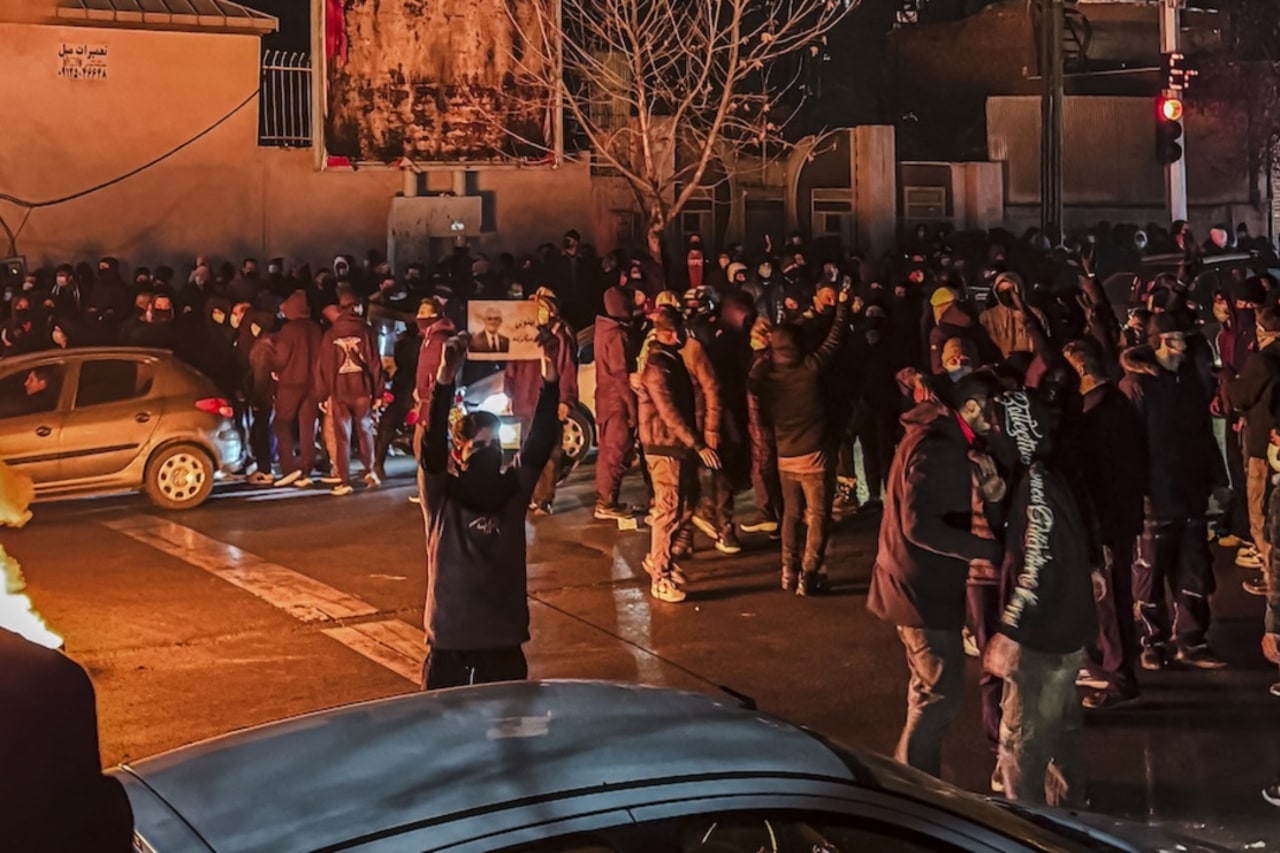
We do not know the exact number of Iranians killed, arbitrarily arrested, and tortured during Iran’s lethal crackdown on protesters – but we do know the number is staggering. Foreign citizens, including a Canadianare among those murdered by Iranian authorities. In moments of atrocity and upheaval abroad, it can be hard to know what a country like Canada should do beyond statements of solidary and concern. But there is a step Ottawa can take immediately: open investigations and prosecute Iranian regime officials who are present in Canada and who are implicated in crimes against humanity.
This is not an abstract proposal. In 2021, a Tehran police chief was spotted at a Toronto-area gym. In 2024, it was reported that 700 Iranian nationals linked to the Iranian Revolutionary Guard Corps (IRGC) resided in Canada – the same group that has been designated as a terrorist entity by the Canadian government. That same year, five Iranian regime figures faced deportation back to Iran.
Deportation? Yes. The governing Liberal government moved to send regime figures, including some involved in repression and human rights violations in Iran, back to Iran. That is also the policy of the opposition Conservative Party. Responding to the alleged presence of 700 IRGC-linked figures in Canada, Conservative leader Pierre Poilievre stated in February 2025: “We will find and deport all of the IRGC’s thugs… They will be kicked out of this country.”
In Canada, deportation is both the Liberals’ and Conservatives’ preferred approach to dealing with suspected perpetrators of mass atrocities like those committed by the Iranian regime. Successive Conservative and Liberal governments have adopted this policy without securing any guarantee that perpetrators will face consequences following their deportation. What if they go back to torture, maim, and murder? According to the government, that’s not its problem.
Sending atrocity perpetrators back to where they committed their crimes is not just irresponsible. It flouts demands for justice and risks putting more people in the cross-hairs of repressive regimes. Another option is possible.
Under the Crimes Against Humanity and War Crimes Act, Canada’s War Crimes Program can initiate investigations and prosecutions into atrocities perpetrated abroad, even when they are committed by foreign nationals against foreign nationals. This is known as the principle of universal jurisdiction. All that Canada needs is for a suspect to be present in Canada and for evidence showing that they were credibly involved in international crimes. When it comes to Iran, it is clear that the regime’s abuses – both now and in the past (including the Woman, Life, Freedom movement) – are systematic and widespread, meaning that they constitute crimes against humanity. Indeed, the United Nation’s Fact-Finding Mission on Iran has previously concluded just that.
Using universal jurisdiction isn’t new. Canadian authorities have exercised it on a handful of occasions, including in two cases related to the 1994 Rwandan Genocide as well as an upcoming trial of an alleged ISIS member, who faces charges on four counts of war crimes. In addition, Canada has opened a number of ‘structural investigations’, probes that collect evidence in contexts characterized by mass atrocities. It has one opened into the war in Ukraine and one into the “Israel-Hamas war.” But deportation is still preferred for the simple reason that it is easier and cheaper than prosecutions.
Some might argue that investigating events thousands of miles away would be too cumbersome and that getting rid of suspects, regardless of whether it puts people in harm’s way, is a better option. Others might insist prosecutions are a poor use of resources at a time when Canada faces its own endemic challenges. Neither argument is persuasive.
For one, much of the evidence of Iranian atrocities can be found in Canada and among its allies, including the witness testimony and experiences of Iranian victims and survivors. At the same time, universal jurisdiction cases increasingly rely on open-source evidence: photographs, images, and data that is stored on people’s phones and computers – sometimes of victims, and sometimes of perpetrators. Despite Iran’s attempts to shut down coverage of its crackdown, there is no shortage of open-source evidence of its atrocities. Basing cases on open-source information is also much cheaper than relying on witnesses and physical evidence.
Moreover, prosecutions of atrocity perpetrators are not only relevant to Iranians in Iran, but to those in Canada. They signal that the plight of Iranians is our common plight, and that Canada has a role to play in addressing the suffering of others. After all, crimes against humanity, as their name suggests, are crimes against all of us. It is thus in Canada’s interest not only to show solidarity with people risking their lives for democracy and the rule of law, but also their loved ones who call Canada home.
Of course, exercising universal jurisdiction does carry some risks. In 2022, a Swedish court found Iranian Hamid Nouri guilty of war crimes related to the 1988 Iran prison massacres. In response, Iranian figures detained a Swedish national and then successfully used him as bait to secure the return of Nouri back to Iran. Such hostage ‘diplomacy’ is a risk, one that needs to be carefully considered and mitigated, including by communicating clear instructions of the risks of visiting Iran to the citizens of any state mulling the use of universal jurisdiction.
Ultimately, states like Canada can do much more to support the courageous people of Iran in their plight to not only rid themselves of a tyrannical regime but hold it accountable for its crimes. Initiating investigations into Iranian regime atrocities is low-hanging fruit. The moment to do so is ripe.


 Justice in Conflict
Important post.
Just worth noting, a ruling of Canadian court (court of appeal for Ontario) where an Iranian citizen, claimed compensation for tortures he had suffered in Iran. That is a civil lawsuit, more than bit problematic in International law. But, worth reading.
Here to the ruling:
https://www.asser.nl/upload/documents/DomCLIC/Docs/NLP/Canada/Bouzari_AppealsJudgment_30-6-2004.pdf
Thanks
Thank you for the comment. You’re right that there have been such cases, including others that we successful in suing Iran for torture under the Justice for Victims of Terrorism Act. Different, but nonetheless important.
One would’ve thought smart attorneys had already learned of the Fascist covert terrorism operation run against Iran which turned peaceful protests deadly, effectively making Iran society chaotic in a similar manner to 2014 in Kiev: The Fascist covert operation which led to the murders of over 100 police and civilians, come to be known as the “Maidan Massacre”..
Unfortunately, Justice in Conflict will unlikely reference the (newest) covert operation, and unlikely post then respond to this comment.