
The following is a guest post by Sarah Nimigan, on the recent travel of Israeli Prime Minister Benjamin Netanyahu over Canadian airspace, in defiance of the ICC’s warrant against him. Sarah is a an Academic Research Associate with the Centre for Transitional Justice and Post-Conflict Reconstruction, at the Western University, in London, Ontario.
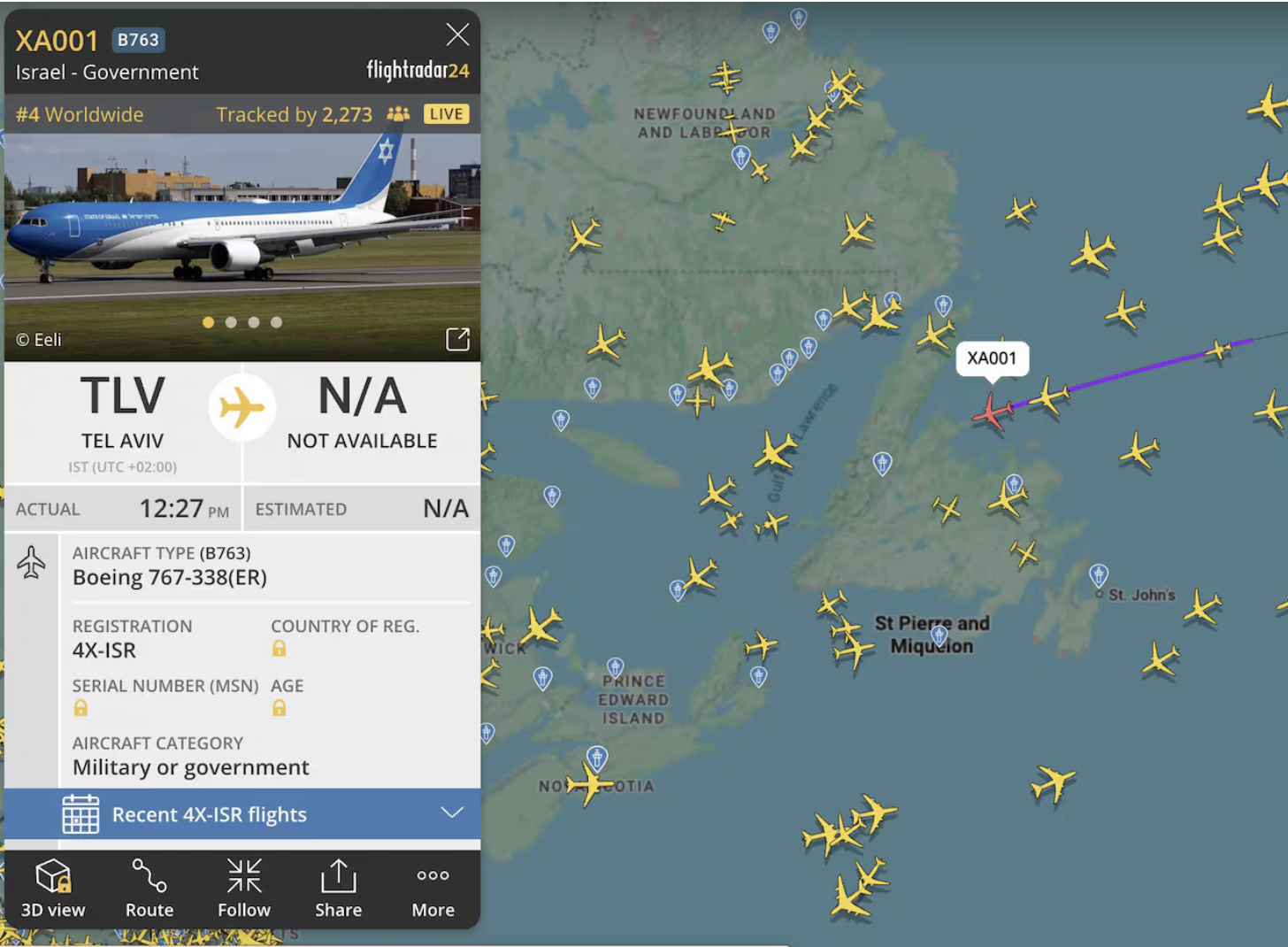
Earlier this month, Israeli Prime Minister Benjamin Netanyahu flew over three Canadian provinces on his way to Washington D.C: Newfoundland, Prince Edward Island, and New Brunswick. The failure to prevent the use of Canadian airspace and to arrest Netanyahu, led to heavy scrutiny of the Canadian government and Prime Minister Mark Carney. The obligation to arrest the Israeli leader stems from his outstanding arrest warrant by the International Criminal Court (ICC) for allegedly committing the war crimes and crimes against humanity, including starvation as a method of warfare and of intentionally directing an attack against the civilian population, murder, persecution, and other inhumane acts. When he became Canadian Prime Minister, Carney said Canada was prepared to arrest Netanyahu if he visited Canada. What happened?
The point of this post is not to debate the merits of the charges against Netanyahu. They exist and create a cascading series of obligations on the States Parties to the ICC, including Canada. What this post does is examine what would have happened if, instead of allowing Israel to use its airspace, Canada had arrested Netanyahu.
Canada’s relationship with the ICC has historically been a close one. Ottawa took a leading role in its establishment and institutional operationalization within the Court, and has had nationals occupy key roles in both the judiciary and the Office of the Prosecutor at various points since its conception. Canada demonstrated its strong commitment to the Court by not only ratifying the Rome Statute but also implementing it into domestic law, under the Crimes Against Humanity and War Crimes Act.
More generally, Canada’s global position as a middle power heralds an identity as a staunch human rights defender, which continues to shape its priorities and agenda setting in the context of its international relations. For these reasons, it is unsurprising that in November 2024, former Prime Minister Justin Trudeau pledged that Canada would arrest Prime Minister Netanyahu if he stepped foot in Canada, because “This is just who we are as Canadians.” Since taking office, as noted above, Mark Carney has maintained this position, expressly stating that he will arrest Netanyahu if he visits Canada, honoring the ICC’s arrest warrant and subsequent Treaty obligations under international law.
Despite political pressure to drop its commitment, the Canadian government has maintained, at least in its public discourse, its prioritization of international law over and above the varying degrees of political pressure to overlook it in this particular instance. But the fact remains that Netanyahu has crossed into Canadian airspace now on two occasions, once on December 29, 2025, where his aircraft flew over Newfoundland and Nova Scotia on his way to Mar-A-Largo and the most recent instance on February 10, 2026, referenced above. The Canadian government was most certainly aware that Netanyahu planned to travel through Canadian airspace, since an application must have been submitted at least three business days before entry to Global Affairs Canada. While the focus has largely been on Canada’s failure to apprehend and transfer Netanyahu to The Hague, one might question what would happen if the Canadian government actually did?
While there is a place to be critical of a government that is acting in opposition to its purported position on enforcing the ICC’s warrant, reverse engineering the events might allow for a more balanced outlook on why the decision was made to allow for Netanyahu’s safe passage through Canadian airspace for a second time in the past two months.
Given the requirement to notify Canadian authorities of the use of Canada’s airspace, the Royal Canadian Air Force would have had ample time to organize an interception/tactical response using CF-18 Hornet fighter jets. However, such interceptions are often organized and executed under the North American Aerospace Defense Command (NORAD). It takes little digging to see the problem there, since NORAD is a mutual defense organization established between Canada and the United States. Israel-U.S. relations remain strong, both economically and politically to the point that President Trump has sanctioned ICC staff over the situation in Gaza, making specific mention of Netanyahu’s arrest warrant as justification for this action.
Nevertheless, if the Canadian government were to continue down the path of interception, once the Royal Canadian Air Force unilaterally intercepted the aircraft, the Royal Canadian Mounted Police, and Canada Border Services Agency would manage any detainment and eventual transfer of Netanyahu to The Hague. This would not be a straightforward or peaceful process. It is well documented that Netanyahu travels with extensive security forces, including special teams (Shin Bet Security) and the aircraft in question, “Wing of Zion,” is fully staffed with security forces during international travel.
Any mission to arrest Netanyahu would likely compromise Canada’s relationship with the United States and could have resulted in loss of life for Canadian military and police personnel involved in the extraction. The question thus becomes do the benefits of championing the ICC and functioning as the ‘world police’ outweigh the risks of demolishing political relations with the United States and risking Canadian life in the process? Given the position of the U.S. on the ICC and its insulation of Israel-U.S. ties, the potential for escalation is unbelievably risky. Canada is stuck between a rock and a hard place. If anything, this situation is an effective illustration of what happens when the Canadian government has foreign policy objectives that directly clash with those of the United States. It also demonstrates the cleavages in sovereignty that exist directly because of Canadian codependency on the United States’ military hard power (i.e., NORAD). The reality is that hard power still matters, perhaps more than ever, and Canada has demonstrably less of it than the United States.
It is easy to understand why the Canadian government did not intercept the Wing of Zion in Canadian airspace. What is less easy to understand is why they would authorize its passage at all? This is complicated even further by the fact that Netanyahu did not return to Tel Aviv through Canadian airspace. In other words, he did not have to take this route, and it seems like a completely avoidable political windstorm for the Canadian government. When asked, Global Affairs Canada declined to comment on specific routes chosen by foreign leaders, in the interest of security. To be sure, Netanyahu is very aware that he is taking a risk by traveling over States Parties to the ICC and has detoured his aircraft to avoid doing so. It stands to reason that he had express assurance of safe passage, at least on the way into North America. If fault lines are to be drawn, it is at that stage: before authorization is provided. The Wing of Zion should not have been permitted to cross into Canadian airspace in the first place.
Canada’s decisions have direct consequences for the institutional credibility of the ICC. Ottawa contributes approximately 5% of the total budget to the Court. It becomes problematic to justify giving that much money to a Court and not fully supporting it. With that said, Netanyahu also flew over ICC States Parties Greece, Italy, and France during his February trip to Washington. It is not only the Canadian government that is experiencing this moral and practical power struggle and yet it sets a very unfortunate global precedent.
If the Canadian government finds itself in a position where it cannot fulfill its obligations under the Rome Statute, it might consider withdrawing in the interest of preserving the Court’s credibility. Otherwise, it would be logical for the government to express that Canada-U.S. relations are complicating the ability of the Government to fulfill its Treaty obligations, and the safety and wellbeing of Canadian citizens is taking priority in foreign policy agenda setting at this time. It has been argued that States Parties do more damage to the Court’s authority by remaining signatories and actively disregarding the subsequent Treaty obligations that stem from this commitment. If Canada continues to prioritize its relationship with the U.S. over international law, it would be prudent to reframe its public position on the ICC instead of jeopardizing its credibility and legitimacy going forward. Increased transparency on the part of the government would help to make sense of the moral and practical tug-of-war that choreographs the delicate dance of international relations and international law and temper expectations in the future.


 Justice in Conflict