
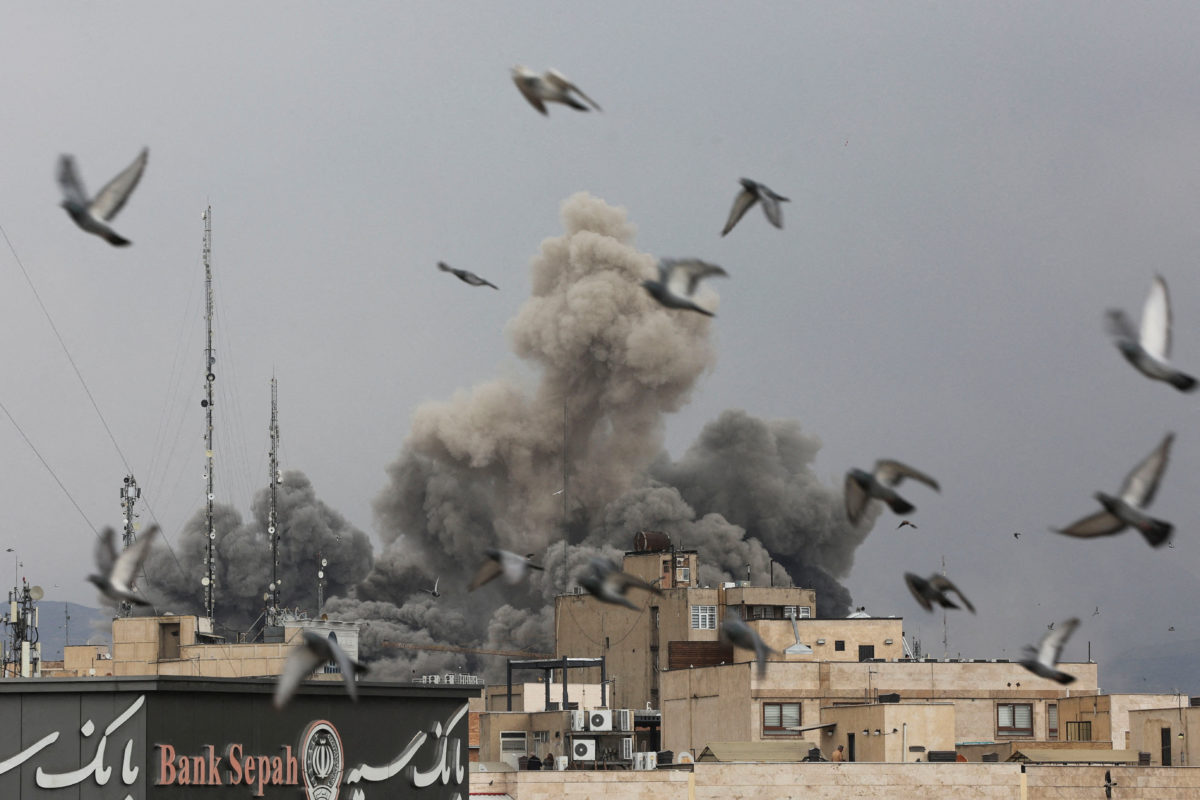
In response to U.S. and Israeli attacks on Iran, the Canadian government declined to defend the United Nations Charter and its prohibitions on the unlawful use of force under Article 2(4). Statements by Prime Minister Mark Carney and Foreign Minister Anita Ananda did not even refer to international law’s relevance to the growing conflict in the Middle East. Their reaction left former Foreign Minister Lloyd Axworthy so exasperated that he said Mr. Carney was “abandoning” Canada’s commitment to preventing aggressive war. He added that Canada was “simply endorsing Trump’s sort of new obsession with becoming an imperial power… the worst kind of situation for Canada.” Axworthy is right. But the truth is, Canada has long been a laggard in denouncing acts of aggression. Against the backdrop of threats to not only its adversaries, but to its allies and Canada itself, it’s time for Ottawa to change tack.
First, though, let’s be clear: while the Iranian regime is beyond the pale in its cruelty and disregard for human rights, the strikes on Iran were manifestly illegal. Neither justification for war – self-defence or UN Security Council approval – were met. There’s no evidence that Iran posed any imminent threat, and the rationale of “pre-emptive” strikes on Iran is word salad for illegal attacks. This is not controversial, but the consensus of international lawyers. As Marco Milanovic explains, “It simply cannot reasonably be argued that these strikes are lawful under the Charter… The violation of the Charter here is simply as plain as it could possibly be.”
It thus appears that Canada’s government has cheered on an act of aggression, the illegal commission of war by one state against another.
At the Nuremberg Trials, former Nazi leaders were charged with the crime of aggression. In the wake of the horrors of WWII, aggression was famously called the “supreme crime” because other atrocities – war crimes and crimes against humanity – were precipitated by Germany’s illegal invasion of neighbouring states.
The logic here extends to modern conflicts. Russia’s invasions of Ukraine – in 2014 and 2022 – laid the groundwork for countless war crimes, crimes against humanity, as well as allegations of genocide. Only because Moscow invaded Ukraine could Russians perpetrate atrocities – including the theft and illegal transfer of Ukrainian children to Russian families. The atrocities that flowed from those invasions are of such gravity that the International Criminal Court (ICC) issued warrants against Russian officials, including President Vladimir Putin.
But the ICC could not prosecute Russia for the crime of aggression. Why? Because states like Canada did not want it to have that ability. Between 2010 and 2017, Canada was among a group of states that sought to sink any meaningful definition of the crime of aggression under the treaty that governs the ICC, the Rome Statute. Ultimately, they were successful: if an invading state – say Russia, Israel, or the United States – is not an ICC member-state, the Court is powerless to act to address aggression.
Why would Canada do such a thing? In justifying its position, Ottawa insisted that a more robust definition of aggression would prevent states from organizing military interventions motivated by the desire to protect civilians from mass atrocities by their own governments. In all my years working in international law, I have never met anyone convinced that a humanitarian intervention would fall under the ICC’s definition of the crime of aggression.
In the background of these developments, Washington’s influence was palpable. At some of the negotiations on defining the crime of aggression, the U.S. sent the largest delegation, despite not being an ICC member-state. America’s legacy in Iraq and its embrace of double-standards in international law further complicated efforts at addressing the illegal invasion of states, including Ukraine. The position of Washington, Canada, and others won the day; the ICC was rendered feckless in the face of aggression.
One result? Putin’s invasion of Ukraine presented the world with a textbook case of the crime of aggression and no permanent international court available to investigate or prosecute it, so states have had to spend enormous resources and time to set up a separate ad hoc court to do so, via the Council of Europe.
It’s time for Canada to adopt a new approach, not just because it’s the right thing to do but because, against the backdrop of threats to the sovereignty of our allies in Ukraine, Greenland, Taiwan, as well as Canada itself, it is in our collective interests to be clear: illegal war is wrong.
To come out more strongly against aggression, Canada will have to muster the courage to break from Washington. That may not be easy, but it is necessary and more important now than ever. As Bec Hamilton has noted,
In the face of Trump’s wide-ranging threats and actions against any who oppose him (tariffs, territorial seizure, invasion and leadership abduction), it is hardly surprising that States like Canada might pull their punches… [T]he costs of standing up for the UN Charter at this moment are high. The trouble is, the long-term cost of giving up on Art 2(4) of the UN Charter may be even higher.
It would be wrong to believe that Canada can’t stand up for international law and up to the United States. It has done so before, including when it declined to participate or endorse the illegal war in Iraq (itself an example of the crime of aggression) and more recently, when it broke with the United States in recognizing Palestine as a state. Defending the UN Charter also does not require Canada – or any state – to abandon solidarity and commitment to the human rights and dignity of oppressed peoples. As Alex Neve writes,
We can be fierce champions of democracy and human rights in Iran while, at the same time, firmly rejecting unilateral and unlawful military action by one state against another. Both are, after all, grounded in the same values and the same vision for humanity. Both take us in the same direction.
Standing up to American hypocrisy is what many thought Canada would do when Mr. Carney declared at Davos that “Canada was amongst the first to hear the wake-up call, leading us to fundamentally shift our strategic posture,” and that it would be “principled in our commitment to fundamental values, sovereignty, territorial integrity, [and] the prohibition of the use of force, except when consistent with the UN Charter”. Some Liberal members of parliament in Mr. Carney’s government also believed those words. Will Greaves, for example, has broken with Ottawa’s position on international law and the strikes on Iran in stating that:
Canada cannot endorse the unilateral and illegal use of military force, the killing of civilians or the kidnap and assassination of foreign heads of government while also insisting that our sovereignty, our rights and our independence must be respected. If, as the prime minister said at Davos, the old order is gone, then Canadians deserve to know what replaces it. What are our red lines? Which principles guide us? And in moments when the world is most dangerous, how do we avoid sliding into automatic alignment with countries that we can no longer trust and which do not have Canada’s interests in mind?”
It’s not too late to do the right thing; it never is. Prime Minister Carney and Foreign Minister Anand can and should clearly and unequivocally state that international law always applies and illegal war is always wrong, whether committed against friends or foes. After all, the legality of military strikes is not based on whether the targeted state is an ally or adversary, just as the lawfulness of murder isn’t determined on the basis of the likeability of the deceased.
The illegal attacks by U.S. forces on Venezuela earlier this year didn’t end there, and there is no reason to believe the attacks on Iran will be Trump administration’s last act of aggression. Who is next? Turkey? Cuba? Greenland? Canada itself? If Ottawa cannot denounce illegal war now, what will it say then? Out of both principle and pragmatism, it is in Canada’s interest not to wait, but to speak in favour of international law now.


 Justice in Conflict