This article is a critical assessment of the scholarship and current state of the so-called “peace versus justice” debate. It is largely based on findings from my new book, which seeks to assess the impacts of the ICC on ending wars and building peace. The article was originally posted at International Criminal Justice Today, an an online magazine operated by the American Bar Association and Stanford Law School. I am grateful for the opportunity to write for their publication and to work with their wonderful team, especially Beth Van Schaack, Kip Hale, and Allen Weiner.
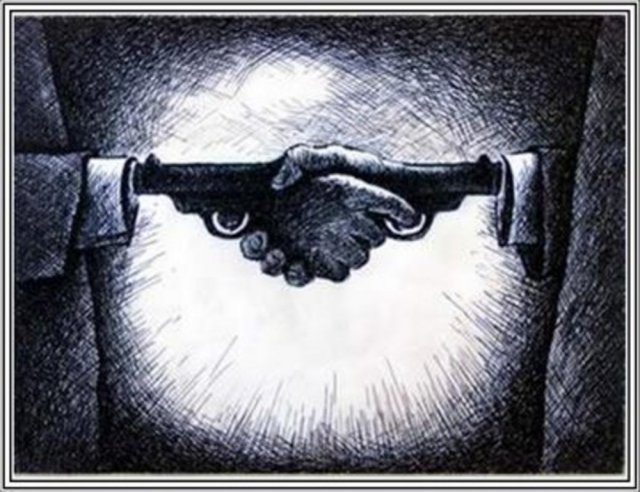
(Image: Dudelol)
Few debates in international justice are as important yet inspire as much disagreement as the debate about the relationship between peace and justice. Should justice be pursued in response to mass atrocities when conflicts are still ongoing or when wars have only been recently concluded? Should peace and justice go hand-in-hand or should justice always follow peace? Does a moral, legal and political obligation to victims and survivors who demand accountability trump the possibility that justice may complicate conflict resolution? Will bringing perpetrators of mass atrocities to justice ultimately help or hinder efforts to build and maintain peace?
These questions arise in the so-called “peace versus justice” debate, which has gained notoriety with the establishment of the permanent International Criminal Court (ICC) and increasing expectations that international criminal justice institutions will act as ‘first responders’ in emerging conflicts. Almost fifteen years have passed since the creation of the ICC, yet it remains difficult to maintain that we’re much closer to a conclusive verdict as to the relationship between international criminal justice and the pursuit of peace. Every time reports emerge that the ICC might become active in an ongoing and active conflict, both sides of the peace-justice debate rehash and recycle their claims: the Court will ruin any prospects for peace or, without the Court, meaningful peace is a pipe dream. The current state of the debate needs fresh thinking and a renewed appreciation of the complexity of issues at play when the ICC investigates and prosecutes belligerents in active conflicts. Focusing so singularly on the ICC’s effects at the expense of the broader political factors and conflict dynamics at play has entrenched rather than alleviated the harshly dichotomous nature of the peace-justice debate. There is a need to see the forest for the trees.
So what, if anything, have we learned about the ICC’s impact on conflict resolution and peace-building? In this brief article, I would like to assess some of the challenges confronting a more accurate and nuanced understanding of the ICC’s effects on peace and then offer some thoughts stemming from my own research on the peace-justice debate, recently published in a book entitled ‘Justice in Conflict – The Effects of the International Criminal Court’s Interventions on Ending Wars and Building Peace’.
There is no doubt that the International Criminal Court is a unique entity. It is, at once, both an international organization, whose existence and operations depend on the support of states, and an international court with a mandate to pursue justice for the worst crimes known to humankind. As such, it treads — often uncomfortably — at the nexus between politics and law. Its staff insist that the Court’s involvement in conflict situations are merely an expression of its legal mandate. It does not practice politics. This position plays down the controversial role of the Security Council in issuing highly-politicized referrals of situations to the ICC in response to breaches of the peace — most notably by prohibiting the ICC from investigating citizens of non-member states, of which there are three on the Council (China, Russia, and the US). This mantra also lies at the heart of how the professionals that make up the ICC see their role in contributing to peace. Former chief Prosecutor Luis Moreno-Ocampo and current Prosecutor Fatou Bensouda have insisted that there must be a division of labour between the pursuit of justice and the pursuit peace. The Court is responsible for the former; other institutions, like the United Nations Security Council, are responsible for the latter. At the same time, however, they insist that there cannot be a credible or durable peace without justice and that, in cases in which the ICC has influenced a peace process, as in northern Uganda, its impacts have been positive. This contradictory posture — that peace is none of the ICC’s business, but peace is impossible without the Court — belies a significant problem: no one in the ICC’s Office of the Prosecutor (OTP) or any other organ of the Court systematically assesses the institution’s impact on peace processes.
To those who view international criminal justice processes as having a role to play in atrocity responses and prevention, it remains frustrating that the ICC itself does no stock-taking of the impact it has on the conflicts in which it intervenes. As a result, whatever the ICC learns from its previous interventions depends wholly on the feedback it receives from third-parties — diplomats, NGOs, and academics. The Court’s staff may argue that this is not part of their mandate. However, this is a spurious claim. The ICC consistently speaks of its indispensability in establishing peace. It also regularly creates roles for itself outside of its strictly judicial purview, such as strengthening the ability of domestic judiciaries to prosecute international crimes themselves.
Another possible reason for the Court’s reluctance to stock-take its impacts is likely to be that the institution doesn’t have sufficient resources to dedicate to such stock-taking. This too is unsatisfactory. If resources are the problem, the Court can and should push for additional funding from member-states. There is nothing costlier to the legitimacy of the Court than repeating mistakes and feeding the acrimony of those who believe the ICC has no place operating in ongoing conflict situations in the first place. Learning how the Court affects conflict and peace processes isn’t just about making peace more likely or justice less disruptive; it also holds the promise of making the pursuit of accountability more effective and efficient.
There is also a danger in relying on third parties to understand how the ICC affects peace and conflict processes, namely that it permits the avoidance of inconvenient truths by fostering a cherry-picking attitude to evidence. Much research on the peace-justice debate continues to occlude rather than elucidate the effects of the ICC. This is true of studies that critique the Court’s ability to contribute positively to conflict resolution and peace as well as those that seek to lend credence to the Court’s virtues.
Many of the ICC’s critics often recycle intuitive but speculative claims, insisting that any and all targets of the ICC will inevitably “dig their heels in” and have little choice but to fight to the bitter death. In doing so, these detractors reduce all actor types — heads of state, senior officials, rebel commanders, militia leaders, and the various rank-and-file — to the same, basic set of incentives towards the ICC and resolving the war in which they act as belligerents. Reducing complex and different types of actors risks severely over-simplifying the psychology and incentives of warring parties. A rebel leader like Joseph Kony of the Lord’s Resistance Army is not the same kind of actor as Muammar Gaddafi, the former head of state of Libya. Yet critics assume that they follow precisely the same logic: if the all-mighty ICC targets them, they will fight to the death and never agree to peace. Continue reading →




 Justice in Conflict