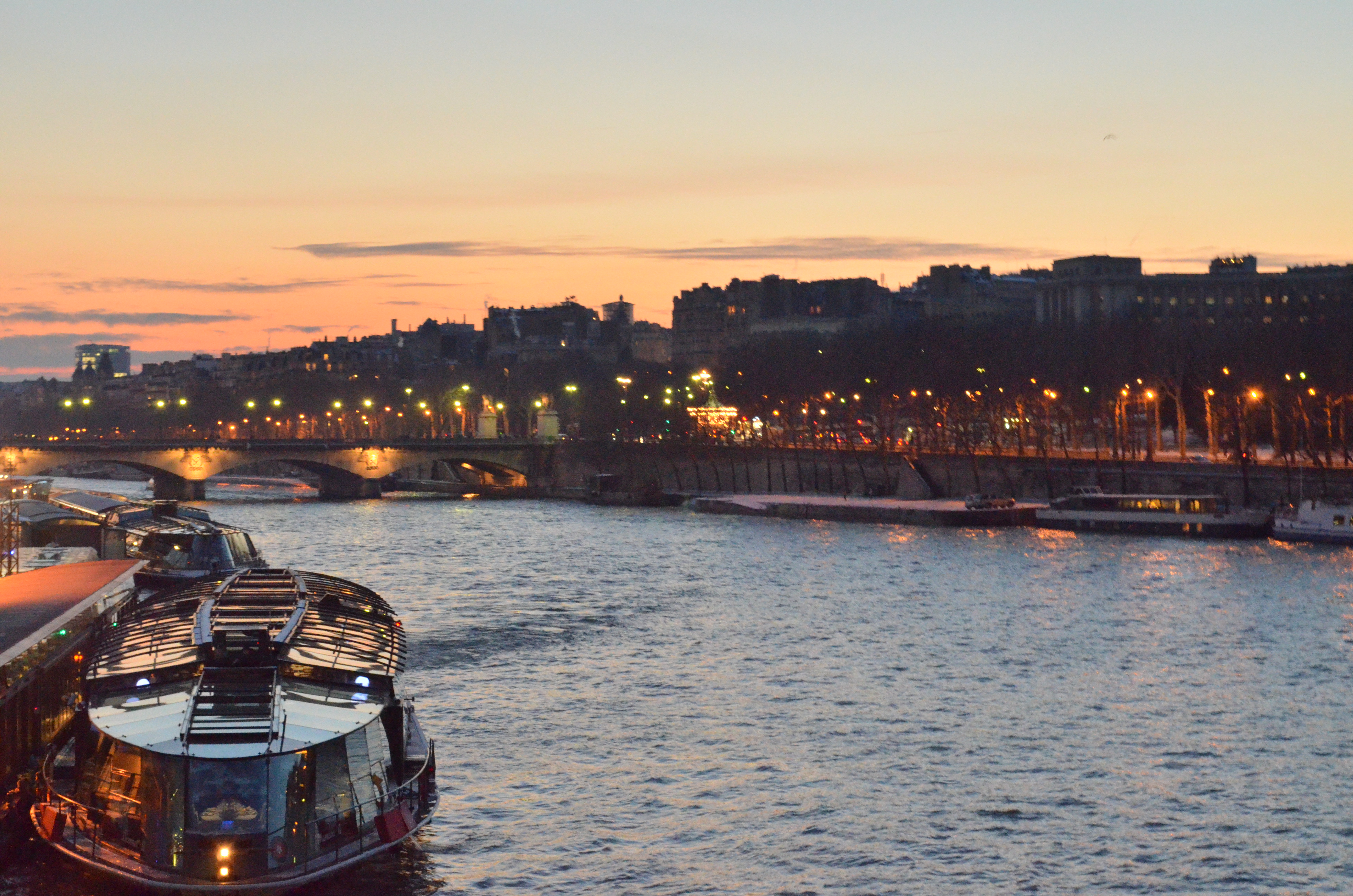
The Seine. Photo credit: Terrence Peterson
Did you know that in 1961, French police massacred more than 100 Algerians as they demonstrated peacefully in the center of Paris?
If you didn’t, it’s not surprising. Even in France, the event has been obscured by decades of official silence. It doesn’t appear in history books and the exact death toll remains uncertain.
The facts, as we know them, are these: On October 5, 1961, following attacks on the Paris police by FLN separatists, a curfew was imposed on North Africans living in the city and its suburbs. When some 40,000 protesters poured into the streets on October 17, the police cracked down. Their chief, Maurice Papon (note: Papon was later convicted of crimes against humanity for his role in the Vichy government’s deportation of Jews to concentration camps during WWII) allegedly ordered his men to take brutal measures. At least 100 people were slaughtered; shot to death in the streets of central Paris, tortured and killed in the courtyard of the police prefecture, or pushed into the Seine to drown.
And then, for decades, no one spoke about their deaths. It was 51 years before the French government formally acknowledged the massacre. But in the aftermath of the November 2015 Paris attacks, many are looking back to 1961, the last time France imposed a state of emergency.
To get some context, I turned to Terrence Peterson, a historian (Ph.D., University of Wisconsin 2015) and expert on the French war in Algeria. Terry’s book project, Keeping Algeria French: Counterinsurgency, Development, and Colonial Utopianism, 1955-1962, explores and contextualizes French efforts to remake Algerians in the image of Frenchmen. He’s therefore the perfect person to talk to about this (and his office is conveniently right next door to mine at CISAC). Here is our conversation, edited for length and clarity:
KCF: First of all, why is this massacre relatively unknown?
TP: Perhaps the most important reason why the massacre remained so shrouded in mystery for so long was simply the French government’s refusal to talk about it. The Parisian press covered the events, and the National Liberation Front (FLN) which was fighting for Algerian independence certainly made efforts to publicize the violence. But French administrators categorically denied the massacre had taken place, and they kept archives related to the matter locked down. The number of Algerians killed is still uncertain for that very reason.
KCF: So how do we know about it at all, then?
TP: It wasn’t until a historian named Jean Luc Einaudi published the first really in-depth investigation of events in 1991 that the public really became aware of events. And even then, public awareness was highly politicized: debate really began in earnest in 1999, only after Maurice Papon sued Einaudi for libel. After that, 17 October became a potent symbol for state violence against Algerians, but because of that it has remained a really sensitive topic.
KCF: Was the massacre a one-off event, or is it indicative of a broader pattern of treatment of Algerians in France during this period?
TP: The 17 October massacre was unique within metropolitan France in the scale of violence: Police in Paris killed somewhere between 120 and 200 Algerians, and imprisoned another fourteen thousand in detention centers around the city in the days following.
KCF (interrupting): I’m sorry, did you just say the French government put thousands of Algerians in detention camps? Continue reading



 Justice in Conflict