
Shehzad Charania, Legal Advisor and Head of the International Law Team for the British Embassy in The Hague, joins JiC once again, this time for an interview with ICC Registrar Herman von Hebel. Shehzad spoke to von Hebel about why he had wanted the be Registrar, his experiences of working at the other international criminal courts and tribunals, the unique challenges within the ICC Registry, his hopes for the Court, and his own plans within it.
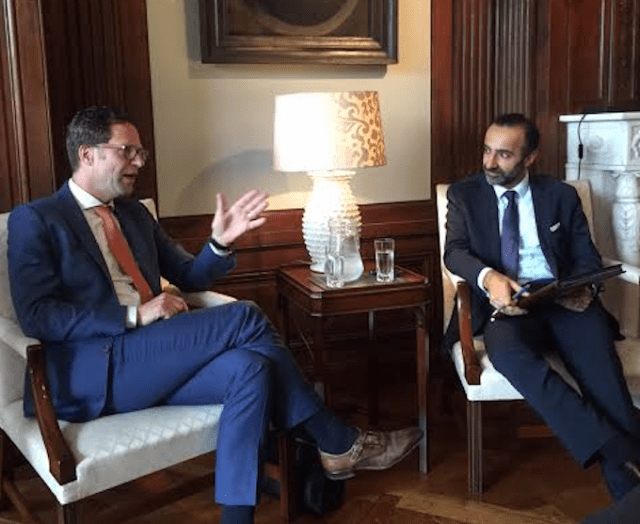
ICC Registrar Herman Von Hebel speaks with Shehzad Charania
Why did he want the job?
I began by asking about his motivations for taking on his current role. The Registrar recalled that he had been part of the Dutch delegation dealing with ICC matters from 1995, continuing through to the Rome Conference in 1998. After this, he spent time working at the International Criminal Tribunal for the Former Yugoslavia (ICTY), the Special Court for Sierra Leone (SCSL) and the Special Tribunal for Lebanon (STL). He could see similarities and differences between, on the one hand, his roles at the other courts and tribunals, and,on the other, the ICC. He wanted to bring the experience he had gained in these other institutions, as well as the Dutch Ministry of Foreign Affairs, to the ICC, in order to address the ICC’s unique challenges. When he interviewed for the job of ICC Registrar, he had focused on the need for reform, and an overhaul of the existing structure.
Law or administration?
I asked why having spent so much of his early career – in particular with the Dutch Foreign Ministry, and the ICTY as Senior Legal Officer – dealing with the purely legal and judicial aspects of international criminal law, he had decided to move to the administrative side of the work of the legal institutions. The Registrar felt that the shift wasn’t so great. Law and diplomacy continued to be a central part of his current job, as they were in his previous roles. He needed to exercise his legal muscles on a daily basis. He did not consider the role of Registrar as a purely administrative job – of course, it was a major part, but there was also a significant focus on issues of leadership and forging a common vision.
Previous Registrar jobs
In terms of the differences between his jobs as Registrar at the STL and SCSL, and the ICC, the ICC stood out as being radically different from the others. The STL and SCSL, as well as the ICTY, had focussed on a single situation, be it Lebanon, Sierra Leone or the former Yugoslavia. This determined the organisational structure, and the way those institutions functioned. The ICC’s global reach had a huge impact on the way it was set up: it was almost a set of “mini-tribunals”, each dealing with a different country situation. The external governance structure of the various courts was also different. For example, to finalise the ICTY budget, the Tribunal had to go to New York every two years and answer the questions of the Advisory Committee on Administrative and Budgetary Questions for a week. After this, they presented their proposal to the UN Fifth Committee. With the STL and the SCSL, as Registrar he had to present his budget proposal to a Management Committee of ten and six members respectively. None of these relationships were as labour intensive as within the ICC, where the Court had to deal with the Assembly of States Parties (ASP), its Bureau, The Hague and New York Working Groups, and the various facilitations. His experience of the different governance structures made him question whether the current relationship between States Parties to the Rome Statute and the Court was the right one. After all, the ICC was not just another international organisation in the same mould as the United Nations or the Organisation for the Prohibition of Chemical Weapons. The ICC was a court of law, bound by the Rome Statute and the mandate encapsulated within it.
The ICC website
One of the specific issues the Registrar had said he wanted to tackle when he was first elected was the ICC website. On this, progress was being made. There had been a number of technical and design issues to tackle. But he had received positive feedback from a number of stakeholders on test versions of the new site. He was hopeful of a launch in early 2016, after the Court had moved to its new building.
The Revision Project
We then moved on to talk about the “ReVision project” – the Registrar’s reorganisation of the Registry. The Registrar was adamant that his decision to undertake the project had been the correct one, despite the challenges he has faced since the work began. When he arrived at the Court, it was clear that the Registry was not functioning as well as the Registries in the other international courts he had worked in. This was reflected in ASP resolutions, reports of the ASP’s advisory body the Committee for Budget and Finance (CBF), and the 2013 report of Price Waterhouse Coopers on the organisational structure of the Court. He considered it an obligation to deal with the issues identified; he would rightly have been criticised if he had not taken action. And even though the ReVision project was almost complete, there was still work to do: on the management structure, ensuring all staff shared a common vision, the budgetary process, working even more closely with the other organs of the Court, building a single, internal case law database, and putting in place adequate performance management systems. Continue reading








 Justice in Conflict