
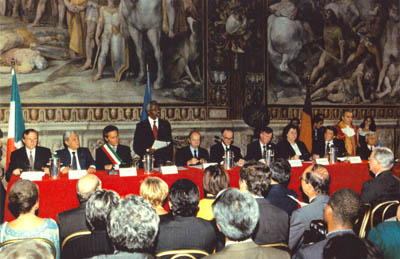
Press conference during the Rome Conference at which the ICC Statute was adopted
Nobody could know for certain how the International Criminal Court would work in practice when the Rome Statute was adopted in 1998. The first surprise was the speed at which the Statute was ratified by the 60 states necessary for the treaty to enter into force. The required number of states parties was reached already on 11 April 2002. Another surprise was how fast the ICC was confronted with its first cases and the way these cases were referred to the Court. The first three situations in Uganda, the Democratic Republic of Congo and the Central African Republic were so-called self-referrals; they were referred to the Court by the respective states themselves. The Rome Statute is not explicit about the possibility of these self-referrals (see Article 14). The modus operandi for state referrals foreseen in the Rome Statute was rather one of states parties referring cases of other states parties to the court. For a helpful discussion of the legal issues arising from these self-referrals please refer to this article by Payam Akhavan.
The emergence of self-referrals as an unexpected trigger for ICC investigations has led to some problems. This is particularly true as the Chief Prosecutor encouraged these self-referrals to obtain state cooperation. The fact that a state invites the ICC to investigate crimes committed on its own territory might raise questions concerning the ICC’s independence if these investigations are not handled extremely carefully. After all, why should a state invite the ICC to investigate if this entails negative repercussions for the very government which invited the Court? The suspicion that the government in question has cut some kind of deal with the ICC is quite natural for those who do not trust the independence of international institutions. Unfortunately, Uganda is a case in point for the problems that arise from self-referrals.
First of all, the Chief Prosecutor took the unfortunate decision to announce his investigations in Uganda side by side with the Ugandan President, Yoweri Museveni, despite the national army and the government being accused of having committed atrocities during the Lord’s Resistance Army conflict in northern Uganda. This led to immediate doubts about the independence of the ICC among the local population. Many thought that the ICC was indeed a tool for the Government of Uganda to mobilise international support against the LRA. The Chief Prosecutor quickly declared that he is independent in his investigations and would investigate all parties in Uganda, a statement that did not convince the local population.
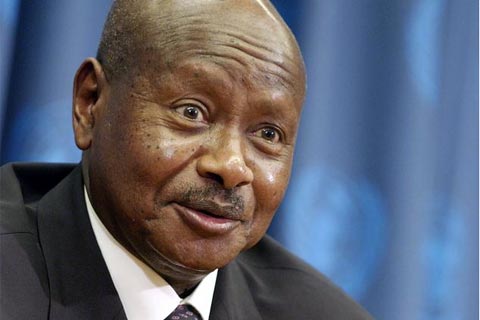
Uganda's President Museveni took the decision to refer the LRA conflict to the ICC. UN Photo / Mark Garten
The initial mistake of announcing investigations at the side of one of the conflict parties could have been redeemed in the course of the investigations by showing that the ICC is committed to thoroughly investigate both parties. Unfortunately, the Office of the Prosecutor (OTP) has so far largely failed to convincingly demonstrate that it has indeed investigated allegations against the Uganda People’s Defence Forces (UPDF) and the Government of Uganda. To be fair, the situation in northern Uganda is highly complicated and it is not an easy task to carry out independent investigations that satisfy the local population in this context. First of all, some of the most serious atrocities the UPDF is accused of having committed took place in the late 1980s, when the UPDF was still the National Resistance Army (NRA). There were extensive human rights violations in northern Uganda when the NRA moved to the north in pursuit of the remnants of Milton Obote’s army, after taking power in Kampala. Additionally, there were reports of extensive cattle rustling, extrajudicial killings, beatings, rape, torture and some massacres committed against the civilian population that was seen as being supportive of the former army chased out of Kampala by the NRA. The most notorious massacre attributed to NRA forces during that time is the Mukura Massacre during which the NRA allegedly herded civilians into train wagons which they later set on fire. It has taken the ICC a lot of work to explain to the local population that the Rome Statute only allows investigations of crimes committed after July 2002 and that those massacres can thus not be investigated by the ICC (see Mark’s earlier post on this). Continue reading









 Justice in Conflict