
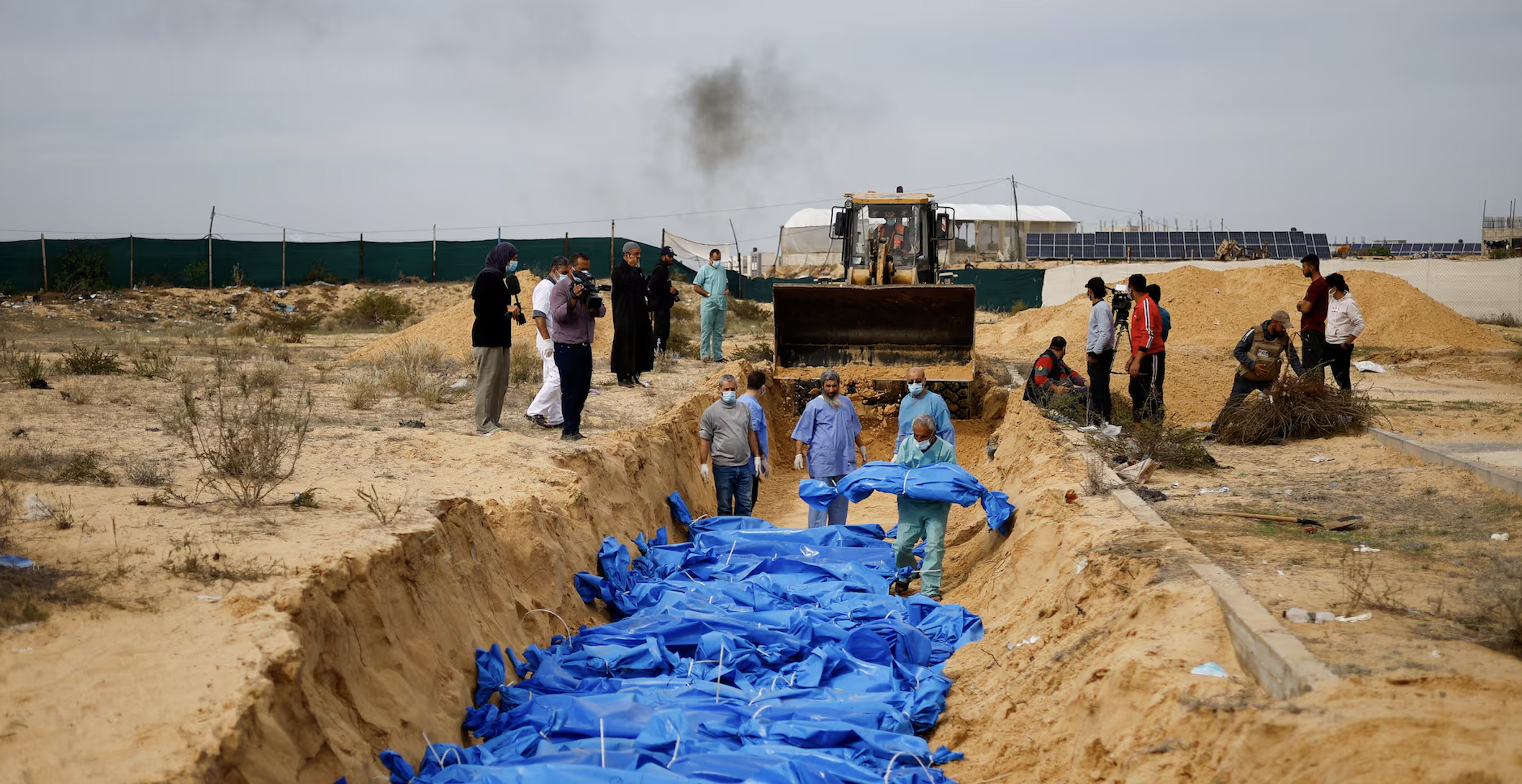
In late September 2024, a container was brought into Gaza from Israel on a truck. Inside were the bodies of eighty-eight Palestinians killed during Israel’s offensive on the Gaza Strip. Who were they? No one appeared to know and those who knew weren’t willing to provide an answer. Palestinian health authorities refused to accept the bodies or bury them until someone told them who they were and why they had died.
Whoever these bodies belonged to or what they had done in life, they were someone’s son, someone’s husband, and someone’s father. Those someones deserve to know the fate of their relatives. That their right to know is refused may form part of a crime against humanity.
Enforced disappearances are perpetrated in virtually every conflict in the world marked by mass atrocities. The UN Working Group on Enforced or Involuntary Disappearances has catalogued tens of thousands of cases of disappeared persons. The UN says that such disappearances are used “as a strategy to spread terror within the society,” aimed not only at close relatives but “their communities and society as a whole.”
Enforced disappearances typically begin with an arrest, abduction or detention by secret police, militaries, or militias working for a government. Detention is often, although not always, followed by torture and death. What makes the cruelty of enforced disappearances unique is that family and community members of the disappeared are left in the dark as authorities refuse to disclose the victim’s fate or whereabouts.
Where are they? Are they alive? If they were killed, where are their bodies?
Not knowing is devastating. It creates what Pauline Boss has called ‘ambiguous loss’, a brutal, gnawing sense of unknowing that emanates from the refusal of authorities to tell the truth.
It is because of these effects that relatives – and not just the disappeared person – are considered victims of enforced disappearances. Enforced disappearances are also considered a continuous human rights violation. The offence continues until the person is returned, or their fate is shared with family members. No statute of limitation applies. And when committed as part of a widespread or systematic attack, enforced disappearances are a crime against humanity, for which the International Criminal Court (ICC) has jurisdiction.
In Palestine, enforced disappearances have been a prominent feature of violence over the past year. According to one report, since 7 October, “tens of thousands have disappeared in Gaza, their whereabouts unknown to their relatives or friends.” The International Committee of the Red Cross has engaged with the families of 9,444 Palestinians who have been reported missing. The UN Office of the High Commissioner for Human Rights says that along with mass detentions, thousands of Palestinians may have been disappeared by Israeli forces in northern Gaza alone.
The disappeared include men, women, and children.
In July 2024, Amnesty International called on Israel to end its practice of arbitrarily and indefinitely detaining Palestinians incommunicado. The human rights organization “documented the cases of 27 Palestinian former detainees, including five women, 21 men and a 14-year-old boy, who were detained for periods of up to four and a half months without access to their lawyers or any contact with their families”. The organization added that a specific law, the Unlawful Combatants Law, has enabled the enforced disappearances of Palestinians.
While not a state, there is also a case to be made that Hamas, as a political organization, has perpetrated enforced disappearances as a crime against humanity. Some of the hostages that were taken on 7 October have been killed. Their bodies have not been returned. Other hostages have not been heard from. Their families are left in anguish, not sure when or even if they will be able to see or bury their loved ones.
This snapshot suggests that there are grounds to believe that both Palestinians and Israelis have been subjected to enforced disappearances on both a widespread and systematic scale – the hallmarks of a crime against humanity. The ICC must act.
When the ICC chief Prosecutor Karim Khan requested arrest warrants for Israeli Prime Minister Benjamin Netanyahu and Defence Minister Yoav Gallant, along with three Hamas leaders (two of whom have since been assassinated by Israeli forces), he chose not to charge any of them with enforced disappearances. This is perhaps not surprising. Despite its ubiquitous relevance in armed conflicts, no international court has ever prosecuted enforced disappearances as a crime against humanity. It is time to finally do so.
There is another reason why the ICC should examine enforced disappearances in Gaza: the rights of the dead. Under the laws of armed conflict – international humanitarian law – the bodies of the deceased must be treated with dignity. This is a right of the dead but also one that also extends to their loved ones: they have the right to know that the bodies of their sons, daughters, fathers, mothers, husbands and wives will be treated with respect and care. But the commission of enforced disappearances denies all of that, leaving families adrift, the truth denied in order to prolong and deepen their suffering.
The ICC is limited in what truths it can reveal. It won’t help return Gaza’s missing and disappeared. But it will put perpetrators on notice and signal to people around the world that enforced disappearances cannot and will not be tolerated. They are a crime against the direct victims, families, and indeed – as a crime against humanity – a crime against all of us.


 Justice in Conflict
Yes, Hamas goes to war with Israel, and they embed themselves throughout the entire population of Gaza, turning all of Gaza into a war zone, putting every life at risk. Hamas spends billions in their terrorist operations and nothing to protect the people of Gaza.