
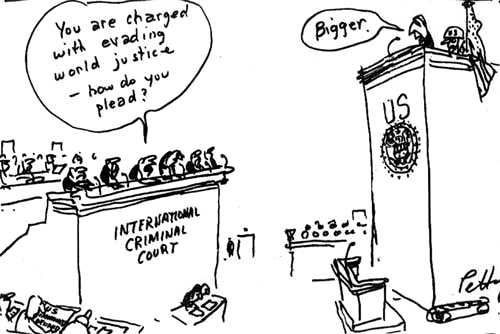
The world’s only permanent international tribunal mandated to prosecute war crimes, crimes against humanity, and genocide is facing its greatest challenge to date. With the incoming Trump administration and sanctions looming over the Court and its staff, a simple question looms: can the International Criminal Court (ICC) survive the next four years?
I ask this question after attending the Assembly of States Parties of the ICC, the yearly diplomatic conference of the Court’s member states. The gathering took place as dark clouds gathered – both figuratively and literally – over The Hague, where the ICC is headquartered. Sanctions are coming, and maybe sooner than later.
It has emerged that the U.S. may not wait for Trump to be inaugurated before sanctions are issued. Instead, Republicans may attach sanctions to the National Defense Authorization Act, the bill that lays out Washington’s yearly defence budget and expenditures.
The hope among proponents of the Court is that the sanctions will target senior officials at the Court and not the Court itself. The ICC can withstand sanctions against a few of its staff. But if the sanctions are issued against the institution, they are likely to have a much larger – and worse – impact. How could ICC investigators and officials travel? How would the court pay its staff if the banks and financial institutions it uses fear being found uncompliant with the sanctions? Could judges even use Microsoft Word to write their judgements?
This is not the first time the Court has faced U.S. sanctions. In the last months of the Trump administration, sanctions were issued against a few staff members, including then-chief Prosecutor Fatou Bensouda of The Gambia. But now the Court – and its supporters – are staring down the barrel of four years of coercive measures from Washington. And even if the sanctions are targeted against specific ICC staff, they will expose familiar discriminatory and racist thinking within the Trump administration: ICC staff from Western allies are much better positioned to persuade Trump to exclude their citizens from sanctions than those of the Global South.
The challenge the Court faces is acute. It must somehow avoid further escalation with the U.S. while maintaining its independence and, all the while, avoid normalizing or legitimizing Trump.
At this juncture, it is difficult to imagine how this is possible. Consider the following trajectory: in the coming weeks, the Trump administration issues sanctions for senior ICC staff. The Court does what it should do and insists that it will remain undeterred. Member-states rally behind the institution. The Court’s work continues, and the Prosecutor requests an arrest warrant for Israeli National Security Minister Itamar Ben-Gvir over war crimes and crimes against humanity committed in the West Bank. The move is celebrated by much of the world as the right – and obvious – thing to do for an independent court. But an upset White House escalates, issues new sanctions against the ICC as an institution, and goes a step farther, demanding that unless its allies also sanction the Court, it will impose 30% tariffs on trade with them.
The above scenario is entirely plausible. American Senator Lindsey Graham has already claimed that the likes of Canada, France and Germany should be sanctioned for supporting the ICC. Would the Court be able to withstand such pressures? Would its member-states?
The ICC has previously withstood interference in its work from Washington, especially during its early years when it faced the hostile administration of President George W. Bush. America eventually realized that the ICC posed little or no threat to its interests when it targeted the likes of the Lord’s Resistance Army leader Joseph Kony or Sudan’s President Omar al-Bashir; on the contrary, American interests were undermined by its bombastic opposition to prosecuting notorious atrocity perpetrators. Former Secretary of State Condoleeza Rice even claimed that her administration’s approach to the ICC had been akin to ‘shooting ourselves in the foot’.
But now the ICC is in direct conflict with U.S. interests, especially over the issuance of arrest warrants for Israeli Prime Minister Benjamin Netanyahu and former Defence Minister Yoav Gallant. Those warrants aren’t going away. Nor is American opposition.
How does the Court survive this?
Surviving will ultimately be up to the States that created the ICC in the first place. First and foremost, they must recognize this moment as posing an existential threat to their institution. They should recognize that the threats emanating from Washington are real and will remain persistent for the foreseeable future, and respond with proactive measures to protect the Court. They must do everything possible to insulate the ICC and its staff from sanctions.
States must also remind America that sanctioning the Court over the warrants against Netanyahu and Gallant will fundamentally undermine accountability efforts in those situations where U.S. interests are aligned with the ICC: Ukraine, China-backed Myanmar, and Venezuela. Every time a new coercive measure is imposed against the ICC, American policymakers should be forced to hear from Ukrainian, Rohingya, and Venezuelan victims and survivors of atrocities. They too will be hurt by sanctions against the ICC.
As for the Court, it must not kowtow to a state that has for too long sought to determine the institution’s viability and decision-making. But the ICC can remain undeterred and counter American hostility in strategic ways. For example, investigators should explore bringing cases against Iranian leaders over aiding and abetting Hamas and its atrocities. That is the right thing to do but also has the added benefit of making it harder for Trump, Graham, and others to lambast the Court as a whole.
The ICC will survive the next four years. Whether it emerges as a meagre shadow of itself or as a strategically competent and more effective international tribunal is up to its leadership and the states that claim they support the Court, but who must now do everything in their power to prove it.
*********************************************
A version of this article first appeared on Al Jazeera English.


 Justice in Conflict
US officials, including Donald Trump and Lindsey Graham, should have been prosecuted long ago for crimes committed against people kidnapped and deported from ICC member states to black sites in other countries and Guantanamo Bay, Cuba in violation of GC IV, article 49. Graham was a military JAG officer and principal author of the Military Commissions Act. There isn’t any issue of complimentarity when SCOTUS rules that a President is immune from criminal prosecution for any offenses committed in connection with core constitutional duties; he appoints cabinet members who think servicemembers shouldn’t be prosecuted for war crimes; and pardons any accused of war crimes.
The ICC was created to end that type of impunity. It will only survive if it indicts US officials when they commit such serious crimes against member states and then obstruct justice in flagrant disregard of the Rome Statute. If that situation is allowed to go unaddressed, it wouldn’t matter that there was something called a court, it would not have survived.