
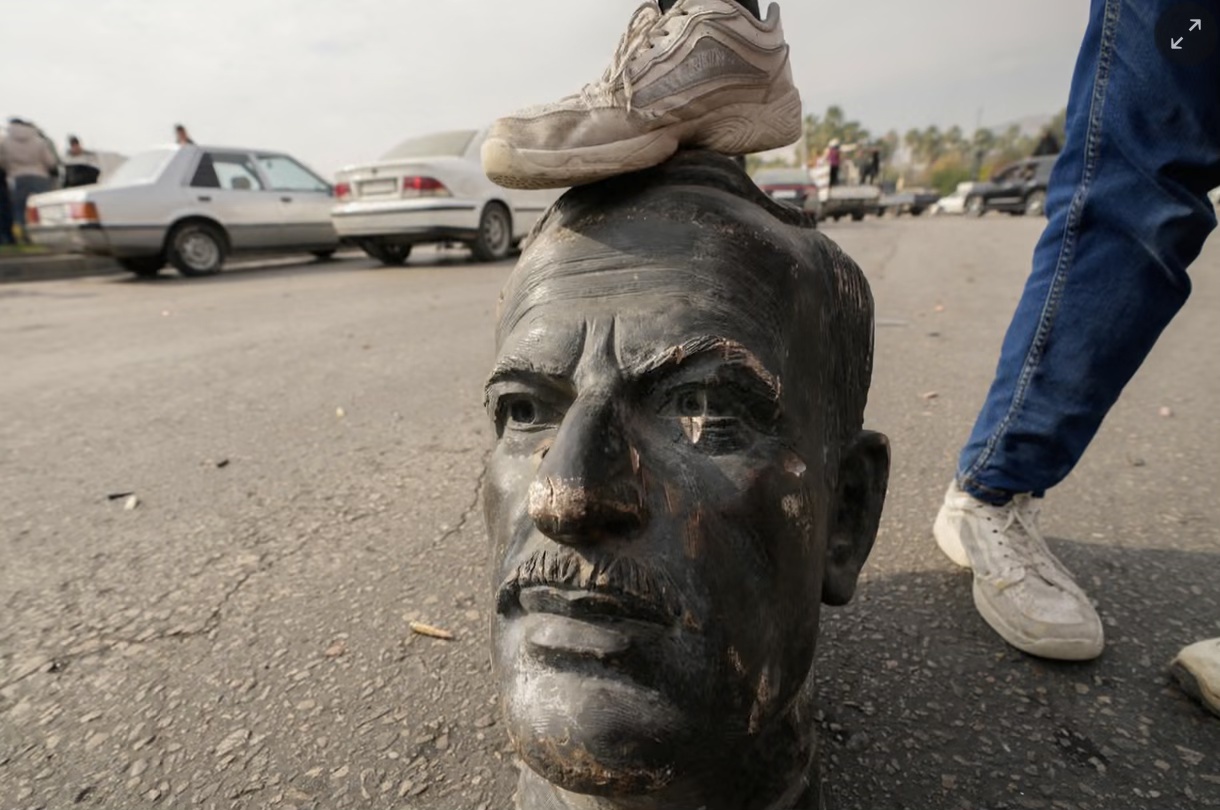
The list of atrocities committed since Syria’s civil war erupted in 2011 is almost endless. Every core international crime – war crimes, crimes against humanity, and genocide – has been perpetrated in a conflict that also left one-in-five Syrians living outside of the country. Diplomats have said the evidence of crimes committed in Syria is the strongest since the trials of Nazis at Nuremberg. With President Bashar al-Assad escaping to Moscow following a “perfectly timed rebel offensive” and thousands of his supporters as well as his henchmen fleeing the country, now is the time to deliver justice – in the courts of the countries they are running to and at the International Criminal Court (ICC) in The Hague.
When regimes collapse, the first thing officials and state authorities implicated in atrocities do is pretend to be someone else. Some try to save themselves by insisting they were opposition figures all along, or officers who were just trying to challenge the regime and mitigate its brutality from the inside.
Others know that attempting to do so is futile; there’s too much blood on their hands. They change stripes and clothes, quite literally, to present themselves as innocent civilians. They hastily marshal whatever resources and assets they have and look for a quick exit, preferably to locations with diasporas where they can blend in. As they jump ship, these officials – many of whom are also perpetrators – create opportunities to hold them to account.
How do we find them before they slip away and manage to disguise themselves among unsuspecting communities?
The answer is through careful, strategic tracking and evidence collection. In our data-rich world, no person can move without leaving a trace. People leave clues about who they are and where they are going. Investigators involved in addressing international crimes – for non-governmental organizations, states, or international institutions – should therefore be doing a lot of tracking of flights out of Syria over the last few days and over the next few weeks. Flight registers and flight paths of private jets could provide clues as to who is going where.
Investigators should likewise be tracking cellphone numbers, IP addresses, and other data that attaches to people’s telecommunication devices. Identifying, verifying and preserving open-source information is also crucial, including the videos captured of Assad’s notorious torture centers, like the Sednaya prison.
Likewise, investigators should track the Facebook and other social media posts of anyone who may be implicated in atrocities in Syria. The fact is that perpetrators are overconfident, publishing information and even sometimes evidence of their own crimes online. In a landmark case in Sweden in 2017, a low-level Assad regime solider was convicted for war crimes by using such evidence against him.
Of course, perpetrators don’t move alone. They bring assets with them. Investigators should therefore be asking financial institutions and banks to be on the lookout for recently arrived persons from Syria bringing in large sums of cash. If those assets can be frozen, they could even be repurposed as reparations to the Assad regime’s victims.
If these kinds of data are collected in real time, the movements of Assad regime perpetrators could be mapped. Relevant state authorities in the countries where these figures have escaped could then be alerted to their presence. At least some of those countries, including those in Europe, could then prosecute these alleged offenders under the principle of universal jurisdiction, prosecuting them in their own courts for international crimes committed in Syria. We know they can do this because they already are, but mostly for Islamic State fighters, rather than the regime officials who had remained in Syria, protected by Assad – until now.
At the same time, it would be wise for whoever governs Syria next not to “hunt down” perpetrators but to ask the ICC to open an investigation into atrocities committed in the country during the Syrian civil war. A new government could voluntarily accept the ICC’s jurisdiction, become a full-fledged member of the Court, or do the former now and the latter in due course.
This would be a smart move for whoever next governs from Damascus. Those who have nothing to hide, and the greatest confidence that they bear no responsibility for atrocities, should find it easy to demonstrate that fact by accepting the ICC’s jurisdiction and inviting investigations into the conduct of their nemeses.
If granted jurisdiction, the ICC could investigate the Assad regime for its litany of war crimes and crimes against humanity, as well as the Russian authorities who backed Assad and who committed their own crimes against Syrian civilians. Crucially, with ICC investigators on the ground, the Court could share information that it collected to ensure that states where perpetrators had fled could build strong and ultimately successful cases.
A week ago, achieving accountability for the atrocities committed by the Assad regime was a pipedream. Today, it’s a distinct possibility. As Lama Fakih of Human Rights Watch notes: “For Syrians scattered across the globe, the dream of accountability for years of crimes and brutality is closer to becoming a reality.”
Syrian perpetrators are on the move. Now’s the time to find and prosecute them.


