
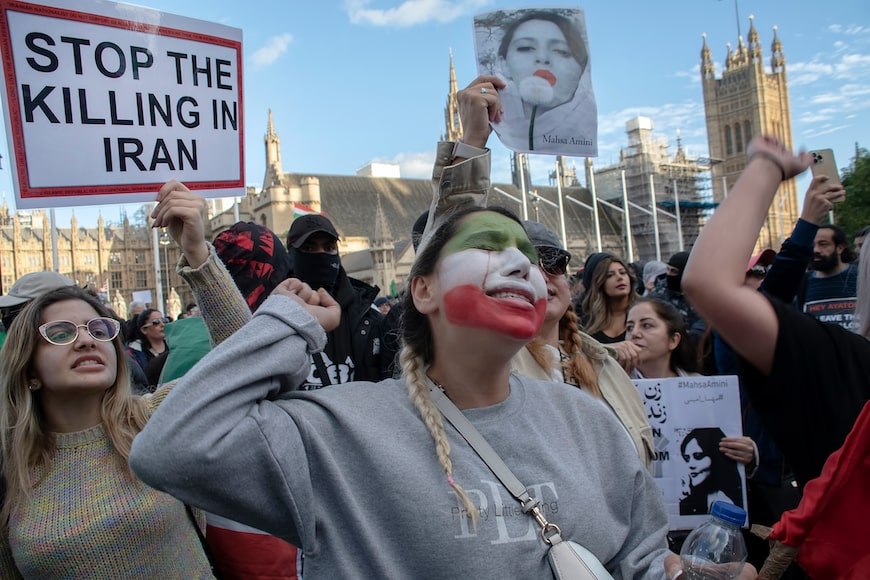
It is not an exaggeration to say that Iranian civilians have been subjected to atrocities by every party involved in the conflict in Iran: the Iranian regime, U.S. forces, and the Israeli military. Iranians deserve better than the stream of war crimes and crimes against humanity committed by a government hell-bent on repressing its population and states that view their country as the latest theatre for their illegal and senseless wars. The plight of Iranians demands accountability. But what options exist? In what follows, I canvass avenues for justice, emphasizing which ones are available and should be prioritized.
The International Criminal Court
A common, knee-jerk reaction to reports of atrocities is to call on the International Criminal Court (ICC). Unfortunately, the ICC cannot act in the interests of justice for Iranians. While Tehran has reportedly forwarded evidence of atrocities committed by others to the ICC, Iran is not a member-state and isn’t likely to expose itself – or its legion of perpetrators – to the Court’s scrutiny by accepting its jurisdiction over Iranian territory. At the same, the United States and Israel are not members of the ICC either, so their citizens cannot be investigated for any atrocities committed in Iran.
In short, the ICC is currently a non-starter. But its absence from the accountability equation does not mean that nothing can be done. Far from it. States can act to achieve accountability for Iran in the absence of the ICC. And they must.
Universal Jurisdiction
Iranian regime figures – including those responsible for atrocities – regularly travel abroad. This creates an opportunity to hold them to account under the principle of universal jurisdiction, which allows states to investigate and prosecute perpetrators of international crimes even when they are committed by foreign agents and against foreign citizens. There is even some precedence for this when it comes to Iran.
In 2019, Iranian regime figure Hamid Nouri was arrested at Stockholm Airport, in Sweden. He was then prosecuted and, in 2022, convicted for his involvement in the commission of war crimes, including extrajudicial killings and enforced disappearances, related to the 1988 massacre of Iranian political prisoners.
Nouri’s conviction was a landmark moment for justice and accountability for victims of Iran’s bloodthirsty and brutal regime. But it was short-lived. In 2024, he was sent back to Iran in a prisoner exchange after Tehran detained a Swedish diplomat.
Still, universal jurisdiction retains potential. Take Canada as an example. The country is host to a reported 700 individuals linked to the Iranian regime. Some politicians have demanded that they be deported back to Iran. That is reckless and dangerous – no one should be sending regime figures back to Iran where they could continue to repress civilians. They should be holding them accountable.
So, what if, instead, they were prosecuted for their involvement in atrocities committed against the Iranian people? Canada and other states have the laws, resources and expertise to investigate and prosecute international crimes, and unlike the ICC, they can exercise jurisdiction against perpetrators regardless of their nationality. In addition, states should press Iranian regime figures for evidence of their government’s crimes to build cases and preserve information for when a new tribunal – or perhaps one day the ICC – is available to use it.
An Investigation Mechanism
Just because independent and international courts are not currently available does not mean that the collection and preservation of evidence of atrocities can’t be done. That was the lesson that states learned when the civil war in Syria erupted in 2011.
The ICC wasn’t available and neither was any other international tribunal. The United Nations Security Council wasn’t about to create a court; Russia, in particular, backed the regime of Bashar al-Assad and was itself directly involved in the commission of war crimes against Syrians. Instead of giving up, in 2016, the UN General Assembly established the International, Impartial and Independent Mechanism (IIIM) for Syria, which has since collected and preserved a tremendous amount of evidence of atrocities committed in Syria – evidence some call stronger than anything the world has seen since the Nuremberg trials of the Nazi leadership in 1946.
The evidence that the IIIM collected was subsequently used in prosecutions, including universal jurisdiction cases against Syrian perpetrators in Europe. Now, with the unceremonious collapse of the Assad regime, that evidence might even be used in justice processes and in prosecuting regime figures in Syria’s own courts. Had the IIIM not been established, all of that evidence would now need to be collected – and much of it would have been lost over, and to, time.
Could a similar mechanism be created to collect and preserve evidence of atrocities in Iran? Surely, the answer is yes. Doing so would help to ensure that whenever an international court with competent jurisdiction finally came online, the evidence would be ready for use.
A Tribunal for Iran
Given the comprehensive nature of atrocities committed against the Iranian people over long periods of time and by many different actors, the ICC could never be enough. The court is fundamentally limited and can only ever prosecute a tiny fraction of the perpetrators involved in any atrocity situation. Therefore, states that support the people of Iran in their plight against the regime and against the crimes of intervening states should explore the creation of a separate tribunal with jurisdiction over any crimes committed in Iran – whether by the government, Israel, or the United States. As some have pointed out, this is possible, even without approval of the UN Security Council. The work done by European states to set up a tribunal for Ukraine has set exactly this precedent.
Is the creation of such a court likely in the near future? No, at least not with the Trump administration in power and states still appeasing Washington in the hopes of tariff relief. But that government won’t last forever, and neither will the regime in Iran. For those states who profess solidarity with the Iranian people and who oppose the commission of atrocities, the option should be put squarely on the table. Concrete planning for a court should begin sooner than later. And in the meantime, these states should invest in a body to preserve evidence of atrocities committed in Iran. Those who choose not to will invariably be admitting how little they care for Iranian lives.
The world has watched over many years as Iranians have courageously insist on exercising their human rights and dream of a future free from atrocity only to be met with waves of repression. Against this interminable violence, there are options for justice for Iran. All must be exhausted, to remind Iranians that states stand with them and to remind ourselves that no one, no matter how powerful, is beyond accountability.


I wrote this weblog article in November 2016 not long after the conclusion of HarvardX’s Humanitarian Response course. 2 years after worshippers, followers, supporters & adherents, etc. of an ideology that exemplifies Child Marriages & Child Sex Predation ravaged Christians & Yazidis unencumbered. Christian & Yazidi children went through marriages with adults & suffered child sexual predation & abuse. Despite these horrificly unimaginable crimes, the World of their kind mostly did nothing. Ask Nadia Murad Basee as an example. These worshippers, followers, supporters & adherents, etc. of an ideology that exemplifies Child Marriages & Child Sex Predation, have downright putridly vile minds & acts – whether seen & unseen.
I wrote in late 2016 towards ensuring protection of Christian & Yazidi victims of atrocity crimes despite the deliberate thefts of my academic, scholastic, professional, some personal documents, other properties, etc. of mine & the deliberate targeted killing of my kid bro neighbor & business associate Martin Lee thereafter.
It is said that Christian priests & Jewish rabbis will fully comprehend the fullest gravity when one seeks blessings/protection of the Supreme Lord Creator in the language of Jesus – Aramaic and Moses – Hebrew.
Only in Hollywood films they both speak English.
Nevertheless, the WORLD is dealing with the very personification of evil – their potentates-rulers, clerics, politicians, public servants, lackeys, followers, subjects, etc. I won’t writing about this anymore. I won’t even bother to remind after this.
MarketThrob™ will be launched in 48-72 hours.
https://internationallegaljusticeobserver.weebly.com/
https://internationallegaljusticeobserver.weebly.com/