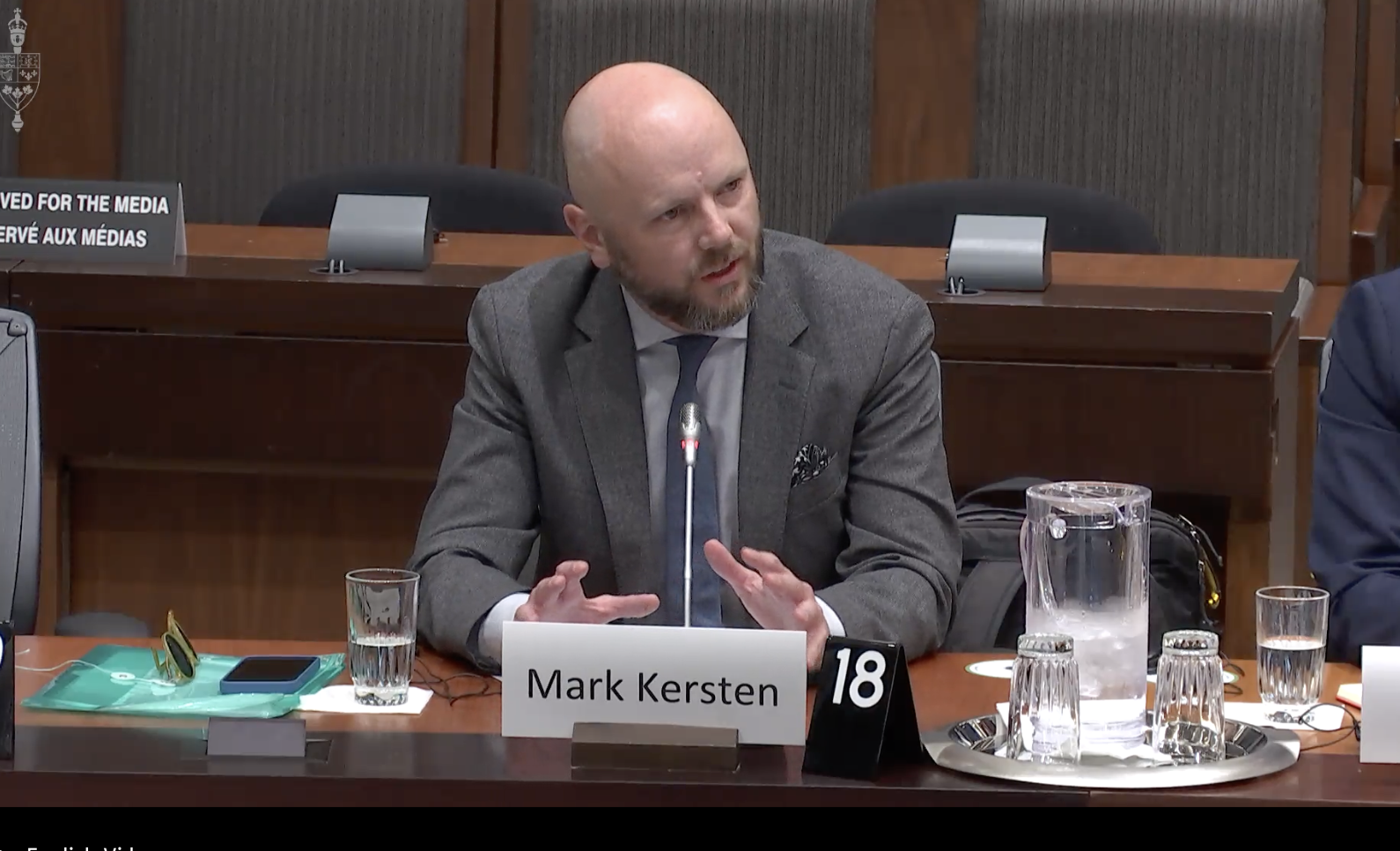
Dear JiC readers: I had the privilege of testifying this week at the Canadian House of Commons’ Subcommittee on International Human Rights of the Standing Committee on Foreign Affairs and International Development. The topic was Transnational Repression (TNR). In my testimony, I emphasized the links between atrocities and human rights violations in source countries with transnational repression in Canada. Understanding those links, I argued, is necessary to devise policies that hold perpetrators accountable in meaningful ways – and not simply rely on quick-fixes and immigrations remedies like deportations. I also testified to emerging threats of TNR, including that which is emanating from the United States. For those interested, you can find the recording of my testimony here, and the text of it below. Thank you, as always for your readership!
Thank you, Mr. Chair.
As transnational repression, or TNR, continues to grow, it is critical to remind ourselves: transnational repression is not waged against abstract entities or states, but against people and communities. Canada’s response must therefore be grounded in human rights.
With my time, I will emphasize three points and conclude with recommendations.
First, TNR in Canada is inextricably linked to human rights violations committed in source countries.
Second, understanding these links means tackling both, by holding perpetrators accountable.
Third, the threats of TNR are growing and include states that Canada considers allies.
TNR is not separate from repression in source countries. It’s an extension of it. Those who call out and push back on atrocities – in Iran, Russia, China, India, etc. – are targets for repression here.
How Ottawa responds must appreciate that it is those who dream of human rights in their homelands that face the nightmare of transnational repression in Canada.Given the springtime, consider the following analogy.
If Canada continues to focus only on how repression is expressed on Canadian soil, it will be cutting dandelion flowers while leaving the roots intact. Worse, current Canadian policies might even allow the weedy world of repression to flourish.
I have studied the presence of Iranian regime figures in Canada and what responses are available to authorities. And like others, I was dismayed to see some MPs calling for Iranian regime figures to be deported back to Iran.
Trying to tackle TNR in Canada by sending perpetrators back to a regime engaged in the oppression of civilians is reckless and dangerous. Sending agents back risks strengthening the Iranian regime – and its repressive capabilities.
It was thus a lost opportunity when Canada decided last week not to investigate and potentially prosecute, but to return a former IRGC commander Mehdi Taj back to Iran.
If Canada’s response to TNR is to deport perpetrators, what lesson will those states engaged in repression learn? ‘We can send our guys in to terrorize diaspora communities; the worst that will happen is Canada will send them back to us – and foot the bill.’
Canada cannot tackle repression here by exporting its perpetrators abroad and putting them into positions to again oppress and violate the rights of civilians in source countries.
We must instead uphold our sovereignty by reaffirming the human rights of those targeted by TNR. We can do this by holding perpetrators of transnational repression and atrocities accountable in our own courts and under our own laws.
Canada can become a world leader in this endeavour.
There is a framework that Canada can use to identify emerging threats of TNR: look for states that perpetrate atrocities against their own people with impunity and who lack respect for state sovereignty.
That means that we must look not only at states like China, India, Iran, but also the United States as an emerging risk for TNR.
Canadians are rightly worried that the U.S. Immigration and Customs Enforcement (ICE), a paramilitary force engaged in rights violations in the U.S. – kidnapping and killing migrants and citizens – might do the same in Canada. It’s a reasonable fear.
The U.S. may not be engaged in repression in Canada today, but it is precisely states that behave as they do that enable repression and seek to silence those who push back against their crimes.
To conclude, allow me to offer the following three recommendations.
Canada must be indiscriminate in our fight against repression and not allow the aspiration of good relations to blind us. Our commitment to accountability must not rest on double standards or partisan games.
First, Canada should allocate new resources to the Crimes Against Humanity and War Crimes Program and encourage it to open a structural investigation into TNR linked to the investigation and prosecution of atrocity perpetrators residing in Canada. This could include an analysis of whether transnational repression may, in some cases, amount to a crime against humanity.
Second, Canada should create a non-partisan working group to study the creation of a Bill of Rights for victims of TNR to offer them an effective institution to seek protection and remedies, including access to compensation from the seized assets of perpetrators.
Thirdly, Canada. should review the current operations of ICE in the country. Ottawa must explain to Canadians why ICE, a paramilitary force of an increasingly autocratic government, should still operate through its offices in five Canadian cities.
It’s not a matter of whether Canada can do this. We have the right people, resources, and institutions.
It’s only a matter of whether Canada has the will and courage to do it, in line with the goals of accountability and protection of human rights.
I hope that it does.
Thank you for your time.