
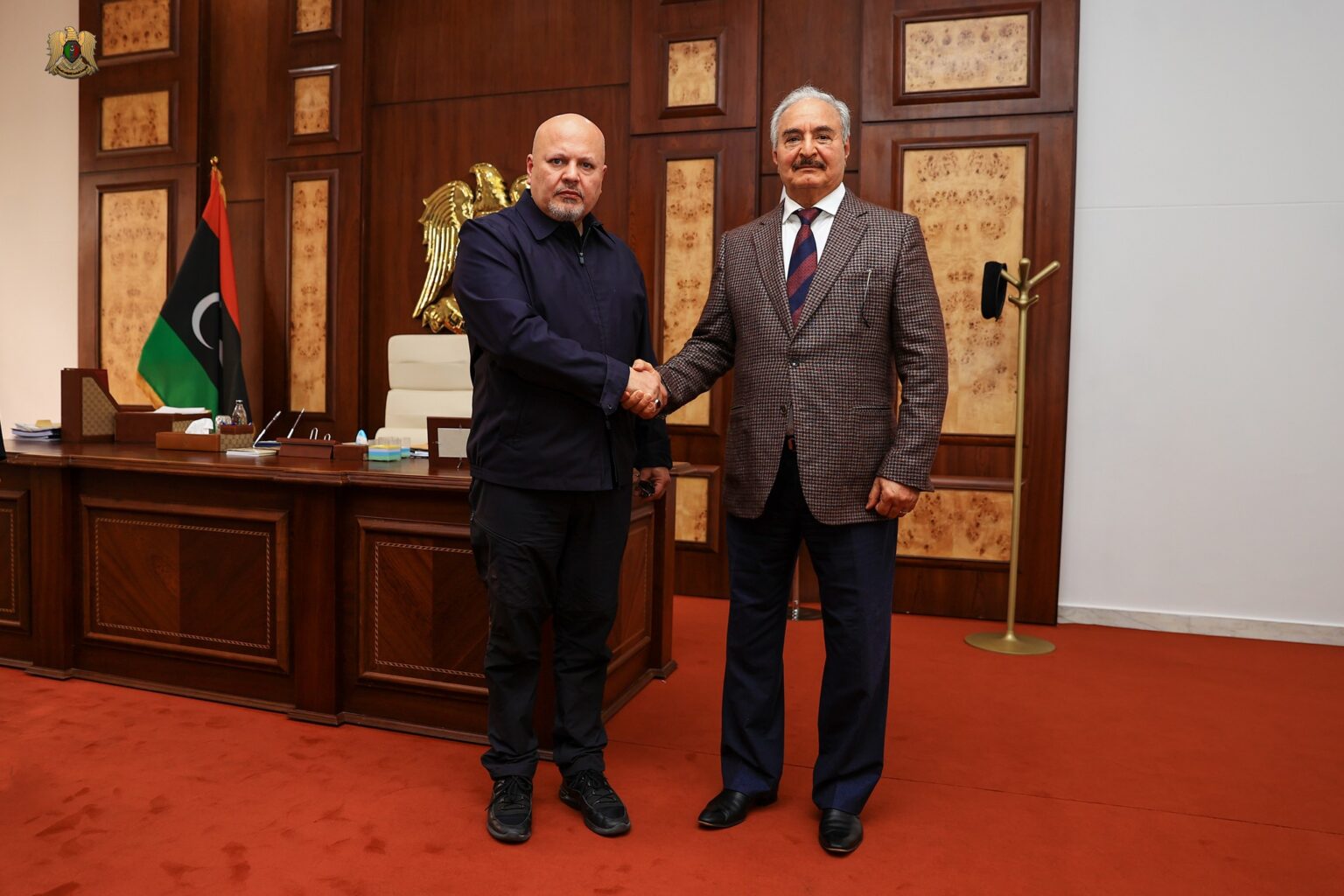
Earlier this month, ICC Prosecutor Karim Khan met with notorious warlord Khalifa Haftar, widely suspected of international crimes in Libya. The meeting raises the question: should the International Criminal Court (ICC) Prosecutor meet with perpetrators of mass atrocities?
JiC readers will be familiar with this question (see our ‘perceptions of justice debate here). The most obvious answer is no; the Prosecutor should be prosecuting rather than glad-handing perpetrators. Yet throughout its existence, the ICC Prosecutor has met and been photographed with many alleged war criminals. At play is a difficult balancing act on the part of the Prosecutor that deserves greater attention and transparency.
Every ICC Prosecutor to date has sought the cooperation of atrocity perpetrators. In the early 2000s, then ICC Prosecutor Luis Moreno-Ocampo successfully negotiated a referral of northern Uganda to the Court with Ugandan President Yoweri Museveni. In 2003, Moreno-Ocampo announced the ICC’s first-ever investigation at a glitzy press conference with Museveni. That might not have been an issue if it wasn’t for the fact that many Ugandans and rights advocates have highlighted Museveni’s complicity in mass atrocities in northern Uganda and his interest in the ICC’s singular focus on his opponents.
In 2012, Fatou Bensouda succeeded Moreno-Ocampo. She met and posed for photos with former president of the Democratic Republic of Congo (DRC) Joseph Kabila, widely alleged to be responsible for international crimes. Bensouda also met with Rwandan leader Paul Kagame who stands not only accused of serious human rights violations and fueling conflict in neighbouring DRC but has fomented anti-ICC fervour among African leaders and undermined the Court’s work.
Khan, the ICC’s third and current Prosecutor, has continued the trend, meeting with Sudanese political and military leaders, including Abdel Fattah Al-Burhan and Mohamed Hamdan Dagalo. Both are accused committing human violations against Sudanese civilians during the country’s transitional period. Dagalo is also widely understood to have engaged in atrocities in Darfur, a situation that the ICC has had under investigation since 2008.
Continue reading




 Justice in Conflict