
The following contribution to our ongoing symposium on the next ICC Prosecutor was written by Mark Kersten, the founder of Justice in Conflict and a Senior Consultant at the Wayamo Foundation. Be sure to also head over to Opinio Juris to see Beth Van Schaack’s contribution on then need for the next Prosecutor’s to engage the US public.
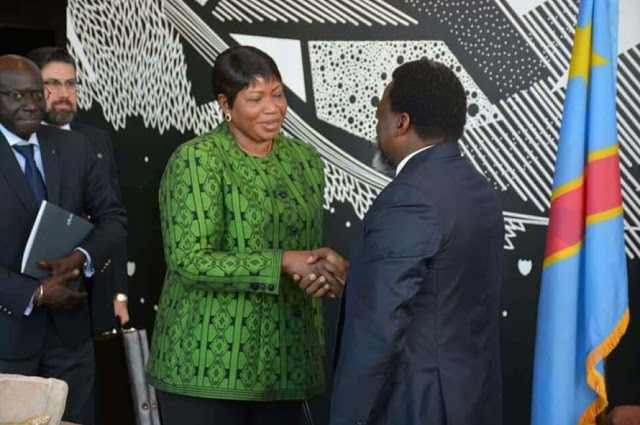
ICC Prosecutor Fatou Bensouda meeting with (former) DRC President Joseph Kabila in New York, in 2017 (Photo: ICC)
The contributions to this symposium have offered incisive and cogent insights into what qualities the next Prosecutor of the International Criminal Court (ICC) should have. One constant thread relates to competing visions of the Prosecutor as a political versus legal actor. That tension won’t soon be resolved. It is simply impossible to separate the legal from the political at the ICC. The institution will always be both an international organization, replete with the politics that come with the territory, as well as a criminal court, seeking to do its work – and justify it – by the letter of the law.
The Prosecutor walks a tightrope between playing politics and pretending that they don’t exist within the confines of the Office that they run. Indeed, the Office of the Prosecutor exhibits a certain phobia to being seen as political. Given the political realm in which the Court exists and the impossibility of abstracting prosecutorial decision-making from the institutional politics of the ICC or the political repercussions of any given decision, it would be wise for the Court to ditch this attitude. Doing so would allow the Prosecutor’s Office to improve on its own politics as well as its political effects it has (see Patryk Labuda’s post on this too). In a nutshell: to be better at politics, you have to acknowledge that what you’re doing is politics. That, in turn, would could lead the ICC to better understanding the conflict and post-conflict contexts in which it intervenes.
The Focus Shouldn’t be on Major Powers
With a few exceptions, the focus of many of the submissions in this symposium has been on how the next Prosecutor will manage the Court’s current and future confrontations with major powers (see here, here and here). How the Prosecutor handles high-profile preliminary examinations and investigations into Afghanistan and Israel, as well as the blowback from Washington and Tel Aviv, will shape the future of the Court. Both legally and politically, the ability of the next Prosecutor to stick-handle through these sticky situations will determine whether the Court remains an ‘audacious’ or ‘aspirational’ institution.
The relationship between the likes of US, UK, Russia, and Israel with the ICC deserves scrutiny from scholars as well as Prosecutor candidates. The overblown theatrics and political hissy-fits from Washington and Tel Aviv also make it hard to just keep calm and carry on. But too much of a focus on the Court’s relationship with major powers may inadvertently give the impression that the Court’s relationships with powerful states are its most important. There is a real risk that an overemphasis on major power relations will reaffirm the problematic but popular belief that that the ICC’s priorities reside in managing relations with the most powerful.
It is important to recall that the most glaring political challenge that has faced the ICC is not the result of any confrontation with major powers. The Court’s most crucial relationships remain with the countries in which the ICC has intervened. These largely pertain to contexts where major power geopolitical interests are entirely absent, minimal, or in line with the Court’s.
The Court’s most persistent problem remains the asymmetrical selection of cases within the situations in which the Court intervenes; this is an issue that has already outlived multiple rounds of major power confrontations with the ICC – and will outlive the latest bout of Washington’s hysteria too.
The issue of in-situation selectivity has received an enormous amount of critical attention in recent years. But the pattern remains the same: following self-referrals or Article 12(3) invitations to investigate, the ICC only targets non-state actors for prosecution. Following UN Security Council referrals of particular conflicts, the Court homes in on state actors as its targets. This selectivity of cases is just as problematic for the ICC as the geographic distribution of the situations it investigates. Even in situations where the Prosecutor’s office repeatedly promised that it would prosecute all sides, as in Ivory Coast, it has done nothing of the sort. Continue reading



 Justice in Conflict