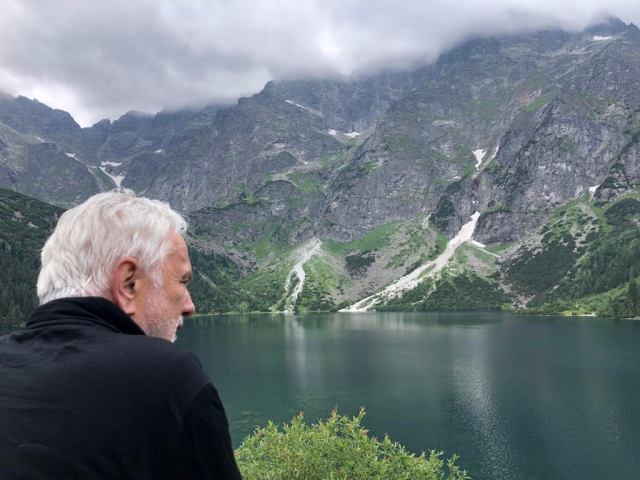
My father, Gregory Kersten, in the Tatra Mountains in 2019. (Photo: Marta Kersten)
In writing for Justice in Conflict, and in my career more generally, I have tried not to get too personal. Separating the personal from the professional is unspoken custom in journalism and academia, professions that endeavour to observe and describe the world with objectivity. Though I know that it is impossible for us to totally detach ourselves from what we put out to the world, it is important to try.
Perhaps that is why, when people have asked me why I am interested in justice and conflict, I have been unsure how to answer. I would most often reply that the coverage of arrest warrants issued by the International Criminal Court (ICC) against former Sudanese President Omar al-Bashir was what got me hooked. To some extent it’s true; it is what sparked my intellectual energy and interests on the relationship between peace and justice. But I also knew that there was more. I was interested in justice and fairness long before the ICC targeted Bashir and the international community collectively fretted over its impact on resolving the war in Darfur. In recent years, I began to understand more clearly that it is because of my family that I care about what I care about. Now more than ever, I understand just how much it was because of my father.
My father, Gregory Edmund Kersten, died unexpectedly and suddenly on 26 May 2020. I will be coming to terms with that for many months and years to come. Having dedicated my life’s work to studying and trying to understand the world, I have difficulty understanding it without him in it or why it seems to continue on the same without him here.
But I can say that he left a legacy, one which I will work to ensure is a lasting one. This blog is part of his legacy, though readers are surely unaware of that fact. I want to change that.
More than anyone, my dad encouraged me to write. When I experienced down times or anxiety in my life, he would tell me to work and, especially, to write. I would find solace in doing so. I still do. In 2010, he told me that it would be a good idea to start a blog to focus my energy and interests. I never imagined JiC becoming what it has become. So many of the opportunities that I’ve had and the professional relationships that I’ve developed are due to this site – and are therefore because of my father. He regularly read JiC, and would tell me which pieces he enjoyed, comment on them, and offer constructive criticism. Of course, he would also point out where I had left spelling errors, which was a bit less fun.
My father was wedded to his principles, none of which resonated more clearly than his commitment to fairness. It did not always make him an easy person. I did not always agree with him. We often argued ferociously. But even when I thought he was wrong, I knew he was wrong for all of the right reasons. Weeks later, I would often find my own arguments shaped by his.
My dad’s principles were not instilled in him through an easy life. He was born four years after World War II ended, and grew up in communist Poland under difficult personal and political circumstances. In the 1970s and 1980s, he worked in underground publishing for the anti-Communist Solidarity / Solidarność movement with his parents and my mother. From a very early age, I found their contribution to the resistance and the whittling away of autocratic rule fascinating. It inspired me. That fascination manifests itself in my desire to work on global justice and accountability initiatives and to write openly about regimes and governments complicit or actively engaged in human rights violations.
My father left Poland just before Martial Law was officially lifted with his wife Greta and my two siblings, Marta and Mik. In 1983, they drove to Antwerp, Belgium, in a car on ‘vacation’, crossing into free Europe at Checkpoint Charlie. I can’t imagine the exchange of tension and relief that he must have felt upon making it through the Berlin Wall, with the weight of all of that responsibility resting on his shoulders. Years later, I found it moving to realize that I worked in the field of international justice for an NGO, the Wayamo Foundation, that was based on territory that my family fled just 30 years prior, behind the Iron Curtain. The transformation is remarkable.
During the Cold War, regular emigration to ‘the West’ wasn’t permitted. As they departed Poland, it was not clear to my parents if and when they would see their family and friends again. From Belgium, they applied to emigrate to Canada. Nine months to the day after they arrived on 14 December 1984, I was born.
Immigrating to Canada from a context of political violence and structural oppression opened up many opportunities for my family, as it has for so many others who begin new lives on Turtle Island. But it took an enormous amount of work for my parents to succeed here.
While improving his English, my father became a university professor, and devoted his life to the field of negotiation and group decision-making. It is a theme that I would take up in my work in international criminal justice. It brought me great joy that, while we came to the field of negotiation from different angles, we owned some of the same books and the same dedication to mediating disputes.
Throughout his life, my father’s sense of fairness was unwavering and indiscriminate. He rejected any notion that power or wealth should determine who got justice or who was treated with dignity. He also believed, to his core, that conflicts of all kinds could be resolved if we simply spoke to each other and communicated.
While he did not suffer fools lightly, my father was the most generous person that I have known. Since his death, I have been astounded by the number of people who have reached out with stories about how he touched their lives. He spent hours of his day working with students and colleagues, speaking to them on the phone or online, hosting them at his home – sometimes for weeks. It has been touching, comforting, and heartbreaking to know that I am only one among so many who will miss him.
I hope that some of my father’s principles and faith in humanity resonate through the pages of this site. The blog will continue to serve as a place where students, advocates, and scholars alike can have their say on matters of international and transitional justice.
Meanwhile, my family and I are committed to continuing my father’s work and legacy. In 2011, he started the Kerstens’ Foundation in honour of his parents, Adam and Krystyna, both acclaimed Polish historians. The Foundation has offered scholarships to Polish graduate students for almost a decade. As one way to remember him, we are working to create a scholarship in his memory, in the hopes of fostering in young people the principles that he stood for.
Those principles are the ones that this blog has stood for and will continue to stand for, for many years to come.
I do not believe that my father is ‘gone’, but rather that he lives in and among the many people who loved him. Still, I miss my father beyond what mere words can express.
Thank you, as always, for reading.
Mark
 The list will no doubt take some digesting. In full disclosure, I only know anything substantive about the work of two of the four candidates, Gaynor and Okalany, although I know a bit about Mr. Roy’s work in Canada, on the SNC Lavalin case, about which I have previously written. A full report (update: now available here) on their qualifications and expertise will be forthcoming, permitting greater understanding of their backgrounds and abilities. On Twitter, Kevin Jon Heller has already begun posting some of that information. Hopefully the candidates will also engage transparently with civil society actors and speak to their abilities and visions for the ICC too (see below). Continue reading