
B. Aloka Wanigasuriya joins JiC for this post on the chances of Sri Lanka achieving justice and accountability for atrocities committed during the country’s civil war. This piece coincides with the ten-year anniversary of the end of the war. Aloka is an Australian lawyer and a PhD scholar at the Faculty of Law, University of Copenhagen (Denmark).
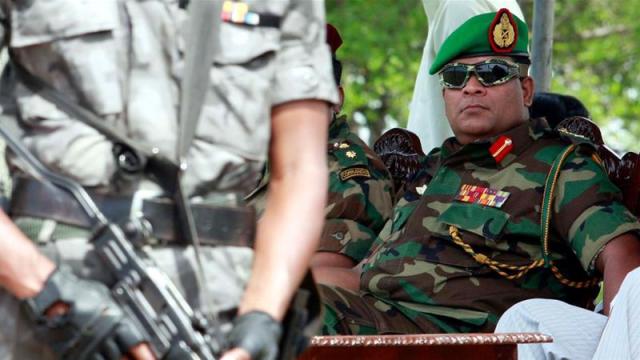
Instead of being prosecuted for alleged war crimes, Shavendra Silva was recently appointed to Sri Lanka’s second-highest army ranking (Photo: Reuters)
In May 2019, Sri Lanka marked ten years since the end of its civil war that raged for nearly three decades between government troops and the guerrilla force, Liberation Tigers of Tamil Eelam (LTTE). An estimated40,000 civilians perished during the final offensive, which lasted from January to May 2009, and allegations emerged of the commission of serious international crimes by both parties to the war.
Calls to establish a UN-mandated international justice mechanism to investigate the alleged international crimes appear to have fallen on deaf ears. As Sri Lanka has not ratified the Rome Statute it is not subjected to the jurisdiction of the International Criminal Court (ICC). Therefore, the ICC cannot currently prosecute alleged crimes committed in Sri Lanka. The only avenue for ICC prosecution is through a UN Security Council referral of the situation to the Court – and the chances of that happening are slim to none. No domestic prosecutorial avenues exist for seeking criminal justice for these alleged international crimes. Since the end of the war, several attempts have been made by victims and human rights groups to bring the alleged perpetrators of these crimes to justice either through utilizing the national laws of other states not party to the conflict (for example through filing civil suits) or through the application of universal jurisdiction. However, due to a host of political reasons, the current possibilities of accountability look bleak.
Extraterritorial prosecution
In September 2017, citing “the absence of credible action in Sri Lanka to ensure accountability for alleged violations of international human rights law and international humanitarian law”, the UN High Commissioner for Human Rights advocated for the use of universal jurisdiction. However, as repeated previous failed attempts indicate, the exercise of universal jurisdiction to bring perpetrators of the alleged international crimes to justice isn’t an easy task. In 2012, a US court rejected a lawsuit against the then Sri Lankan president, Mr. Mahinda Rajapaksa reasoning that as a foreign head of state, he enjoyed immunity from prosecution. Similarly, in late 2010 an attempt at seeking an arrest warrant against Mr. Rajapaksa and senior members of his entourage during a visit to the UK came to naught. In 2011, a similar attempt seeking his arrest during his visit to Australia for the Commonwealth Heads of Government Meeting was rejected by the then Australian Attorney-General due to head of state immunity.
In the past, incumbent and former heads of state such as Charles Taylor (former president of Liberia) and Slobodan Milosevic (former president of Serbia and the Federal Republic of Yugoslavia) have been prosecuted by international criminal courts and tribunals. However, such cases have been rare. Recently, states have been reluctant to arrest current or former heads of state from other countries. For example, despite an ICC arrest warrant being in place for his apprehension, the former Sudanese president, Omar Al Bashir managed to travel unhindered to numerous countries. However, in a recent turn of events, the Appeals Chamber of the ICC in its judgment in the Jordan Referral re Al-Bashir Appeal, held that neither State practice nor opinio jurissupports the existence of head of state immunity under customary international law vis-à-vis an international court. This was also held to be relevant “for the horizontal relationship between States when a State is requested by an international court to arrest and surrender the Head of State of another State”. However, given indications of a possible request for an advisory opinion from the ICJ, this is unlikely to be the final word on the immunities issue.
Previously, in instances such as in (i) the prosecution of former Chilean leader, General Pinochet, and (ii) the ICJ Arrest Warrant Case (Democratic Republic of the Congo v. Belgium, 2000) concerning the Belgian arrest warrant issued against the incumbent foreign minister of the DRC, attempts were made to apply universal jurisdiction to prosecute individuals using a second state’s domestic legal system. Of these, the latter could be relevant to the Sri Lankan situation given its links to the alleged commission of war crimes and crimes against humanity, and the personal immunities extended to certain categories of state officials. Here, the ICJ found no exception under customary international law that strips away the immunity from criminal jurisdiction granted to incumbent government ministers who are suspected of committing war crimes or crimes against humanity. This suggests however that this personal immunity terminates at the cessation of the state official’s official duties, hence exposing them to the possibility of prosecution. Still, due to states not wishing to be exposed to a diplomatic minefield, the chances of a second state arresting and prosecuting individuals such as the former president of Sri Lanka on international atrocity crime charges through exercising universal jurisdiction remains slim. Continue reading



 Justice in Conflict