Ten African States Who Will Stick with the International Criminal Court

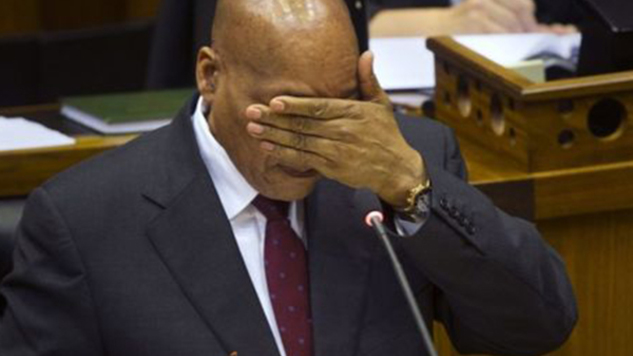
South African President Jacob Zuma (Photo: Getty)

South African President Jacob Zuma (Photo: Getty)

In the wake of South Africa’s, Burundi’s and The Gambia’s decision to withdraw from the International Criminal Court (ICC), the focus of observers and commentators has been on who is next. Who will join the “queue” to leave the ICC? Which state will be the next “domino” to fall? Where is the the next candidate to partake in this “mass exodus”. Much less attention has been paid to which African states won’t be joining the withdrawal parade. To that end, here are ten current African ICC member-states that I believe won’t be heading for the exit, starting with the obvious ones — those states that have declared their support for the ICC in the wake of recent withdrawals.

Botswana

The government of Botswana has made by far the most emphatic statement criticizing the recent spate of withdrawals from the Court. In a press release, the government exclaimed that withdrawing from the ICC undermined victims and the global fight for impunity. Botswana has regularly stood alone in publicly proclaiming its support for the ICC, particularly in African Union (AU) summits. Notably, Botswana also doesn’t believe that the Malabo Protocol, which would allow the African Court on Human and People’s Rights to prosecute international crimes, should go forward given its immunity carve-outs for state officials and the continued existence of the ICC. Botswana isn’t going anywhere.

Senegal

Senegal was among a handful of states that ensured that the issue of an Africa-wide withdrawal from the ICC did not reach the agenda of Head’s of States at the July AU summit in Kigali, Rwanda. The country’s Justice Minister, Sidiki Kaba, also acts as the President of the ICC’s Assembly of States Parties (ASP). Representing his government and the ASP, Kaba has expressed his regret over the decision of African states to withdraw from the ICC.

Sierra Leone

It is rare to hear much from Sierra Leone regarding the ICC. The country, of course, has a rich and unique place in the history and development of international criminal justice. The Special Court for Sierra Leone (SCSL) examined atrocities committed in the country and, in a landmark case, convicted and sentenced former Liberian President Charles Taylor to fifty years in prison for war crimes and crimes against humanity during the country’s civil war. More pertinently, Sierra Leone’s Ambassador to the Netherlands stated this week that “just because three states are leaving, does not mean Africa is leaving” the ICC.

Tunisia

Tunisia was among those states that pressed AU delegates to avoid the agenda item of an Africa-wide mass withdrawal reaching the Heads of States’ negotiation table at the last AU summit. Moreover, Tunisia is the most recent African state to become a member of the Court. It joined in 2011, in the wake the Arab Spring. The government in Tunis has never suggested, or even implied, that it held any regret over the decision and its recent actions at the AU suggest its happy as an ICC member-state.

Nigeria

Like Tunisia and Senegal, Nigeria stood up for the ICC at the AU summit in Kigali. Ongoing violence in the country is currently under preliminary examination by the ICC and in its late stages. It seems unlikely that Nigeria wants the ICC to open an official investigation. But the relationship between the ICC and Abuja is good. The country is cooperating with the Court to ensure that, wherever possible, it is able to bring perpetrators of mass atrocities to account itself. Continue reading
Posted in Africa Group for Justice and Accountability (AGJA), African Union (AU), Botswana, Central African Republic (CAR), Democratic Republic of Congo, Gabon, Gambia, International Criminal Court (ICC), International Criminal Justice, Ivory Coast / Côte d'Ivoire, Ivory Coast and the ICC, Mali, Niger, Nigeria, South Africa | 5 Comments

Some Thoughts on South Africa’s Withdrawal From the International Criminal Court

South Africa ICC withdrawal

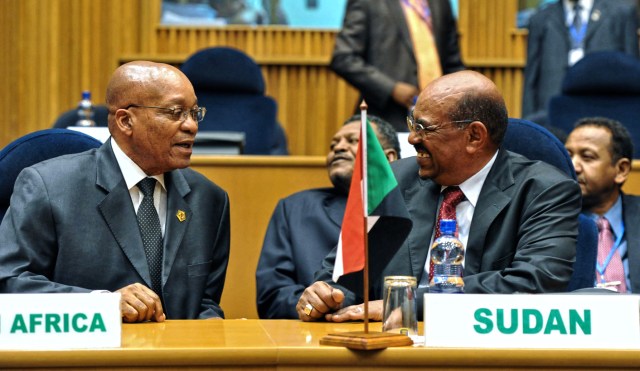
South African President Jacob Zuma shares a laugh with Sudanese President Omar al-Bashir in 2011 (Photo: Ntswe Mkoena / EPA)

Contrary to the suggestion of some, the dust on South Africa’s and Burundi’s (and Gambia‘s) withdrawal from the International Criminal Court (ICC) has not settled. It won’t for some time. These two withdrawals have sparked an intense debate on the future of the ICC. Many observers have already provided cogent commentary since South Africa deposited its notice of withdrawal to the United Nations Secretary General. In this post, I want to offer and add a few thoughts on what South Africa’s and Burundi’s decisions mean.

1)    On Africa and ICC, I got it wrong

I would be remiss if I did not admit that my previous post, on Burundi’s potential withdrawal, was inaccurate. Indeed, I considered calling this post “My Awkward — And Mostly Pointless — Post on ICC Withdrawals”. In that piece, I argued that the decision of President Pierre Nkurunziza made little sense given that the Africa-ICC relationship was getting better, not worse. I stand by the empirical observations in that post — namely that Gabon’s self-referral and the dampened pressure for an Africa-wide withdrawal at the African Union (AU) matter. I also continue to believe that, for those elements supporting a mass withdrawal of African member-states of the ICC, Burundi was a poor choice (which, as argued below, helps to explain South Africa’s own decision to withdraw). But my diagnosis was wrong and it led to a faulty prescription.

To be perfectly clear, South Africa’s withdrawal from the ICC hurts the Court. There may be a few silver-linings and certainly many lessons, but there is no sugar coating these developments.

2)    What’s with the ICC Withdrawals — Why Now?

Why did South Africa’s executive decide to move now? The government has given its own reasons, focusing on its intent to avoid obligations to arrest ICC-indicted heads of state involved in peace processes. It also wants to avoid domestic civil and criminal sanction over their hosting of Sudanese President Omar al-Bashir in Pretoria last year — although withdrawing certainly can’t achieve that aim. South Africa may also have timed its decision as a means to sucker-punch the ICC’s Assembly of State Parties conference which begins in two weeks.

But it is also clear that South Africa wanted to “beat Bujumbura to the punch”. South Africa did not decide to withdraw last week. But, because of Burundi, they sped up the process of doing so. For champions of international criminal justice, Burundi would have made an ideal leader for any Africa-wide withdrawal process; few, if any governments, would be keen to follow any initiative led by Nkurunziza. There are ongoing and serious tensions between African states and Burundi. Nkurunziza’s friends on the continent (especially those in high places) are few and far between. When Desmond Tutu exclaimed that “African leaders behind the move to leave the ICC are effectively seeking licence to kill, maim and oppress their people without consequences”, he was surely speaking of the likes of Nkurunziza and his hired guns.

South Africa’s decision to withdraw was not made in solidarity with Burundi nor was it to protect or promote Nkurunziza. Not a single South African government officials has mentioned Burundi’s potential withdrawal in the same breath as South Africa’s. Instead, it appears that Burundi’s decision sparked a ‘withdrawal race’. The number of competitors remains unclear, but South Africa jumped on the opportunity. On Wednesday the 19th of October, just one day after Nkurunziza signed a presidential decree to withdraw from the Court, South Africa’s cabinet met to draft an executive order withdrawing the country from the ICC. If anyone was going to lead an Africa-wide withdrawal, it wasn’t going to be Burundi. South Africa thus judged that it should be in the vanguard. So President Jacob Zuma’s cabinet put their pedal to the metal and accelerated a process of withdrawing that was, it should be noted, already in the works. That it was South Africa — and not Burundi — who was the first to withdraw from the ICC makes the possibility of others following suit more likely.

3)    Expect some further Withdrawals but no Mass Exodus

There have been two broad reactions to South Africa’s decision to withdraw from the ICC. One set of responses has bemoaned — or, in some cases, celebrated — the loss of South Africa as an ICC member-state. The second has warned of — or, again, celebrated — a potential “domino effect” or “mass exodus” by African states from the Court. My prediction is that a handful of states (somewhere between 5-10) will seriously explore withdrawing, some will follow suit, there will be increased diplomatic pressure at the AU for more to do so, but most African ICC member-states will remain members.

It is worth clarifying that Burundi has not deposited any notice of withdrawal from the ICC and thus has not begun the process ending its membership in the Court. Still, there are a few other  key candidates for withdrawal. Namibia, Kenya, and Uganda have all previously expressed an interest in withdrawing from the ICC: Namibia’s cabinet has voted to withdraw; Kenya’s parliament has twice voted to withdraw from the Court; and Ugandan ministers have regularly suggested that the country is preparing its own unceremonious exit. Yet none of these states have expressed support for South Africa’s decision. Nor have they given any clear signal that they would, indeed, withdraw in the coming days. Namibia has remained silent on the matter. A Ugandan minister has stated the country was “undecided” about any withdrawal. And a Kenyan official said that any decision to withdraw was up to President Uhuru Kenyatta’s cabinet. All three may end up peacing out. But it isn’t as clear as the dooms-day predictions may suggest. Continue reading

Posted in Botswana, Gambia, ICC Prosecutor, International Criminal Court (ICC), International Criminal Justice, Omar al-Bashir, South Africa, Sudan | 5 Comments

Transitional Justice Battlegrounds: Another Bad Week in Burundi

Astrid Jamar joins JiC for this guest-post on recent developments regarding transitional and international criminal justice in Burundi. Astrid is a Research Assistant in Political Settlements Research Programmes at the University of Edinburgh’s School of Law.

Political violence erupted when President Pierre Nkurunziza sought a third term. (Photo: BBC / Getty)

Political violence erupted when President Pierre Nkurunziza sought a third term. (Photo: BBC / Getty)

Transitional justice has been taken a number of worrying steps in Burundi. While the Truth and Reconciliation Commission is preparing for public hearings addressing crimes committed between 1962 and 2008, Burundi has been engulfed in political conflict since the controversial candidacy of Pierre Nkurunziza and his re-election for a third presidential mandate in 2015. From the beginning of the crisis, gross human rights violations have been widely reported, making the problem of impunity even more serious. Two decisions from the Burundian authorities over the past week illustrate their attitude towards the problem of impunity in relation to ongoing crimes: the Burundian government’s declaration that the UN human rights investigators are persona non grata in Burundi after the publication of their report on Burundi; and a law has been adopted to withdraw from the International Criminal Court (ICC).

These decisions are in line with other rejections by Burundian authorities of international involvement in the crisis. This includes the refusal of an African Prevention and Protection Mission in Burundi – MAPROBU from the African Union – or a UN Police Mission to be deployed, refusal to engage in the East African Community-led dialogue with the armed oppositions. They also demonstrate the failure of international initiatives to effectively promote human rights and the international justice agenda. Despite rhetorical and policy commitments towards transitional justice and human rights from Burundian authorities and international donors, the human rights situation has severely deteriorated over the past few years. This piece aims to place these recent developments in the context of the national and international political battles in play, and underlines the crucial need to refocus the debate on the implications for Burundians.

Old and Recent Problems of Impunity

The problem of impunity is not new to Burundi. In 2000, the Arusha Peace Agreements provided for truth-seeking and judicial mechanisms to address the legacies of four decades of violence. None of them has yet been fully implemented. After long and difficult negotiations, a truth and reconciliation commission (TRC) was established in 2014 and its implementation was launched in March 2016. Even before the current crisis emerged, most scholars assessing transitional justice in Burundi agreed that there were limited prospects for accountability. Given the current situation and the departure of many critical voices from the country, the potential contributions of the TRC are even more questionable.

In parallel, a United Nations Independent Investigation on Burundi (UNIIB) was established in December 2015, among other regional and international responses to the ongoing crisis. Three independent experts were appointed. They initially planned four visits to Burundi. Only two missions could take place due to political and security problems.

Published on 20 September 2016, the experts’ final report concludes that, even if no exact overview of the situation could be established given the security risks in investigating these crimes, more than one thousand people have been killed, thousands have reportedly been tortured, unknown numbers of women have been victims of various forms of sexual crimes, hundreds of people have disappeared, and thousands remain in illegal detention. From April 2015 to August 2016, 286,036 sought refuge in neighbouring countries, according to the UN HCR. Overall, the 23-page report clearly denounces the political and targeted nature of crimes committed by security forces. It acknowledges third parties also committed gross human rights violations. However, the report notes “the responsibility for the vast majority of these violations should be laid at the door of the Government”.

Political Battles Around Ongoing Problems of Impunity

On several occasions, the investigators denounced the “blanket denial of all violations”, the lack of responses to numerous communications and the refusal of most suggestions from the authorities, and non-existent mechanisms of accountability by the government, resulting in a situation where impunity is endemic. As a result of the report, the UN OCHR Council created a commission of inquiry to conduct “investigation into human rights violations and abuses in Burundi since April 2015, and to identify alleged perpetrators”. For people keeping a close eye on Burundi, the content of the report is not necessarily revealing new elements. Of course, it provides a more authoritative voice to denounce the alarming situation. The reactions from Burundian authorities, including key actors in charge of human rights and rule of law matters, are leading to political battles with critical voices, including the UN, and representation battles about what is happening in Burundi rather than addressing the situation. Continue reading

Posted in Burundi, Guest Posts, Human Rights, International Criminal Court (ICC), International Criminal Justice, Justice, Transitional Justice, United Nations | 6 Comments

Gabon Refers Itself to the ICC as Others Threaten to Withdraw

Stephen Lamony joins JiC for this article on Gabon’s self-referral to the International Criminal Court (ICC) and the threat of African Union states to withdraw from the Court. Stephen is the Head of Advocacy and Policy, Coalition for the International Criminal Court (CICC). The views expressed here are his own and do not reflect the CICC.

Gabon International Criminal Court

Police patrol the streets in Libreville, Gabon, earlier this year (Photo: AFP)

As the African Union considers its next action plan for mass withdrawal from the Rome Statute of the ICC, the Minister of State, Minister of Justice and Human Rights, and Keeper of Seals of the Gabonese Republic voluntarily referred a situation to the prosecutor of the ICC. The referral, currently being examined by the Office of the Prosecutor, will no doubt attract academic debates and criticism from African leaders who believe that the ICC is targeting Africa, as most ICC investigations are African. However, most of these situations were referred to the court by African leaders.

The referral by Gabon is a particularly surprising turn of events. Jean Ping, a Gabonese politician and a former AU Commission person, was a staunch critic of the ICC for allegedly targeting Africa. His support for ICC investigations in Gabon contradicts his previous opinion, as he now states that “We ask Amnesty International and the ICC Prosecutor to go to Gabon to bring to light the events that occurred.” It seems that some states will criticize the court when it suits them, but utilize its investigations when it is in need of assistance to hurt their enemies.

This essay seeks to address arguments of African bias which may have contributed to threats from African states to withdraw from the ICC.

Counting Down Africa’s Threats of Withdrawal from the Rome Statute

Negative perceptions about the ICC have culminated in repeated pressure by a small group of African leaders to press for African member withdrawal from the Rome Statute of the ICC. To date, those efforts have failed, with at least four failed attempts.

The first call for withdrawal was made in 2009 when Libya’s state minister for African Affairs, Abdul Salam Al-Tereyk, tried to mobilize African states who are parties to the Rome Statute to withdraw from the ICC. However, withdrawal did not take place. This is because African states parties such as the Botswana and the Democratic Republic of Congo (DRC) opposed it. Some states reaffirmed their support for the Court, either because they simply preferred suspension of the case for a year or didn’t like the fact that the agenda for withdrawal was driven by non-state parties like Libya and Sudan. At the same time, the AU Assembly also called on African states to not cooperate with the ICC in arresting and surrendering Sudanese president Omar Al-Bashir to the ICC, which has challenged the court’s ability to function effectively.

Two years later, the vice president of Kenya, Kalonzo Musyoka, traveled to South Africa and Uganda to garner diplomatic support for withdrawal ahead of the January 2011 AU Summit in Ethiopia. The Kenyan parliament accused the ICC of “Western Imperialism” and “anti-African bias.”

The Kenyan government was unperturbed by the lack of enthusiasm for ICC withdrawal. In October 2013, they again called for a withdrawal over the trial of Kenyan Deputy President William Ruto. The Kenyan government was successful in obtaining an extraordinary AU summit on the ICC. But again, no African State withdrew from the ICC. Nevertheless, these major setbacks in the attempt for withdrawal from the ICC did not lessen Kenya’s determination to undermine the ICC. In fact, these setbacks have seemed to embolden them to continue their campaign. Continue reading

Posted in Gabon, Guest Posts, International Criminal Court (ICC), International Criminal Justice | Tagged | 1 Comment

Calls to Prosecute War Crimes in Syria are Growing. Is international justice possible?

This article, originally published for the Washington Post’s Monkey Cage blog, focuses on the (very) imperfect options for justice and accountability in Syria. Much of this has been covered at JiC over the years, but I hope it remains of interest to readers.

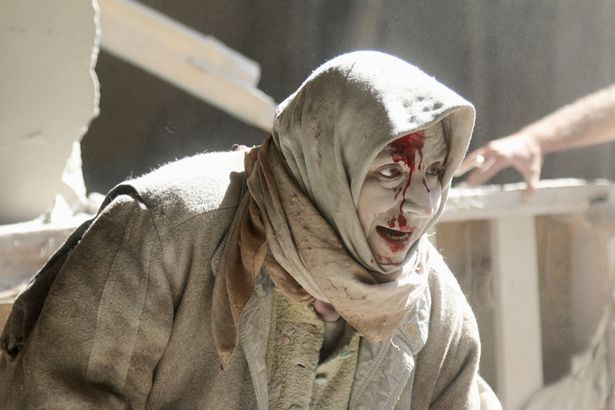
An injured citizen of Aleppo shortly after air strikes on the city. (Photo: Reuters)

An injured citizen of Aleppo shortly after air strikes on the city. (Photo: Reuters)

Frustrated by the Russian veto of a United Nations Security Council resolution on Syria, France and U.S. Secretary of State John Kerry last Friday called for war crime prosecutions over the ongoing assault on Aleppo. Such calls for legal action have been issued multiple times in recent years, including by the United States. Is the international community any closer to delivering justice today for the suffering in Syria? What are the prospects of accountability for war crimes in this ongoing, and tragic, civil war?

More can be done, especially here in the West, to hold people accountable for the situation in Syria. While none is perfect and some difficult to imagine, here are the options that have been proposed:

Investigation by the International Criminal Court

French President François Hollande is adamant that Russia could face consequences for its actions in Syria at the ICC. So stringent is his call for the ICC to prosecute Russian war crimes that President Vladimir Putin postponed a visit to France until it is “comfortable for President Hollande.” By suggesting that the ICC could investigate crimes in Syria, with or without Russian forces, France is setting unrealistic expectations and denying both reality and history.

The only way the ICC can achieve territorial jurisdiction in Syria is if the U.N. Security Council refers the situation in the country to the court. Demands for such a referral from the U.N. Security Council are as old as the conflict itself. Initially, there was little appetite to have the ICC involved. In 2012, then-Secretary of State Hillary Clinton said that prosecuting Bashar al-Assad at the ICC would not be “useful” to peace. It wasn’t until 2014, following a failed round of peace talks, that the United States threw its support behind a referral of Syria to the ICC — and only when it was perfectly clear that Russia would veto any such referral (which Moscow predictably did).

There is a possibility, hinted at by French authorities, that the ICC could investigate perpetrators in Syria who are citizens of ICC member states. The court would have what is known as “personal jurisdiction” over such actors. Fatou Bensouda, the chief prosecutor of the ICC, has acknowledged this possibility in the context of prosecuting Islamic State combatants from states like Jordan, Tunisia, France and the United Kingdom. However, she has also said that the Islamic State “is a military and political organization primarily led by nationals of Iraq and Syria,” and therefore “the prospects of my office investigating and prosecuting those most responsible, within the leadership of the Islamic State, appear limited.”

In short, there may be war criminals from ICC member-states, but they aren’t senior enough to warrant scrutiny from the court.

The cost of a Security Council referral of Syria for the ICC could be high. The relationship between the council and the court is far from healthy. The ICC has been requested by the council to investigate two situations before — Darfur in 2005 and Libya in 2011. In neither case has a single individual indicted by the ICC faced justice in The Hague. And in neither case did the Security Council, on the whole, seemed perturbed by this reality. The political carve-outs apparent in every council referral to date, including the failed referral of Syria to the ICC, do significant damage to the credibility and impartiality of the court.

An Ad Hoc Tribunal

Beyond the ICC, some believe it would be possible to set up an ad hoc tribunal with a mandate to prosecute atrocities in Syria and Iraq. Such a tribunal would likely come in the form of a hybrid court and include a mix of domestic and international prosecutors and judges. Numerous observers, primarily American scholars and lawmakers, have pushed the establishment of such an institution, going so far as to draft a “blueprint” for institution’s statute. As with an ICC referral, their efforts have been unsuccessful to date. Continue reading

Posted in Ad hoc tribunals, Hybrid Tribunals, ICC Prosecutor, International Criminal Court (ICC), International Criminal Justice, Iraq, ISIS, Islamic State, Syria | 6 Comments

Burundi’s Awkward — and Mostly Pointless — Farewell to the ICC

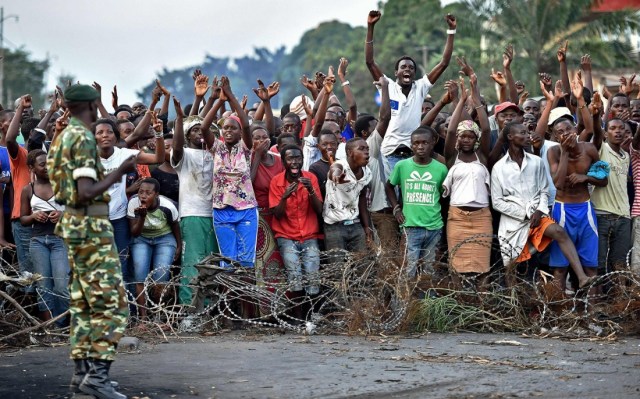
Violence has ravaged Burundi since the President sought a third term (Photo: Al Jazeera)

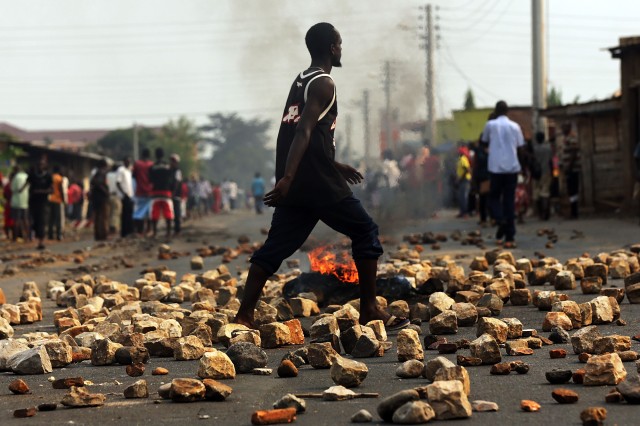
Political violence erupted in Burundi after the President Pierre Nkurunziza sought a third term, sparking a preliminary examination by the International Criminal Court. (Photo: Al Jazeera)

A government led by a President accused of mass human rights violations and crimes against humanity is seeking to end its relationship with the International Criminal Court (ICC). No, the President insists, this is not about hiding from justice. Instead, Pierre Nkurunziza maintains, it is because the Court is biased against Africa. His plan, however is likely to backfire. Nkurunziza and his henchmen cannot escape ICC justice, even if they do withdraw. Moreover, their tirade against the Court may have the unintended consequence of bolstering the fledgling institution’s legitimacy.

Political violence in Burundi has escalated since Pierre Nkurunziza sought a third term as president last year. Estimates suggest that hundreds of civilians have been killed and as many as 300,000 have fled the country. Full details are hard to ascertain in part because the government has denied human rights officials access to the country. Nevertheless, the unrest spurred ICC prosecutors to open a preliminary examination into the violence. Since then, investigators have been monitoring the situation in Burundi and going through the motions of deciding whether or not an official investigation, one that would almost certainly lead to an arrest warrant being issued against Nkurunziza, should be opened.

The Burundian government may be under the false impression that withdrawing from the ICC would curtail the Court’s ability to open an investigation into past and ongoing violence in the country. It would not. On the contrary, the Court can investigate all alleged crimes that have been perpetrated to date as well as any crimes committed one year from the day that the Burundi deposits its notice of withdrawal at the United Nations.

The legal details are murky but as former senior ICC official and current Harvard Professor Alex Whiting points out, Burundi’s threat of withdrawal is likely to act as an incentive for the ICC to speed up its decision and open an official investigation in the violence in Burundi. Of course, Burundian officials may simply not care about such legal vagaries. They most certainly won’t be letting any ICC investigators into the country and, given the ICC’s record, won’t fret any condemnation from the Court over their non-cooperation. But if the goal was to avoid ICC scrutiny altogether, the Burundian government’s anti-ICC tantrum could seriously backfire. What may have been left in the potential purgatory that is an ICC preliminary examination is now likely to be transformed into an official investigation by the Court.

Few, moreover, buy Burundi’s claim that their departure is due to the ICC’s alleged bias against African states. While the relationship between the ICC and Africa has been tumultuous and controversial, Burundi’s threat comes at a time when relations seem to be improving. Continue reading

Posted in Burundi, International Criminal Court (ICC), International Criminal Justice, Preliminary Examinations | Tagged | 3 Comments

Peace and Justice in Colombia – I Fought the Law and the Law Won

Mark Drumbl joins JiC for this post on the role and relevance of international law in the Colombia peace process. Mark is the Class of 1975 Alumni Professor of Law & Director, Transnational Law Institute, Washington & Lee School of Law. To read the other contributions to JiC’s symposium on peace and justice in Colombia, see here.

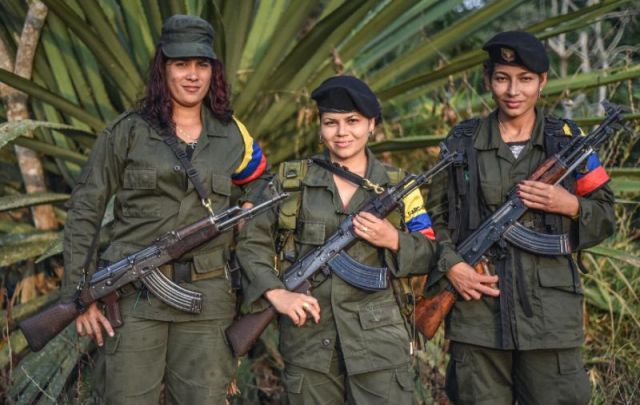
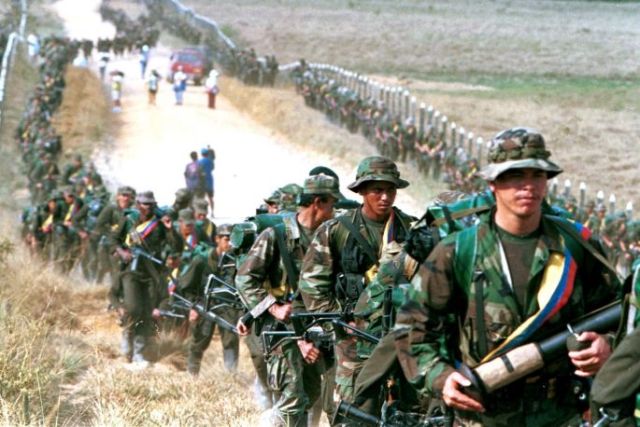
Members of the FARC rebel movement pose for a photograph (Photo: Luis Acosta / AFP)

Members of the FARC rebel movement pose for a photograph (Photo: Luis Acosta / AFP)

“Breakin’ rocks in the hot sun
I fought the law and the law won.”

— Sonny Curtis and the Crickets (1959), redone by many (my favorite being The Clash (1979)).

International criminal lawyers take the ‘duty to prosecute’ seriously. This duty fuels the powerful normative calling that systematic human rights abusers are to face the reckoning of the courtroom and, if convicted, the sanction of the jailhouse. Amnesties and pardons have become démodés. These duties and callings, in turn, color the self-portraiture of international criminal lawyers: they tincture how we see (our)selves. And, mostly, my impression is that we see (our)selves as fulfilling progressive causes and energizing the march of history and national politics eschatologically towards freedom, fairness, and justice.

Colombia however tells a different, less comforting, slightly more confronting, and certainly a much more complicated story. This story involves how the duty to prosecute international crimes, and to convincingly punish, can energize a right-wing ‘law-and-order’ agenda to the detriment of progressive interests.  In light of the tangibility of a firm duty to prosecute, a decision by a state to prosecute too little and to sentence too leniently can unleash anger. All sorts of politics (ant-leftist, anti-Chávez, anti-establishment, anger over evictions and land ownership, relations with Cuba) can be pretextually articulated under the guise of a palatable and otherwise attractive oriflamme, that is, the duty to prosecute FARC members. Certainly the need to prosecute and punish the FARC presented as a powerful rhetorical device for Álvaro Uribe. It allowed him to chastise the peace agreement as too soft, too permissive, and as simply wrong on moral grounds. What is more, the peace agreement failed to comport with best practices and international standards, which require prosecution and punishment. The peace agreement, painstakingly negotiated over four years, was seen my many as a ‘dubious giveaway’ that imperiled Colombia’s ‘judicial integrity.’  The ICC in its increasingly permanent preliminary examination was consistently skeptical of reduced sentences, though it grudgingly tolerated them.  Continue reading

Posted in Colombia, International Criminal Justice, International Law, Peace and Justice in Colombia Symposium | Tagged | 3 Comments

Meeting International Standards: Amnesty in the Colombian Peace Deal

Josepha Close joins JiC for this post on the issue of amnesty in the peace agreement between the FARC and the Colombian government. Josepha PhD graduate from Middlesex University. Her research focuses on the status of amnesties granted for serious crimes under international law. She is also the author of the International Law Blog.

(Photo: AFP)

(Photo: AFP)

Colombia’s Final Accord for the Termination of the Conflict and the Construction of a Stable and Lasting Peace, signed on 26 August 2016, was hailed by the UN Secretary-General as ‘a bright flare of hope that illuminates the entire world’. Its rejection by Colombian voters in the referendum of October 2nd has been attributed in part to the view that it offers impunity to persons responsible for international crimes and serious human rights violations. This post considers the extent to which the peace agreement provides for an amnesty compatible with international law and human rights.

The Amnesty

Different types of amnesties have been endowed with different degrees of legitimacy under international law. While amnesty laws covering international crimes and serious human rights violations are generally considered to be contrary to international law, those applying to political crimes against the State, such as rebellion, are less controversial.

Article 6(5) of the Second Protocol to the Geneva Conventions prescribes that, at the end of non-international armed conflicts, the ‘broadest possible amnesty’ should be granted to persons having participated in the conflict. Accordingly, peace agreements concluding internal armed conflicts have often included an amnesty clause.

Over the last quarter-century, there has been a growing tendency to consider that amnesties extending to serious crimes are incompatible with international conventions requiring the prosecution of international crimes and the provision of redress to the victims of human rights violations. This trend has been driven by the UN, which has adopted a policy of rejection of amnesty for serious crimes in the late 1990s. International courts and human rights bodies have also considered that amnesties are generally incompatible with international law, though some of them have qualified their position in respect of amnesties forming a necessary part of a peace and reconciliation process.

The UN policy has had an impact on the practice of including amnesty clauses in peace agreements. According to my PhD research, while only a small proportion of peace agreement amnesties introduced in the 1990s excluded serious crimes, about a third of those issued since the turn of the 21st century have made such an exception.

The Colombian peace agreement is a case in point. It extends an amnesty for political and related crimes, such as rebellion, sedition, mutiny, the lawful killing of enemy combatants and the illegal possession of weapons. However, pursuant to international standards, this amnesty makes an exception for international crimes and serious human rights violations, including crimes against humanity, serious war crimes, torture, the taking of hostages, enforced disappearances, extrajudicial executions, sexual crimes, forced displacement and the recruitment of child soldiers.

The Alternative Sentence Scheme

The Colombian agreement thus explicitly excludes amnesty for perpetrators of serious crimes. However, subject to two main conditions, those perpetrators are eligible for an alternative sentence entailing reparative labour and some restrictions on their liberty of movement but no prison term. First, they must confess their crime and acknowledge responsibility for it. Second, they must devise an individual or collective reparation project covering a period of 5 to 8 years, which needs to be approved by a special tribunal. Offenders who refuse to submit to those conditions face terms of imprisonment of up to 20 years. Continue reading

Posted in Amnesty, Colombia, Peace and Justice in Colombia Symposium | 4 Comments

The Great Escape? The Role of the International Criminal Court in the Colombian Peace Process.

As our online symposium on peace and justice continues, Kirsten Ainley joins JiC for this contribution on the role that the ICC played in the Colombian peace process. Kirsten is an Assistant Professor of International Relations at the LSE and the Director of the Centre for International Studies. She researches the development and politics of international criminal law, transitional justice, human rights, and international ethics.

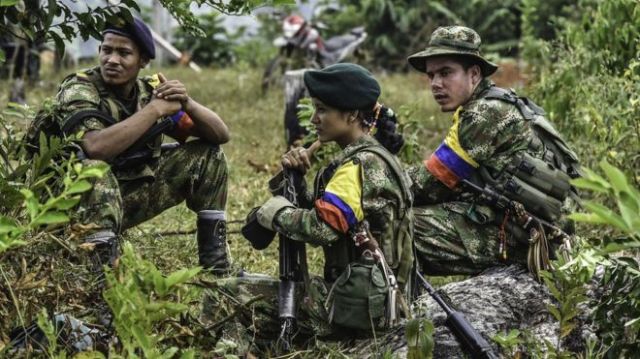
FARC troops patrol a roadway near to San Vicente de Caguan, in 1999. (Photo: Reuters)

FARC troops patrol a roadway near to San Vicente de Caguan, in 1999. (Photo: Reuters)

As the shock of the referendum result in Colombia dissipates, there is an inevitable search for culprits. How can it be that this opportunity to end a fifty-year civil war has been squandered? The guilty parties must be found – former President Alvaro Uribe, Human Rights Watch, or perhaps the weather? One of the actors which has long been criticised in terms of its effects on the prospects for peace and accountability in Colombia is the International Criminal Court (ICC). But to what extent can the ICC be held responsible for the fate of the peace process between the Colombian government and the FARC?

Before setting out the details of ICC’s role, it’s worth questioning whether the referendum result is a catastrophe. A ‘Yes’ vote seems, on the surface, to be the right result, and the Yes campaign was supported by the current government, the leaders of the FARC, a wide range of NGOs, regional governments, the US government (who seem willing to prop up the peace financially), the ICC Prosecutor and many of the Colombian electorate – particularly those in areas most affected by conflict. But peace may not be worth having at any price, and one doesn’t have to buy Uribe’s ‘fight to the death’ position to reject the current deal as going too easy on war criminals — on all sides of the conflict. If the Colombian electorate has really voted against the peace deal because a large proportion of it is dissatisfied with the accountability provisions contained therein, then this is a very significant moment, and a big challenge to some of the existing scholarship on peace and justice. Critics of international criminal law have tended to assume that populations will favour peace even at the cost of impunity, and that international actors (international courts and institutions, human rights NGOs and so on) are the ones who impose their own values that justice must be done no matter what the effects are upon peace processes. Yet many in the Colombian electorate seem to have voted to some extent in favour of accountability at the expense of peace. For all that observers might disagree with their views, it is not straightforwardly mistaken to have voted as they did.

What is the role of the ICC in all of this? For an institution which is expected to be staunchly principled – pursuing justice though the heavens may fall – it has been remarkably pragmatic when dealing with Colombia. The Colombian conflict was in the midst of its most violent period (1996-2002) when the Rome Statute was drafted. Paramilitary groups were carrying out massacres of civilians, thousands of people were assassinated and thousands more were kidnapped (mostly by FARC and the ELN) or disappeared. The FARC’s biggest military victories also took place during this period, and drawn-out peace talks failed. There existed significant evidence of a long list of probable war crimes and crimes against humanity, and a government that seemed unwilling and incapable of holding anyone to account for these crimes. Colombia was identified by Luis Moreno Ocampo, upon taking office, as one of three countries in which the gravest of crimes within the jurisdiction of the Rome Statute were being committed. However, because national proceedings of a fashion were underway in Colombia, the ICC’s Office of the Prosecutor (OTP) focused on Uganda and the Democratic Republic of Congo. Later, in June 2004, the OTP launched a preliminary examination into the situation in Colombia (an examination that was made public in 2006) and, in March 2005, the Prosecutor informed the government of Colombia that he had received information on alleged crimes in Colombia that could fall under the jurisdiction of the Rome Statute. However, an official investigation has never been initiated, despite the harms caused by the war continuing to increase: by 2013, the war has resulted in more than 220,000 deaths, around 80% of whom were civilians, and the displacement of more than 5 million people, making Colombia home to the world’s second largest population of internally displaced people (behind only Syria).

The ICC has been criticised both for doing too little, ie. for failing to progress from preliminary examination to investigation, and also for doing too much, that is, for interfering in the peace process. The truth is rather more prosaic: the OTP has done what it sensibly could, in the face of enormous challenges to Colombia and to the Court itself as a fledgling institution, to achieve its mandate. Its actions have contributed to the drafting of a peace agreement few would have predicted to be possible, and have also developed a model of how to use the threat of ICC action to help to support domestic justice initiatives. There is much to be learned from the ICC’s dealings with Colombia, and many of the lessons are about what the OTP got right. Continue reading

Posted in Colombia, Guest Posts, International Criminal Court (ICC), International Criminal Justice, Peace and Justice in Colombia Symposium, Peace Negotiations, Peace Processes, Preliminary Examinations | Tagged | 2 Comments

Peace with Justice in Colombia: Why the ICC isn’t the Guarantor

Lesley-Ann Daniels joins JiC for this post on the role of the International Criminal Court in the ongoing struggle for peace in Colombia. Lesley-Ann is a post-doctoral researcher at the Barcelona Institute for International Studies (IBEI). Her doctoral thesis examined the effects of amnesty on civil wars termination and her research interests are civil war and post-conflict peacebuilding. This is the fourth piece in JiC’s ongoing symposium on peace and justice in Colombia. You can find links to all of the contributions here.

(Photo: ABC)

(Photo: ABC)

On 4 October, the people of Colombia voted on whether to support the peace agreement signed only a few weeks previously by President Santos and the FARC rebel group leader, known as Timochenko. The peace accord had the potential to end a conflict that has lasted 52 years and resulted in a quarter of a million dead and many millions displaced, and it earned President Santos the Nobel peace prize.

While a popular referendum on the accord was not necessary, Santos had been promising for many years to put any agreement to a popular vote, as a way to ensure buy-in and gain legitimacy for the agreement. In the end, it was the government who lost, with a paltry turn-out (37.41% of the voters) and a wafer-thin majority rejecting the agreement (50.2% against). In the midst of the anguish and soul-searching, some themes are emerging that try to explain the defeat. One is that old favourite of peace versus justice. Voters in Colombia did not feel that “criminals” should be rewarded with “injustice, money and political representation”.

The question that remains is why the idea that justice will be sacrificed for peace still has so much resonance in a world where the International Criminal Court (ICC) exists, and especially in a country that is a state party to the Rome Statute. Surely, with the ICC as the backstop of international criminal justice, voters should be sure that anyone guilty of war crimes, crimes against humanity or genocide will end up in court. Voters should have felt reassured that either the deal meets ICC requirements (in order to avoid a post-agreement ICC intervention) or that the deal did not meet ICC requirements, in which case they could rely on the ICC to intervene. Why was the threat of ICC action not enough to reassure voters that rebels would face justice, even if the government was prepared to make concessions?

If the ICC is going to work anywhere, it should work in Colombia. The country has a long-standing support for international norms. For example, Colombia jealously promotes its reputation for signing international treaties and following international norms – “we are not some pariah”. Also, Colombia has a strong track record of conforming with rulings against it at the Inter-American Court of Human Rights. This is important because the ICC has no independent enforcement powers and much of its effects are through moral traction.

Furthermore, the ICC has had its eye on Colombia for some time; the Office of the Prosecutor (OTP) opened a preliminary examination in 2004, which makes Colombia one of the earliest and longest-running cases at the court. A preliminary examination is the step before opening a formal investigation; however, a case need not move forward to that next stage. The OTP will not act if the crimes are being sufficiently investigated by national authorities, and the maintenance of an open preliminary examination has enabled the OTP to keep up this pressure on the Colombian government and justice system. Continue reading

Posted in Colombia, Guest Posts, International Criminal Court (ICC), International Criminal Justice, Peace and Justice in Colombia Symposium, Peace Negotiations, Peace Processes, Peacebuilding, Preliminary Examinations | Tagged | 2 Comments