
This article was written for a symposium, organized by the Italian Institute for International Political Studies, entitled “Africa vs the ICC: Searching for an Exit Strategy”. I encourage all readers to check out the other submissions, including those by ICC Judge Cuno Tarfusser, Maddalena Procopio, Juliet Amenge Okoth, as well as Gerhard Werle and Moritz Vormbaum. Special thanks to Chantal Meloni for organizing!
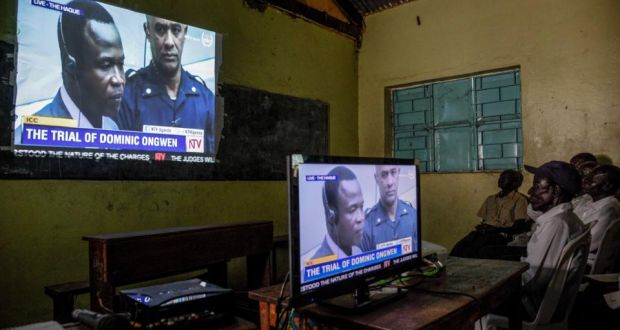
People in northern Uganda watch proceedings in the Ongwen trial at the ICC (Photo: Isaac Kasamani/ AFP / Getty Images)
Yoweri Museveni likes to present himself as the frontman for an allegedly pan-African movement against the International Criminal Court (ICC). According to the Ugandan President, the ICC is responsible for “blackmailing” African states and is composed of “a bunch of useless people”. Yet, in early 2016, the Ugandan government ensured that Dominic Ongwen, a senior commander in the notorious Lord’s Resistance Army (LRA), was surrendered to the Court. Ongwen’s arrival in The Hague marked a major victory for the fledgling ICC. Of the five individuals the Court has targeted in northern Uganda, Ongwen is the only one to face trial in The Hague. So how do we square the seemingly contradictory reality in which the most vociferous critic of the ICC’s role in Africa also gives the Court a boost in surrendering a prized perpetrator to The Hague?
This article seeks to provide an answer to this conundrum by weaving together three issues: 1) the politics around the ICC’s intervention in northern Uganda; 2) the trial of Dominic Ongwen at the ICC; and 3) the Africa-ICC relationship and the place of Uganda — and the Ongwen trial — within it. The somewhat counter-intuitive argument put forward is that the answer to the above-stated quandary has both nothing and everything to do with governments referring themselves to the ICC.
Africa and the ICC — Nothing to do with Self-Referrals
It is no secret that the relationship between some African states and the International Criminal Court is bruised and battered. There are numerous criticisms of the ICC’s role and impact on the continent. Some are self-interested and some are legitimate. Many of these have tapped into the perceived bias of the Court, a perception fed by the fact that, before 2016, the ICC had never opened an investigation outside of Africa and that the Court has never issued an arrest warrant for a non-African.
In recent years, the rhetoric emanating from African capitals to express their criticisms has picked up on this alleged bias and has become increasingly dramatic. The Court has been described by African leaders a “race-hunting” institution, an “International Caucasian Court”, and “a painfully farcical pantomime” that has become “the toy of declining imperial powers.” Substantively, however, the crux of the criticisms levied against the ICC has never been about the Court’s focus on African states. Rather, the fuel that feeds the fire of anti-ICC sentiment has been the ICC’s relationship with the United Nations Security Council (UNSC)and its permanent members. On two occasions, Darfur in 2005 and Libya in 2011, the UNSC referred situations to the Court. African states have voiced concerns following the ICC’s interventions in both cases and have generally opposed the ICC being invoked by the Council’s permanent member states — China, Russia, and the United States — which simultaneously refuse to submit to the Court’s jurisdiction themselves.
The orthodox response of the ICC and its defenders to criticisms against the ICC has been to focus on two counter-arguments: 1) that it is just the “bad guys” and dictators who claim that the ICC is biased because they are afraid of the Court, and 2) that African states, by-and-large, have invited the ICC to intervene in the first place through the issuance of self-referrals.
The first argument seems to suffer from a mild form of hypocrisy or, at the very least, a myopic and partial accounting of the Court’s history. There is no doubt that some awful leaders implicated in mass atrocities are vociferous critics of the ICC. It may even be that they fear being targeted by the Court. However, there seems to be zero concern with the fact that dictators and human rights abusers previously decided to join the ICC in the first place. This should be accounted for too. Additionally, it is important to recognize that there are many observers, including strong proponents of international criminal justice, who share the same concerns regarding the Court’s record and role in Africa and its relationship with the UNSC. It is deeply offensive, and counter-productive, to have their arguments lumped in with those of despots.
The second argument in defence of the ICC suggests that African critics of the Court are somehow hypocritical because the majority of situations under investigation in Africa were the result of self-referrals. This is a rather curious defence because no African governments have ever complained about self-referrals. The reason is obvious; as explored in more detail below, self-referrals are useful tools to get the ICC to target a state’s adversaries. Again, what African critics of the Court, and indeed many champions of the ICC, are primarily concerned about is the institution’s relationship with the Security Council. This mismatch of critique and defence has produced a rather stilted debate wherein concerns about what happens when the ICC accepts a UNSC referral are met with a defence of pertaining to self-referrals. Continue reading

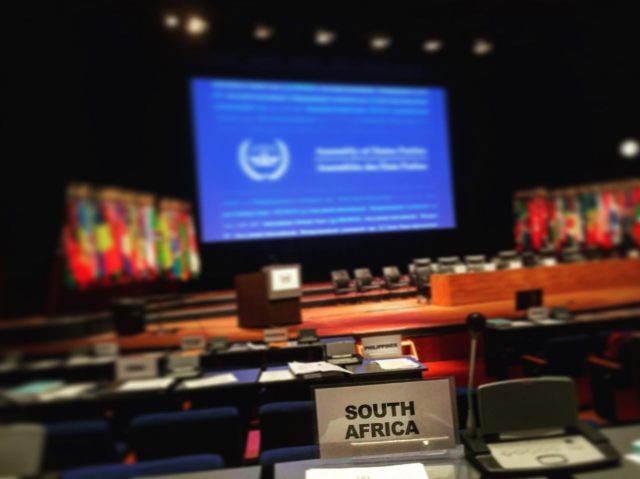
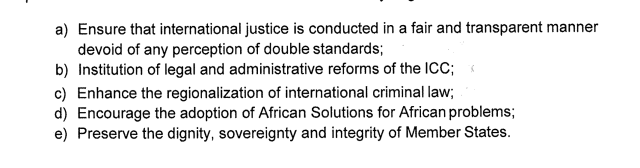 In reading the strategy, it is difficult not be left with the impression that African states remain engaged with the ICC. It certainly doesn’t sound like they’re collectively jumping ship. That’s because the Strategy reads like a largely reasonable list of possible reforms to the Rome Statute and the Court. Indeed, the arguments contained within the Strategy should be taken seriously and continue to be debated. There are at least a handful that should be acceptable to the Court and its champions, such as the long-standing request from Kenya to include “regional criminal jurisdictions” in the section of the Rome Statute’s pre-amble pertaining to the principle of complementarity. More attention also needs to be paid to the fact that the majority of the grievances and concerns expressed within the Strategy ultimately relate to