Barrie Sander continues our symposium on the trial of Dominic Ongwen and the prosecution (or in this case, defence) of former child soldiers. Barrie is a Ph.D. Candidate at the Graduate Institute of International and Development Studies (IHEID). His research focuses on conceptions of justice and the construction of historical narratives in international criminal courts. Barrie is also a regular contributor to JiC. You can find his other posts here. This symposium was inspired by Barrie’s efforts to start a debate and dialogue on the issues and dilemmas raised by the Ongwen trial.
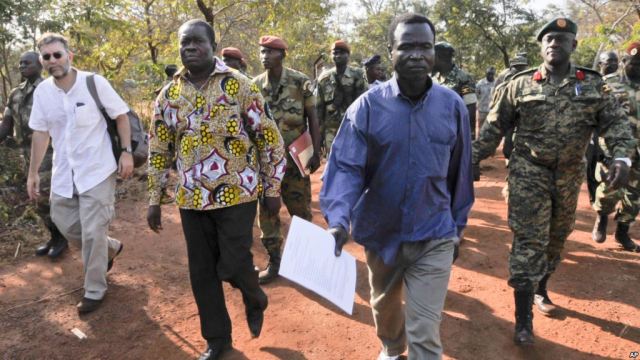
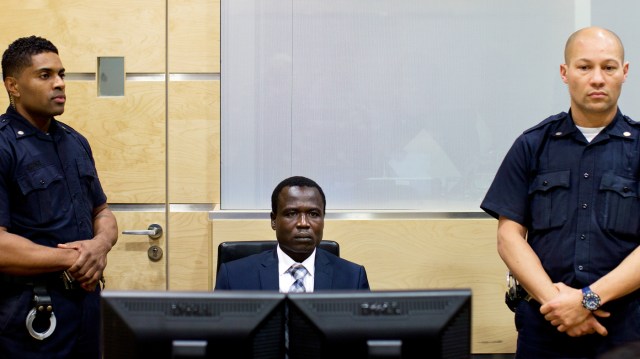
Dominic Ongwen shortly after he was transferred from the the African Union Regional Task Force to the Uganda People’s Defence Forces.
Amidst the flurry of activity within the field of international criminal justice over the past few weeks, Dominic Ongwen – former child soldier and adult commander within the Lord’s Resistance Army (LRA) – became the first individual in the history of the International Criminal Court (ICC) to have charges confirmed against him of which he is also a victim.
The story of Dominic Ongwen has been well-documented within existing scholarship and media accounts of the conflict in northern Uganda. Abducted at the age of nine and trained to become a child soldier, Ongwen grew up to become a notorious commander within Joseph Kony’s LRA. After falling into the hands of Seleka rebels in the Central African Republic in January 2015, Ongwen was taken into US custody and promptly transferred to the ICC in The Hague.
From its inception, the idea of prosecuting Ongwen at the ICC has divided opinion both within Uganda and beyond. For some, since there is little difference between Ongwen and other former child soldiers who have been granted amnesties for their crimes, it seems unjust to single out Ongwen for prosecution. This view feeds into a broader critique of the ICC, which queries whether justice can ever be done within a judicial institution whose prosecutorial selectivity is consistently aligned with the dictates of State power. For others, Ongwen’s prosecution at the ICC is not only welcome but necessary. Adherents to this view caution that failing to prosecute Ongwen would serve as a licence for those in similar circumstances to carry out acts of violence with impunity.
One of the complexities of Ongwen’s case is that his victim-perpetrator status challenges the binary coding of international criminal law, which, as Mark Drumbl has argued, “derives its energy from, and in turn disseminates polarities of guilt/or innocence, capacity/or incapacity, adult/or child, and victim/or perpetrator”.
This dimension of the case rose to the fore during the Confirmation of Charges proceedings when Ongwen’s Defence attempted to rely on their client’s tragic background to argue that the case against him should be dismissed. In particular, the Defence raised two arguments, both of which were ultimately rejected by the PTC.
The Defence first argued that Ongwen should benefit from the legal protection afforded to child soldiers up to the moment of his leaving the LRA in January 2015, almost 30 years after his original abduction, and that such protection should include the exclusion of his individual criminal responsibility.
The Defence emphasised that the crime of conscripting child soldiers is a continuous crime and therefore did not come to an end when Ongwen turned 15 years of age. Forced to witness and perform unspeakable acts as a child, Ongwen was psychologically broken down and disconnected from the social construct of normal society in northern Uganda. Since Ongwen remained locked within this environment throughout his life, the Defence contended that the age of 18 years old, which serves as the marker for adulthood and criminal responsibility before the ICC, has little relevance for someone in his situation. In particular, it would be contrary to notions of justice to use international humanitarian law against Ongwen when that very same body of law had failed to protect him in the first place.
In response, the PTC gave short shrift to this argument, simply observing that it was entirely without legal basis and would therefore not be entertained further.
In its second argument, the Defence argued that Ongwen’s responsibility should be excluded on the ground that he acted under duress within the meaning of Article 31(1)(d) of the ICC Statute. Once again, the PTC rejected the Defence’s argument, this time on multiple grounds.
First, the PTC argued that the threat alleged by the Defence – the possibility that Ongwen would later be subjected to disciplinary measures – had not been “imminent”. In this regard, the PTC emphasised that “duress is not regulated in the Statute in a way that would provide blanket immunity to members of criminal organisations which have brutal systems of ensuring discipline as soon as they can establish that their membership was not voluntary”.
Second, the PTC argued that Ongwen’s stay within the LRA – which the Defence had claimed to be the source of the threat – could not be said to have been “beyond his control”. For this purpose, the PTC pointed to evidence that escapes from the LRA were not rare and that Ongwen could have chosen not to rise within the hierarchy and expose himself to increasing levels of responsibility within the organisation.
Finally, the PTC argued that the Defence had failed to demonstrate that Ongwen had acted “necessarily and reasonably” to avoid the alleged threat and had “not intended to cause a greater harm than the one sought to be avoided”. By way of example, the PTC observed that even if Ongwen could not have avoided accepting forced wives, “he could have avoided raping them, or, at the very least, he could have reduced the brutality of the sexual abuse”.
As this analysis suggests, the Defence and PTC each adopted contrasting narrative perspectives of Ongwen’s behaviour. Whereas the Defence viewed Ongwen’s story as a narrative about inevitability, involving an individual caught up in events beyond his control, the PTC depicted Ongwen’s story as a narrative about choice, involving a moral agent who had genuine opportunities to act otherwise than he did notwithstanding his devastating upbringing. Continue reading →

 It was very belated and it most certainly wasn’t without hiccups, but the International Criminal Court (ICC) finally has a new website. I would describe it as “miles better” but that doesn’t even come close to sufficing.




 Justice in Conflict
