
For months, the international community has been clamouring to find an appropriate response to address the plight of hundreds of thousands of refugees fleeing violence and terror in Syria. But much of the debate about what states can and should do has been framed as a ‘numbers game’, as a matter of the volume of refugees any given state accepts. In this article, a version of which was first published at Open Canada, I argue that our moral responsibility to refugees cannot solely be measured by the number we take in. The piece focuses on the current debate in Canada but, hopefully, will also resonate with readers in communities facing similar situations.
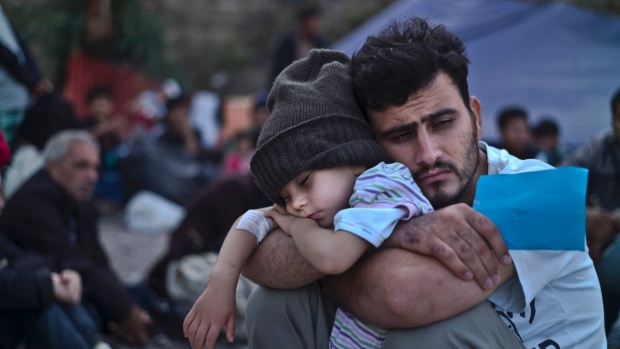
A Syrian man holds his son at a refugee camp (Photo: Muhammed Muheisen / Associated Press
Numbers have power. They determine both politics and policies. We are comforted when we are told that hundreds of billions of dollars will go towards combating climate change — even if few know what that amount of money actually buys. We are shocked and appalled when we hear that 300,000 people, and counting, have perished during the Syrian civil war. We are concerned when confronted with the disparity in wealth and opportunity between the wealthiest one percent and the other 99 percent.
Numbers underpin the decisions we make, the ideas we propagate and the rationales we employ to support both. But numbers don’t always add up. And in some instances, they obfuscate more than they elucidate. The current debate over the acceptance of Syrian refugees to Canada is a case in point.
Since the harrowing images of Alan Kurdi’s lifeless body on a Turkish beach captured the world’s attention, there has been a welcome, if belated, debate about what Canada can do to help the plight of refugees fleeing violence and atrocity in Syria. In part because this debate emerged so powerfully in the midst of last October’s federal election, politicians distilled it into a numbers game. The Conservatives, then under Stephen Harper, promised to bring in and settle 10,000 Syrian refugees by September 2016. The Liberals, led by now-Prime Minister Justin Trudeau, countered that they would accommodate 25,000 refugees from the region by the end of 2015. The question of who would promise to do the most for Syrian refugees thus became a matter of who would offer to accept the most Syrian refugees. But these are not one and the same.
The current Liberal government came under fire for being over-confident, perhaps even naive, in declaring that it could settle 25,000 refugees within three months of assuming power. Subsequently, it revised its target to 10,000 by Dec. 31, 2015, extending the deadline for 25,000 until March.
Now, well into the New Year, the government has reached approximately 25 percent of its target. Are they to blame? Have they failed? Some would certainly claim so. NDP MP Jenny Kwan declared that not only did Immigration Minister John McCallum “irrefutably fail to live up to the promise Liberals made to Canadians in the last election, but he even failed to meet his own lowered expectations.” In a recent op-ed, columnist John Ibbitson has added that, based on the numbers, “the Conservative goal is looking more realistic than what the Liberals promised.”
There is no doubt that the government should be held to account for the promises it makes and breaks. But basing our judgment of appropriate political and moral action to help Syrian refugees should not be a numbers game. The political challenge we face isn’t to ‘fit in’ as many refugees as the government promises in as short a period of time as possible. Bean-counting people and families fleeing terror cannot meet the moral test we are confronting. To do so misses the point: that what we need is a nation-wide conversation about how we can create and maintain a coherent, comprehensive and, above all, compassionate program that not only brings refugees, along with their immense energy and courage, into the country, but ensures that they are adequately supported once they arrive.
Such a program could also serve as an example for how to handle future refugee crises, or, better yet, lead into a debate around the effectiveness of Canada’s process on the whole, considering the many refugees worldwide who are waiting in camps or have been put on years-long waiting lists to be provided entry into Canada. Unless there is a declared global emergency or politically driven attention on their plight, those others are clearly not being served under our current system.
![President Islam Karimov of Uzbekistan. By Ernests Dinka, Saeimas Kanceleja [CC BY-SA 2.0 (http://creativecommons.org/licenses/by-sa/2.0)], via Wikimedia Commons](https://justiceinconflict.org/wp-content/uploads/2016/02/karimov_latvia.jpg)



 Justice in Conflict
