Tinker, Tailor, Lawyer: ICC Staff Arrested in Libya for “Spying”

Saif Gaddafi Zintan

Saif al-Islam Gaddafi, not long after his arrest by Zintani rebels in November, 2011

I really hope John le Carré has read news of the arrest of four ICC staff members in Zintan while attempting to visit Saif al-Islam Gaddafi. A delegation, which includes an Australian lawyer, Melinda Taylor (media reports have not named any other members of the delegation), were detained while attempting to provide Saif with information and documents pertaining to his defense against charges of war crimes for his role in the Libya’s revolution. The team had been invited by the Libyan General Prosecutor’s office to visit Saif. When the delegation went to visit Saif, however, everything went pear-shaped.

A commander from the Zintan brigade, Ajmi al-Atiri, described what appeared to be an intelligence operation against the ICC staff:

“We tricked the ICC team by presenting them with one of our men who we told them was deaf and old and illiterate but he is actually a wise man who can speak four languages including English.

That is when we found out the lawyer had a letter written in English that they wanted him to sign admitting that there is no law in Libya and asking to be transferred to the ICC. When we searched the woman we found she had a letter from [close confidante] Mohammed Ismail for Saif and another one written back to Ismail.

They also took a number of empty papers with his signature on it, and he gave them a number of letters written by Saif for Mohammed Ismail. Before the delegation entered the meeting with Saif, we inspected them and discovered spying and recording materials on one (member) of the delegation.

The case is a homeland security issue…The lawyer should have presented the material to the prosecutor-general’s office before taking it into the suspect.

Saif would only be allowed private meetings with a lawyer if he had appointed one for himself, but in this case the ICC appointed this lawyer for him and so has no right to sit with Saif privately.”


The validity – or lack thereof – of these rather serious allegations remain unclear. For one, I’m very curious what “spying and recording materials” were confiscated. The use of cameras and tape recorders, for example, should not be an issue when meeting with defendants. It has also been suggested, but not confirmed, that Taylor smuggled the allegedly “dangerous” documents in her bra. Media outlets have not picked up on it, but on Twitter #ICCBra has been a trending topic. Continue reading

Posted in Libya, Libya and the ICC | Tagged , | 4 Comments

A Disturbing Tale: Canada’s Human Rights Record and Reputation

Canada human rights

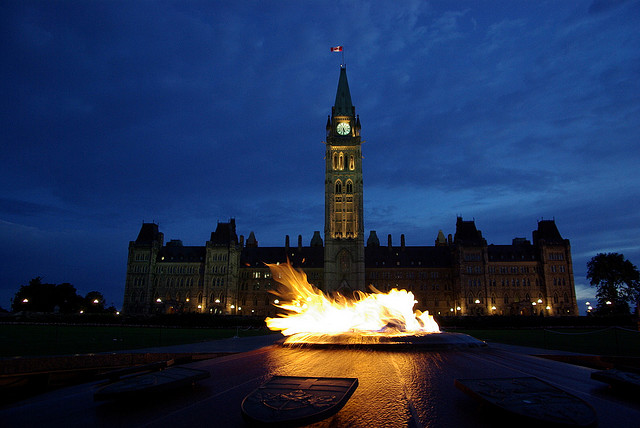
(Photo: DJKing / Flickr)

This past week the United Nations Committee Against Torture released a report into Canada’s human rights record. It wasn’t pretty. The Committee suggested that Canada was complicit in the torture of Canadian citizens post-9/11 and expressed concern at the “apparent reluctance on part of the State party [Canada] to protect rights of all Canadians detained in other countries.” Shocking, right? Not really – not if we look closely at Canada’s recent behaviour with regards to international justice and human rights.

I should disclaim that, as a proud Canadian, this is a subject I feel very personal about. My frustrations may boil over. It is from a profound sense of patriotism and pride in Canada that I am so disappointed, sometimes infuriated, and certainly humiliated by Canada’s record.

Whenever people ask why I am proud to be Canadian, I have a ready-made answer, developed over years from practice as well as hearing why people from around the world respect Canada. I tell them that Canada is a truly multi-cultural country which initiated the creation of peacekeepers, mediated the Suez Crisis, was at the vanguard of creating the Responsibility to Protect and played a leading role in the creation of the International Criminal Court. It is a medium-power that punches well above its weight. It is a moral power that people depend upon to be in the corner of human rights and international justice. So what happened?

Not unlike other Western states, Canada got tangled in the political and ethical dilemmas characteristic of post-911 national and international security. It struggled, in particular, to balance the human and civil rights of its citizens with the prerogatives of anti-terrorist and national security measures. On a number of occasions the government decided that there was nothing to balance at all; security would come at the expense of rights. The results were disastrous. Here are but a few examples that illustrate Canada’s troubling record on respecting the civil and human rights of its citizens post 9/11.

Maher Arar: To Syria, without love – or rights

In 2002, Canadian citizen Maher Arar was deported to Syria while he was travelling through the US on his way back to Canada. US authorities believed he had terrorist links despite insufficient evidence to lay charges. The result was Arar’s extraordinary rendition to Syria where he was subsequently interrogated and tortured. While in detention, Arar maintained that he was forced to confess that he attended an al-Qaeda training camp in Afghanistan. Arar remained in detention for almost a year. He subsequently and successfully sued the Canadian government for $10 million.
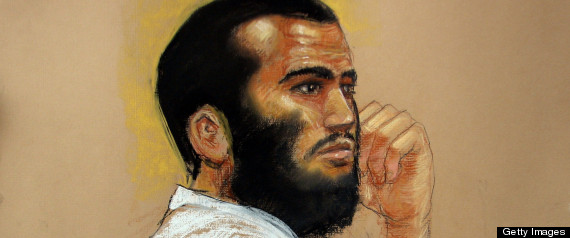
Omar Khadr at his US military war crimes commission trial in Guantanamo Bay

Omar Khadr at his US military war crimes commission trial in Guantanamo Bay (Sketch: Janet Hamlin / AFP / Getty Images)

Omar Khadr: Canada’s Child in Guantanamo

In 2003, Omar Khadr, another Canadian citizen, was detained after allegedly killing an American medic in Afghanistan. At the time of his arrest he was 15 years old. He was then sent to the notorious American detention facility in Guantanamo Bay and has been there ever since. His detention has made a mockery of his right to a speedy trial, to due process, his civil rights as a Canadian, his human rights and, most obviously, international law, given that he is a child combatant. The UN Panel referred to “Canadian officials’ complicity in the human rights violation of Omar Khadr while detained at Guantanamo Bay.”

Even with President Obama’s plan to move detainees out of Guantanamo, Canada refused to repatriate Khadr. It has even been reported that the US had sought a Canadian request to have Khadr sent back to Canada.

Khadr eventually pleaded guilty to murder in October 2010. Part of the plea deal was an agreement that Khadr would remain in Guantanamo Bay for another year before being transferred to Canada. Incredibly, however, he remains in Guantanamo and it is unclear when Khadr, once described by Radhika Coomaraswamy, UN secretary-general’s special representative for children and armed conflict, as representing the “classic child soldier narrative” will be repatriated.

Abousfian Abdelrazik: Stuck in Sudan

The story of Abousfian Abdelrazik may read like a cruel joke. In 2003, Abdelrazik was arrested in Sudan under suspicion of being linked to al-Qaeda and Osama bin Laden. Despite the suspicions, no charges were ever placed on Abdelrazik by any nation, while the CSIS and the RCMP cleared him of any wrong-doing. Because he has been on an international “no-fly” lists which prevented him from taking conventional commercial flights, Abdelrazik was forced to stay in Sudan. The Sudanese government subsequently offered to fly him to Canada on a private Sudanese plane. Canada refused the offer. Fearing for his safety, Abdelrazik took refuge in the Canadian embassy in Sudan in April 2008. The Canadian government called his situation “temporary”, but he stayed for over a year. In total, Abdelrazik spent six years in forced exile in Sudan. Continue reading

Posted in Afghanistan, Canada, Extraordinary Rendition, Guantanamo Bay, International Criminal Court (ICC), Justice, Torture, War crimes | Tagged , , , | 2 Comments

Politics, a Poison for Justice?

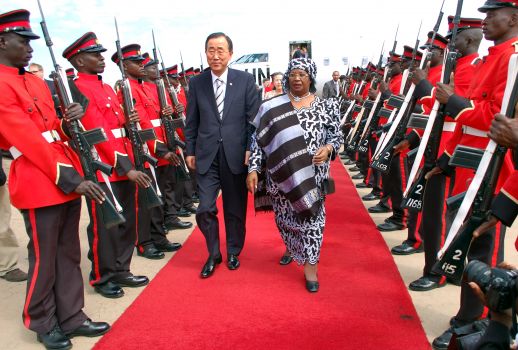
Malawi’s new President, Joyce Banda, with UN Secretary General, Ban Ki-moon (Photo: Aos Gumulira / AFP / Getty Images)

Richard Dicker, the director of Human Rights Watch recently wrote an interesting op-ed in the New York Times, provocatively entitled ‘A Flawed Court in Need of Credibility‘.

Ten years ago, when the treaty creating the International Criminal Court took effect, the prospect of holding heads of state and powerful warlords to account for mass slaughter seemed like science fiction.

Today the signs carried by Syrian protesters demanding “Assad to The Hague” are powerful testimony that the court is making its presence felt.

But as the I.C.C.’s influence grows, its promise of impartial justice for the world’s worst crimes is at risk of being undercut by international politics.

Dicker’s piece succinctly evokes an ongoing debate about the relationship between politics and international criminal justice. There is a prevalent belief amongst jurists, lawyers and advocates of international criminal justice that politics is the enemy of justice. Justice, to them, requires a complete separation from political considerations. Politics and justice are like oil and water. Justice must be neutral, black-and-white, and apolitical. On the other hand, many negotiators, diplomats and scholars of international relations argue that it is naive, if not simply ridiculous, to suggest that international justice can ever be apolitical. After all, international justice will always depend on states which remain the primary political unit in the international sphere. Moreover, justice will inevitably be selective and reflect the interests of powerful stakeholder states.

Dicker, is of course, right to point out the ever-present dangers of powerful states manipulating and instrumentalizing the ICC. As readers will know, I believe that the cozy relationship between the realpolitik of the UN Security Council and the ICC poses dangers for the legitimacy of the Court. But realpolitik is not all that “international politics” is or has to be.

The problem with the debate, it seems to me, is altogether a different issue: it doesn’t allow for any space within which to argue that international criminal justice can be good politics and that good politics can guide international criminal justice. Proponents of international criminal justice shouldn’t aim to talk a separation between politics and justice into reality but rather endorse the convergence of political interests with the interests of justice, to make the political interests of states in line with effectively and appropriately responding to atrocities and combating impunity. In other words, international criminal justice is a political project; there is simply no escaping this fact. But advocates of the project don’t need to fear international politics. Rather, they should work to transform it into good politics.

Consider the example of Malawi. Just last year Malawi, a member-state of the ICC, drew the ire of the Court for hosting Sudanese President Omar al-Bashir in defiance of the ICC which had issued an arrest warrant against Bashir for his alleged role in the commission of genocide, crimes against humanity and war crimes in Darfur. As a result, last December the ICC referred Malawi to the UN Security Council. Continue reading

Posted in International Criminal Court (ICC), International Law, Malawi, Sudan | Tagged | 12 Comments

Thank you and Farewell from Patrick Wegner

Dear readers,

It is with great regret that I have to stop contributing to JiC regularly due to time constraints. I recently became a diplomat at the German Foreign Office and am trying to finish my thesis at the same time, which is very time consuming. I am therefore no longer able to contribute to JiC regularly. You will probably find a post by me every once in a while as a guest author. With Alana Tiemessen, Mark and Elke around I have no doubt that my absence will be barely felt and that JiC will be contributing meaningful commentary to international criminal law in conflicts for the months and years to come.

I would like to thank all our readers for their interest and their comments and I would like to thank the JiC team for an amazing year of blogging together.

All the best,

Patrick

Posted in JiC News | 5 Comments

Has Social Media Successfully Reinvented Social Activism?

This week I had the honour to participate in a debate at the historic Oxford Union on whether “social media has successfully reinvented social activism”. The relationship between social media and social activism has become a critically important subject in the wake of the so-called “twitter revolutions” in Iran and Moldova, the use of blogs, Facebook and Twitter in the Arab Spring as well as Invisible Children’s KONY2012 viral campaign. Nevertheless, we are only just beginning to understand how social media in fact produces real-life results in the context of conflict, revolutions, and social upheaval.

It was a fascinating debate and a wonderful event with an impressive cast of debaters. Speaking in proposition of the motion were David Vitter, US Senator for Louisiana, Mark Pfeifle, former Deputy National Security Advisor to President George W. Bush, Benjamin Cohen, Tech Correspondent at Channel 4 News, and Ella Roberston, a student at Oxford. In opposition were Dr. Christopher Carpenter, professor of Communications at University of Western Illinois, Matt Warman, the Consumer Technology Editor at The Telegraph, Robert Sharp, Head of Campaign & Communications at English PEN, and myself. I am very happy, proud and even a bit surprised to say that the opposition was victorious.

While not directly related, in the wake of KONY2012, the question of how social media and social activism relate has been on the minds of all of us interested in international criminal justice. I therefore wanted to share with you a draft of the speech I gave on this increasingly pertinent subject. At the bottom of this post, you’ll also find a small bibliography with a few online sources which I found particularly useful in my preparation for the debate, especially for deciphering fact from fiction. As noted above, this is just the beginning of the debate. In that vein, I would love to hear what you think!

Madam President, honourable members, ladies and gentlemen,

There is no point in standing before you and denying that social media has changed how political and social activism is done. It clearly and obviously has. Despite this, social media has not, I will argue, “reinvented” the fundamental rules of social activism. To suggest so is to misunderstand what it means to do social activism and to be a social activist.

We are told a very simple story about the relationship between social media and social activism. You have all heard it. Social media topples Arab tyrants. Social media leads to democratic elections. Social media can bring rebel leaders in the heart of Africa to justice. At the core of this apparently irresistible narrative is the belief that social and political campaigns are a success when they achieve massive online traffic and “go viral”. The problem here is simple. None of the above is true.

An absolutely necessary condition for the effectiveness and success of a social campaign is building a political community of real-life, off-line physical human beings committed to a common cause.

Take for example, Invisible Children’s KONY2012 campaign. It did not go viral randomly or because of celebrity endorsements on Twitter and Facebook. Beneath this popular veneer, is the reality that Invisible Children worked for almost a decade to build a network of like-minded individuals willing to drive across Canada and the United States in order to show the group’s latest films in schools and churches. It should thus come as no surprise that KONY2012 began trending on Twitter before the campaign video itself was released – as the carefully cultivated community of Christian youths in mid-sized American cities began tweeting.

Consider too, the role of social media in the Arab Spring. It would be wrong to attribute the effectiveness and success of human rights and democracy campaigners in Egypt, Tunisia, Libya, Bahrain, and so on, entirely to social media. The opposition to these regimes had learned from decades of experience, training in human rights and civil disobedience.

The people who bravely marched on Tahrir Square in Cairo and Green Square in Tripoli did so not because they heard about it on Twitter but because of real grievances; because of years of outrage and humiliation; because, to them, enough was enough.

Part of the popular narrative also tells us that re-tweeters and sharers on Facebook themselves are a new breed social activists, ready at the whim to tackle tyranny and oppression, their iPads and iPhones proof of their commitment to liberal democratic values. Of course, they’re not the same type of activists. Instead, the popular and rather disparaging argument is that they are “slactivists”. Again, this is fundamentally misleading. Sharing and re-tweeting KONY2012 was a symbolic action, the merits of which we can debate. But it was symbolic action taken almost exclusively by people who were never activists in the first place. This helps to explain why Invisible Children’s campaign to “Cover the Night” – which required real activists – was such an epic flop. Continue reading

Posted in Activism, Advocacy, Iran | Tagged , , , , | 12 Comments

ICC Prosecutor Moreno-Ocampo headed to FIFA

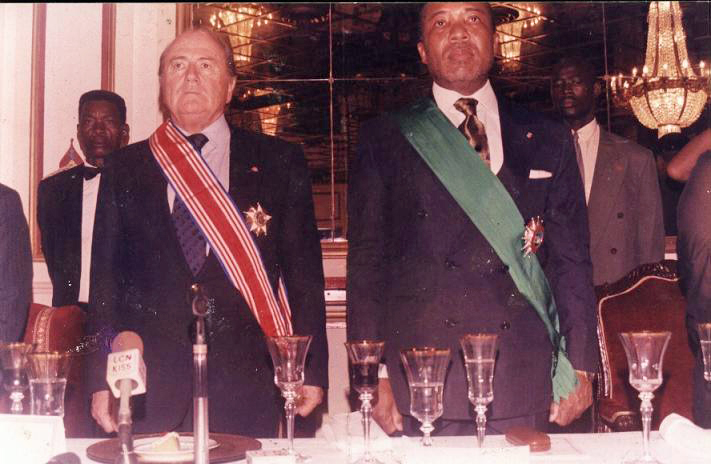
FIFA President, Sepp Blatter, with former Liberian President, Charles Taylor, recently the convicted for aiding and abetting war crimes in Sierra Leone.

So that came out of left field. ICC Chief Prosecutor Luis Moreno-Ocampo will become FIFA’s ethics and corruption czar. As most readers will likely know, Moreno-Ocampo’s tenure at the ICC is coming to a close. In mid-June he is due to leave the Court after nine years as Prosecutor. His position at FIFA brings to an end speculations of where Moreno-Ocampo would go after a controversial but in many ways remarkable tenure at the ICC. Interestingly, Moreno-Ocampo does have a historical link to soccer/football, having been former superstar Diego Maradona’s lawyer.

Here’s from the BBC:

The Argentine is expected to be confirmed next month, and will investigate allegations of corruption or ethics rules breaches.

Ocampo’s chamber will bring charges, while a separate arm will judge cases.

In March, football’s governing body announced a wide-ranging overhaul of its governance, in light of a series of corruption allegations that have rocked the organisation over the last 18 months, concerning bothWorld Cup bidding and the presidential election.

Fifa’s single-chamber ethics committee failed to gather enough evidence to prosecute allegations of vote-rigging during the 2018 and 2022 World Cup bidding contests.

A report by Fifa’s anti-corruption adviser, Swiss professor Mark Pieth, called Fifa’s past investigation of corruption allegations “unsatisfactory”, with sanctions imposed both “insufficient and clearly unconvincing.”

A double ethics chamber, with one arm overseen by Ocampo, is an attempt to improve the efficiency and reputation of Fifa in this area.

David Bond adds that “[c]rucially, this body would have the powers to delve into the past – reopening the prospect of another more thorough examination of claims of wrongdoing during the 2018 and 2022 World Cup bidding contests.” Continue reading

Posted in ICC Prosecutor, International Criminal Court (ICC), Sport | Tagged , , | 3 Comments

Does the ICC Need to Reconcile with Africa? Bensouda Comes Out Swinging

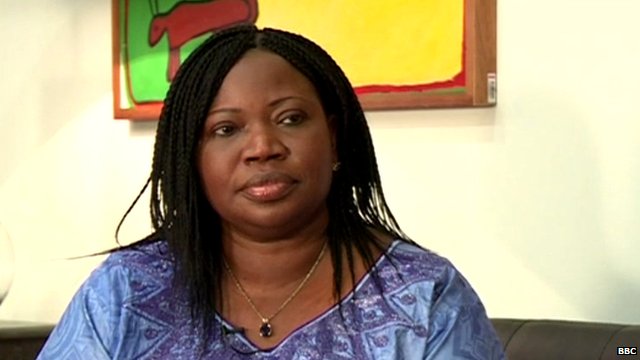
Photo: BBC

Fatou Bensouda, incoming Chief Prosecutor for the International Criminal Court, has put threatening war criminals and defiant states on notice. In several recent public statements she has directly addressed two of the Court’s most significant challenges: the accusation that the Court’s credibility suffers from a “pro-Western, anti-African” bias and the related issue of ensuring state cooperation and support, particularly in executing arrest warrants.

The argument that the ICC has (so far) unjustly targeted only African states and individuals is mostly based on misperception and has become a rhetorical tool of political elites to undermine the Court. Yes, all of the situations presently under the Court’s jurisdiction are from Africa. But as Bensouda and many others have pointed out, the Africa bias criticism is baseless for the following reasons.

African states wanted the ICC: Much of the strongest support for a permanent international criminal court in the Rome Treaty negotiations came from the Africa group. That support continued after Rome and African States Parties have a high level of ratification of the treaty (although, notably, a weak level of corresponding implementation legislation).

African states need the ICC: The empirical reality is that many situations of atrocities, and those that meet the (vague) “sufficient gravity” criteria for the Court to intervene, are in Africa. Moreover, many African states have a weak rule of law that fails to deter and respond to such atrocities, and so these situations justify the ICC’s intervention as a “court of last resort.” As Bensouda defended,

“The office of the prosecutor will go where the victims need us….The world increasingly understands the role of the court and Africa understood it from the start. As Africans we know that impunity is not an academic, abstract notion.”

African states invited and welcomed the ICC: Three states self-referred their situations to the Court (Uganda, DRC, and the Central African Republic) and three states initially welcomed and have since exhibited a satisfactory pattern of cooperation with the Court (Cote d’Ivoire, Kenya, and Libya). Only Sudan remains resolutely defiant and given its head of state is among the accused this should prove, not disprove, the ICC’s credibility. Bensouda expressed frustration that cooperation from African states and civil society is

“not the story relayed in the media….(and) anti-ICC elements have been working very hard to discredit the Court and to lobby for non-support and they are doing this, unfortunately, with complete disregard for legal arguments.”

J’accuse! African war criminals don’t want the ICC: Accusing the ICC of a “pro-Western, anti-African” bias is a rhetorical political tool of the accused themselves. Accusing an international tribunal of pro-Western bias or victor’s justice is also not unique to the ICC – Goering, Milosevic, Taylor, etc. all rejected the tribunals they faced with this grandstanding challenge. The accused cannot defend their crimes, so they choose to undermine their accusers instead and invoke hyperbolic claims of racism and neo-colonialism. Continue reading

Posted in African Union (AU), Fatou Bensouda, ICC Prosecutor | 8 Comments

Welcoming new JiC Co-Author, Alana Tiemessen!

Alana TiemessenDear Readers,

It is with great pleasure and excitement that I introduce to you, Alana Tiemessen, who has joined JiC as a new co-author. Many will already be familiar with Alana’s work on transitional justice, international criminal justice and lawfare at The Duck of Minerva and the Canadian International Council, amongst other publications. Alana already has a fantastic post up on Fatou Bensouda’s defense against allegations that the ICC has an African bias. We simply could not be happier that she’s agreed to join JiC!

Here’s a bit from her bio:

Alana will be joining the University of Chicago in fall 2012 as a Postdoctoral Fellow in the Department of Political Science and is presently a Visiting Assistant Professor in the Department of Political Science at UMass Amherst. Her current research focuses on judicial interventions and the International Criminal Court, transitional justice norms and practice, and the intersection of international security and human rights in failed states and post-conflict societies. She received her PhD in Political Science from the University of British Columbia in 2011. You can follow her on Twitter and on Academia.edu

Please join me in welcoming Alana!

Posted in Uncategorized | Leave a comment

Justice for Sexual Violence and Gender Crimes in Argentina

The following is a guest-post on gender and sexual violence as crimes against humanity and torture in the context of Argentina’s Dirty War by Mariana Rodriguez Pareja and Alia Al-Khatib, who is a human rights activist and Vassar Maguire Fellow in Buenos Aires, Argentina. Enjoy!

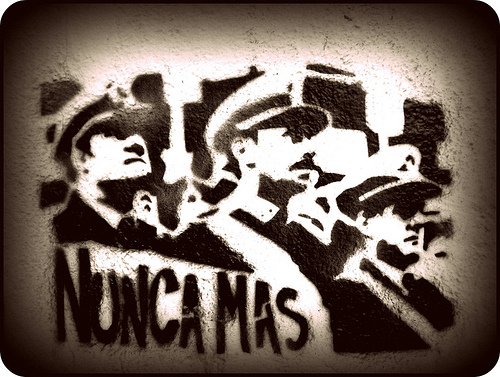
(Photo: Stephen Perry)

The military coup in 1976 began the worst phase of Argentina’s recent history, the so-called National Reorganization Process, which left 30,000 people killed or forcibly disappeared according to official estimates.  In contrast, the restoration of democracy in 1983, with the help of Raul Alfonsín, brought with it a pursuit of justice and truth, especially with the National Commission for Disappeared Persons (CONADEP) and its report, Never Again, as well the famous Trial of the Juntas in 1985.

This process of justice was quickly truncated in 1986 when the National Congress approved the laws of Full Stop and Due Obedience.  These laws prevented national courts from investigating mid and low-level military members for their actions during the dictatorship. Likewise, those who were not included within the standards outlined by these laws benefited from the presidential pardons of Carlos Menem in 1989 and 1990.

Following a strong agenda for justice and memory, former President Nestor Kirchner sent to Congress in 2003 a law which declared the amnesty laws null and provided constitutional status to the Convention on war crimes and crimes against humanity.  Another breakthrough occurred in 2006 when the Supreme Court declared unconstitutional the laws of Full Stop and Due Obedience.

The “mega-trial” ESMA    

The Navy Mechanics School or ESMA is located in the city of Buenos Aires. The largest clandestine detention center during Argentina’s military dictatorship functioned within its facilities.  About 5,000 people were arbitrarily detained, tortured and disappeared, and only about 200 have survived2.

Due to the magnitude of the cause and the number of defendants, the trial or “mega” trial, as it is called in the local media, was divided into three parts.  In 2011, the Federal Oral Court No. 5 in the city of Buenos Aires in a landmark judgment convicted former military officers for crimes against humanity committed in the ESMA. According to the ruling, 12 defendants were sentenced to life imprisonment, two to 25 years in prison, one to 20 years and another to 18 years in prison.  Two defendants were acquitted, however, and remain in custody for other pending cases.

The next trial for crimes committed in the ESMA begins in August of 2012.  It is set to be the largest in the country, with 61 accused and approximately 800 victims.  While charges of torture and murder have been brought, there has been no mention of charges for sex crimes committed in the detention center. Even as testimony revealed sexual abuses in clandestine detention centers, the focus has been on other crimes committed during this period.  To date, there is only a single case on sexual violence committed during the military regime, dated June 16, 2011 from the Federal Court of Mar del Plata, No. 2086, though crimes of a sexual nature have previously been treated as “torture.”

As international criminal jurisprudence evolves and incorporates crimes of sexual violence within the context of systematic crimes committed by the State, a strong push has emerged in Argentina to address these abuses.

Dirty War Argentina

(Photo: Nadim Ab)

Sexual violence as a crime against humanity  

Rape and sexual violence are acts which constitute genocide, according to the judgment in the Akayesu case from the International Criminal Tribunal for Rwanda. Such crimes have also been classified as forms of torture and war crimes.  For the first time in 2001, an international criminal tribunal framed sexual violence as a crime against humanity. During  the case Kunarac et al. at the International Criminal Tribunal of Yugoslavia (ICTY), three Bosnian Serbs were convicted of systematic sexual violence committed during the Bosnian War.  This was the first conviction in an international tribunal that recognized sexual violence as a crime against humanity.     Continue reading

Posted in Argentina, Crimes against humanity, Sexual Violence, Torture | Tagged , | 1 Comment

Justice in Libya: Investigating NATO?

NATO bombing in Libya

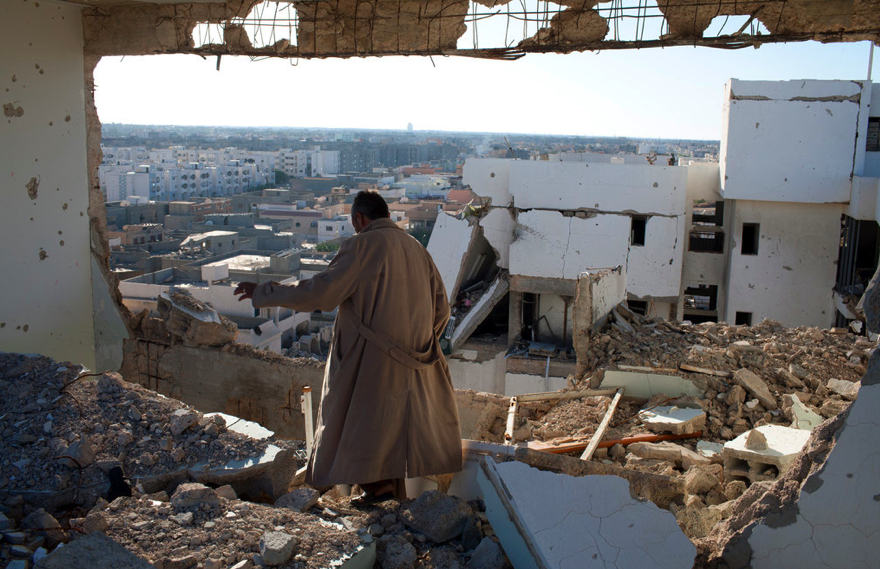
A Libyan man walks through an apartment damaged by NATO bombs in September 2011 (Photo: Tyler Hicks / The New York Times)

A recent report released by Human Rights Watch, entitled “Unacknowledged Deaths: Civilian Casualties in NATO’s Air Campaign in Libya”, has called upon NATO to thoroughly investigate any of its air strikes in Libya last year that killed civilians. NATO reacted sharply, exclaiming that it “deeply regret[s] any instance of civilian casualties for which NATO may have been responsible,” but that “the specific targets struck by NATO were legitimate military targets”and that the organization did everything possible to ensure that the loss of civilian life was minimal. The report and NATO’s response to it have recently triggered a timely debate: could, should and will the International Criminal Court investigate NATO’s role in the Libyan conflict?

Should They?

NATO was involved in a massive aerial campaign in Libya for eight months, there is no escaping that civilians were killed as a result, and any instances where this occurred should be investigated. If NATO or its member states are unwilling to thoroughly and transparently investigate incidences where their bombings resulted in a significant number of civilian casualties, it seems rather clear that the ICC should investigate NATO’s actions in Libya. This, of course, does not mean that NATO is guilty of committing war crimes or that NATO’s intervention should be vilified. There is an ever-present risk of demonizing NATO and the US, not for what they do, but simply for being Western. As David Rohde recently put it: “Some of the perceptions are exaggerated. The U.S. and NATO are not evil incarnate, nor are they perfect.”

There is a general acceptance that NATO’s intervention resulted in a remarkably low number of civilian casualties. Notably, while it was critical of NATO in some cases, the report of the UN Commission of Inquiry on Libya concurred that NATO had taken extensive precautions to prevent civilian deaths. HRW also accepts that civilian casualties were likely minimal. In this context, it is worthwhile highlighting that neither HRW nor the Commission of Inquiry have called on the ICC to investigate NATO, believing that NATO can and should investigate cases of civilian casualties themselves.

Of course, NATO’s success in minimizing civilians deaths does not excuse those instances where there were civilian deaths from being investigated. If there exists any right to truth for victims and survivors to know what happened to their family members, friends and communities, investigations into those aerial missions that resulted in civilian casualties are necessary.

Perhaps the most persuasive reason proffered as to why NATO shouldn’t be investigated is the argument that it would make future NATO interventions in response to atrocities less likely. But this argument presumes that NATO’s mandate cannot be enchanced from being investigated. On the contrary, an investigation by the Court that clears NATO of war crimes would boost the military organization’s credibility in combating atrocity crimes. It would also keep pressure on NATO to continue efforts to minimize the possibility of any civilian deaths in contexts where it intervenes.

Accepting that the ICC should investigate NATO crimes, the question becomes can they?

Can They?

There is no legal barrier to investigating citizens of those NATO states involved in Libya which are also signatories to the Rome Statute. A more controversial question, however, emerges with citizens of NATO members who are not members of the ICC, most obviously the United States. As I have argued elsewhere, the UN Security Council’s referral of Libya to the ICC, under Resolution 1970, was politically tailored by the Security Council (see also my recent academic analyses [here and here]). In this context, the US pushed through Operative Paragraph 6 of Resolution 1970 which excludes citizens of non-state parties from the Court’s jurisdiction, by stipulating that the Council: Continue reading

Posted in Human Rights, ICC Prosecutor, International Criminal Court (ICC), Libya, Libya and the ICC, NATO | Tagged , , | 10 Comments