Updates on Melinda Taylor, Helene Assaf and ICC Staff Detained in Libya

Dear readers,

I have decided to create a post dedicated to updates on the ICC staff detained in Libya. Unfortunately, the media is likely to tire of this story quickly and I figured JiC could contribute to creating a space where information and news on the situation could be shared. I had begun culling articles on my previous post, but it would seem to make more sense to simply have one post dedicated to emerging news on the situations facing Melinda Taylor, Helene Assaf, Alexander Khodakov, and Esteban Losilla. 

I will update this page whenever new information comes in. If you have articles or sources to share, please don’t hesitate to do so, either by contacting me or in the comment section. 

Here’s hoping this debacle ends soon.

Mark

(Photo: Suhaib Salem / Reuters)

June 13: A convoy, which included the Ambassadors of Australia, Lebanon, Spain, and Russia as well as ICC officials, was able to visit with Melinda Taylor and the detained staff. However, according to Australia’s Foreign Minister, Bob Carr, it appears unlikely that they will receive an early release. Carr also relayed reports on the conditions in the prison, saying they were “were generally adequate” and that “Taylor appeared to be well and in reasonable spirits given the circumstances.”

For those interested, you can watch an interview with Taylor’s parents here.

The Libyan leadership has been described as “powerless” to release the four ICC staff members.

June 14: NATO Secretary-General Anders Fogh Rasmussen has added his voice behind efforts to release the ICC staff, saying ”I strongly regret that certain groups in Libya have arrest or withheld representatives of the International Criminal Court. I would urge them to release these individuals as soon as possible.” (see also here)

Melinda Taylor’s husband, Geoff Roberts, who, like Taylor, is an international criminal lawyer, has spoken about the ordeal. He has suggested that Libya’s behaviour should be reflected in the country’s admissibility challenge: ”If they can’t protect their own people when they go into these dangerous places, how will it work? Unless they can protect their staff, these courts can’t function.”

Kate and Amanda, of the fantastic blog Wronging Rights, have a salient piece at The Atlantic where they consider what the arrest of the ICC staff will have on the Court’s ability to investigate in fragile conflict and post-conflict contexts.

This piece by Rory Callinan argues that troubles in providing Saif with a fair defense started long before the most recent visit by the ICC staff. He further suggests that pre-existing tensions contributed to the situation Melinda Taylor et al find themselves in.  Senior ICC defense counsel, Xavier-Jean Keita, for whom Taylor worked, has previously been barred from visiting Saif because of fears that his African heritage might put him at risk. Black Africans are often assumed to have been Gaddafi mercenaries. Nick Kaufman, who is currently representing Muammar Gaddafi’s daugher, Aisha, said that the Defense’s filing of sharp critiques of Saif’s captors “contributed to creating a highly flammable atmosphere in Zintan and if you ask me, I believe Melinda has fallen victim of this hostility which is because of the intensity of the litigation…There is no doubt that these filings contributed to cementing the, shall we say, anger of the local authorities holding Saif, against Melinda and her superior.”

Writing in the New York Times, Marlise Simons confirms that  Khodakov and Losilla have been told they are free to leave Zintan but that they have remained in order to provide “moral support” to Melinda Taylor and Helene Assaf. Simons also quotes Ahmed al-Gehani, a Libyan lawyer who was to be the ICC staff’s liaison when meeting Saif. Gehani confirms that the staff are being held in order to leverage their freedom for information: “[Taylor] had not wanted to answer any questions — this has been the problem from the start.”

June 15: Geoff Roberts, Taylor’s husband, fears that the arrest of the ICC staff will put all Court employees at risk.

According to this France24 piece, the four ICC staff members are in good health. The article also quotes the Court as saying:

“The court is very keen to address any regrettable misunderstandings on either side about the delegation’s mandate and activities during its mission in Libya….The ICC expresses its strong hope that the release of the four persons will take place with no delay in the spirit of cooperation that has existed between the court and the Libyan authorities.”

The UN Security Council made a brief statement regarding Melinda Taylor and the four ICC staff members:

The following Security Council press statement was issued today by Council President Li Baodong ( China):

The members of the Security Council express serious concern over the detention in Libya since 7 June 2012 of the International Criminal Court (ICC) staff members, and urge Libyan authorities at all levels and all concerned to work towards immediate release of all the ICC staff members.

The members of the Security Council emphasize that it is the legal obligation of Libya under the Council’s resolution 1970 (2011) to cooperate fully with and provide any necessary assistance to the ICC pursuant to that resolution.

Australia’s Foreign Minister, Bob Carr, welcomed the news, stating that he was “heartened at the strong international support for a swift resolution in this matter.” Carr also reiterated that the Australian government is working to have Talyor’s case expedited but remains cautious and hesitant in commenting on the allegations against the ICC staff members.

Make sure you check out the always insightful Kevin Jon Heller’s take (and the comment section below) on whether or not the ICC staff are entitled to diplomatic immunity. While it is less clear than many (including myself) have made it out to be, Heller concludes that there is a good argument to make that Taylor et al do, in fact, qualify for diplomatic immunity:

I do think there is a persuasive argument in favor of immunity: paragraph 5 of SC Res. 1970, which provides, as part of the Security Council’s referral of the situation in Libya to the ICC, that “the Libyan authorities shall cooperate fully with and provide any necessary assistance to the Court and the Prosecutor pursuant to this resolution.”  The cooperation obligation in paragraph 5, I believe, requires Libya to honor the substantive provisions of the APIC; the argument parallels Dapo Akande’s compelling claim that the Security Council’s referral of the Darfur situation implicitly removed Bashir’s Head-of-State immunity.  Basing immunity on paragraph 5 seems much stronger to me than arguing that all members of international organizations have immunity under customary international law.  Moreover, emphasizing paragraph 5 should serve as a stark reminder to the Security Council that it has a legal — and not simply moral — obligation to do everything in its power to end Taylor and her translator’s indefensible detention. Continue reading

Posted in Defense Counsel, International Criminal Court (ICC), Lebanon, Libya, Libya and the ICC, Russia, Spain | Tagged , , , | 22 Comments

Did the ICC just issue an Apology to Libya?

Readers of JiC are likely already aware of the ongoing saga facing the ICC’s staff members in Libya. The ICC has just issued a press release regarding the situation facing Melinda Taylor, Helene Assaf, Alexander Khodakov, and Esteban Losilla, employees of the Court who were detained in Zintan, Libya, earlier this month after meeting with Saif al-Islam Gaddafi. Saif was indicted by the ICC for his role in the Libyan revolution. Libyan officials and Zintani militia leaders maintain that the Taylor and, by extension, Assaf over-stepped their mandate, were caught spying and posed a risk to Libya’s national security (see here for more details).

There have been many curious actors in this debacle. No one’s actions and words have received as much attention as Australia’s Foreign Minister, Bob Carr who has taken a front-row seat in the developing crisis. From the beginning of the crisis, Carr has advocated for the release of Taylor, mediated between the ICC and Libyan authorities, and making a personal visit to Libya to meet officials and expedite the release of the ICC staff members.

Recently, after meeting with Libyan officials, Carr suggested that in order for the ICC staff to be released the Court should apologize to Libyan authorities. In a June 19 interview with ABC, Carr argued the following:

“What would help – what would help, I’m coming to a proposal and putting to the ICC, in the form of words from the ICC that expresses regret, even apology about approaches to this very fraught justice question, which weren’t preceded by agreement on protocol and conventions.”

It seemed odd to many that the Court should apologize when it is rather clear (see here and here) that the ICC staff enjoy diplomatic immunity and, from the very get-go, there was no legally legitimate reason to detain Taylor et al. Predictably, Carr’s call for an apology has not been well-received in all corners.

In my view, Carr’s public assertion that the Court apologize to Libya put the ICC in an impossible position. Either the Court said sorry and risked undermining its position and legitimacy or it refused to apologize and risked being blamed for prolonging Taylor’s detention.

Amnesty International also had reservations. Widney Brown criticized the idea, arguing that it could undermine the Court in the long-term:

“I understand the urgency of the Australian government to see Melinda Taylor released, but I would urge the Australian government to have a much longer-term view of whether you want to undermine the independence of the International Criminal Court and create a precedent where governments think well, if we just lock somebody up then we’ll get them to back off.

‘We know that the best way to undermine justice is to attack those who defend the rights of those who are on trial, so this detention is utterly illegitimate; she should be released immediately and there should be no need to apologise.”

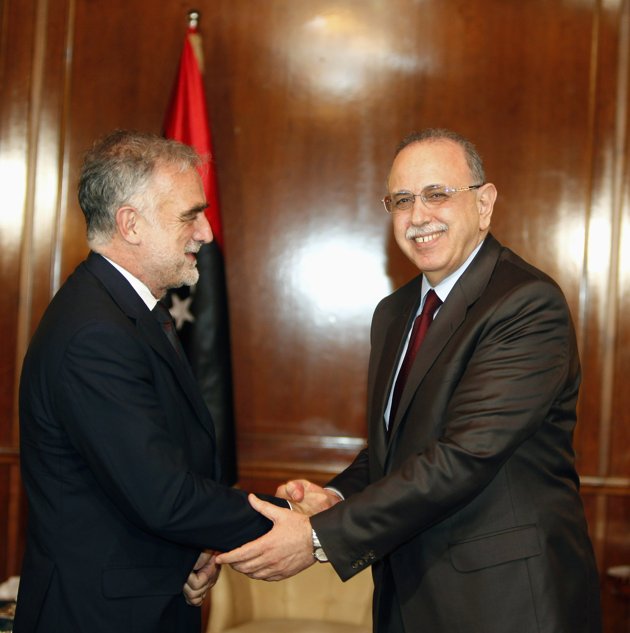
Libyan PM Abdurrahim El-Keib (right) with former ICC Prosecutor, Luis Moreno-Ocampo (Photo: Ismail Zitouny / Reuters)

Kevin Jon Heller vehemently opposed the idea of an apology. Heller claims that the ICC’s legitimacy would be severely hampered if it took up Carr’s suggestion:

“I cannot speak for Taylor, though what I know about her leads me to believe that she would never want the ICC to apologize to a brutal, lawless government for letting her do her job as a defence attorney.  I can say, though, that this is a critical moment in the ICC’s development.  If the Court caves into misguided pressure from Bob Carr and (presumably) the Australian government and apologizes to a brutal, lawless government for protecting the rights of a suspect, it might as well not exist.  And I am not being hyperbolic.”

Despite these criticisms, it appears that the Court has gone ahead and taken Carr up on his advice, issuing a statement of regret on Friday evening.

Statement on the detention of four ICC staff members  

On Friday, 22 June 2012, Mr. Abdelaziz Al-Hassadi, Attorney General of Libya, heading a high level Libyan delegation, visited the International Criminal Court (ICC) in The Hague (Netherlands) where he met with the ICC President, Judge Sang-Hyun Song, the ICC Registrar Silvana Arbia, and other ICC officials to discuss the situation of the four ICC staff members held in Zintan, Libya, following their mission to visit Saif Al-islam Gaddafi, who is subject to prosecution before the ICC for alleged crimes against humanity.

During the meeting, Mr. Al-Hassadi presented to the ICC officials information regarding the visit of the four staff members to Zintan on 7 June 2012.

The ICC President thanked the Attorney General for visiting the Court. He expressed appreciation for the mutual trust confirmed in the meetings and welcomed the commitment of the Libyan authorities to cooperate fully with the ICC in accordance with United Nations Security Council resolution 1970 (2011). The President underlined the shared interest of the ICC and the Libyan authorities that Saif Al-Islam Gaddafi and Abdullah Al-Senussi should face justice.   Continue reading

Posted in Defense Counsel, Libya, Libya and the ICC | Tagged , , , , | 5 Comments

Libya Explains Detention of ICC Staff to the UN Security Council

(Photo: Gallo Images/Thinkstock)

I have just received a copy of a letter, dated June 19 2012, and sent from Libya’s Ambassador and Permanent representative to the United Nations. For the time being, I will withhold any elaborate commentary on the letter but, in short, this is Libya’s version of events regarding the detention of Melinda Taylor and Helene Assaf. There doesn’t seem to be anything new. Nevertheless, it is important to note that Libya is engaging the UN Security Council on this issue.

Non-Official Translation

Memorandum on the Arrest of the ICC Delegation

As positive response to Security Council resolution 1970(2011) of 26 Februa12¢ 2011 requesting the full cooperation of the Libyan authorities with the International Criminal Court (ICC) and the Prosecutor-General of the court and in fulfillment of its commitments to the ICC, the Libyan government received an ICC delegation upon the approval of the Prosecutor-General in Libya starting fi’om 6 June 2012.

The main goal of the visit was to provide an opportunity to the defense counsel assigned by the court to meet the accused Saif al-Islam al-Qaddafi in his detention in the city of Zantan, as well as discussing the possibility of assigning a counsel of his own choice.

The delegation consisted of:

o Ms. Melinda Taylor – Defense Counsel (Australian)

o Ms. Helen Assaf – Translator (Lebanese)

o Mr. Alexander Chodakov – Court Expert (Russian)

o Mr. StevenBeralta Lucia – Head of Defense Support Office (Spanish)

During the meeting, Ms. Taylor handed over to the accused documents which content constitutes a threat to the Libyan National Security, in the presence of the interpreter. One of these documents was a coded letter sent by Mohammed Ismael who had been working as the main aide to the accused, as well as a close security and intelligence assistant to the former Head of Intelligence Service Abdullah al-Sanusi. Remarkably, these documents are irrelevant to the procedures of the ICC and have no connection of any kind with the process of providing a relevant legal advice in the case of the accused. Additionally, it was discovered that Ms. Taylor and the other members of the delegation were carrying spying devices and recorders (a video camera pen and a watch that functions for the same purpose). This act violates the mandate of the court’s delegation and is contrary to the tasks assigned to the assigned defense counsel. It is also considered a blatant violation of the Libyan laws and regulations and a crime under the Libyan criminal legislations. It is contrat3, to the moral and professional commitments of the members of the delegation of the ICC, and a violation of the provisions of the Code of Conduct of the profession for counsels adopted by the court on 2 December 2005.

The present circumstances and the red handed situation urged the Prosecutor-General’s office to launch an immediate investigation where the two accused; Ms. Melinda Taylor and Ms. Helen Assafwere to be interrogated as soon as possible. The Prosecutor-General’s office decided to release the other two members of the delegation, however, they willingly decided to stay in solidarity with their colleagues. The abstention of cooperation of Ms. Taylor with the investigator of the Prosecutor-General’s Office and the decline to make any statements led to restrict her movement with Ms. Helen Assaf. She insisted not to say a word without the presence of an international defense counsel while the Prosecutor-General’s office already provided a local counsel.

The Ministry of Foreign Affairs and International Cooperation immediately transferred the request of Ms. Taylor to provide her with an international counsel to the officials in the ICC. The abstention of cooperation of Ms. Taylor led to a remarkably prolonged detention. Continue reading

Posted in Libya, Libya and the ICC, UN Security Council | Tagged , | Leave a comment

Failed States and International Judicial Intervention

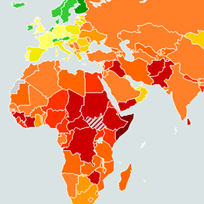
Image (c) Fund For Peace

The new Failed States Index, published yearly by Foreign Policy magazine and The Fund for Peace, is just out and it comes as no surprise that most states with cases at the International Criminal Court are highly ranked as “failed.”  The degree to which a stated is failed is determined by a compilation of 12 indicator scores. Here, I will put aside my skepticism that “state failure” has become a conceptual garbage can to collectivize the world’s governance problems and speculate about the nature and relevance of a correlation between failed states and international judicial intervention.

First, in some ways, the correlation seems obvious. As a “court of last resort,” the intentions of those who designed and continue to support the ICC will argue that it is meant to fill impunity gaps in states that have weakened to the point where atrocities become possible and the rule of law is flawed or entirely absent. Therefore, the ICC will intervene within its legal jurisdiction and consider situations and cases admissible if a) there are grave and mass human rights violations and b) the relevant authorities prove incapable and unwilling to pursue genuine accountability. Three indicators in the failed states index are most relevant to these criteria and states with cases at the ICC have relatively to exceptionally high scores on them:

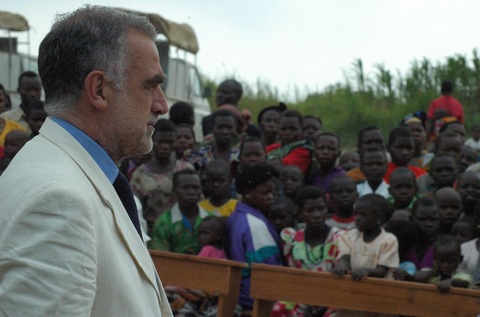
Former ICC Chief Prosecutor, Luis Moreno-Ocampo, visits a massacre site in the DRC.
Photo (c) Sheila Velez, White Pine Pictures

Vengeance Seeking Group Grievance. This indicator includes a “history of aggrieved communal groups citing injustices of the past” and a “pattern of atrocities committed with impunity against communal groups.”

These factors make atrocities more likely and aptly characterize most of the conflict situations among ICC states, particularly those with an ethnic dimension and where electoral contests spark violent protests. Many of the state failure indicators are consistent causes and consequences of atrocities but, of course, not all failed states are home to such mass human rights violations.

Legitimacy of the State. This indicator includes “resistance of ruling elites to transparency, accountability and political representation…”

The Court’s mandate puts pressure on ruling elites to mete out accountability domestically or find themselves in The Hague alongside their rivals.  In practice, investigations and prosecutions are imbalanced in this regard. For example, ruling elites in DRC, Uganda, Cote d’Ivoire have successfully resisted the pressure for domestic trials but have not been called to account at the ICC for their own alleged crimes.

Violation of Human Rights and Rule of Law. This indicator includes the “emergence of authoritarian, dictatorial or military rule in which constitutional and democratic institutions and processes are suspended or manipulated” and the “outbreak of politically inspired (as opposed to criminal) violence against innocent civilians.”

As alluded to above, the ICC can and will only intervene selectively. Impunity gaps and the absence of rule of law make atrocities and human rights violations possible and necessitate international judicial intervention.

(The Fund for Peace provides more elements of each indicator here.) Continue reading

Posted in Central African Republic (CAR), Complementarity, Democratic Republic of Congo, International Criminal Court (ICC), Ivory Coast / Côte d'Ivoire, Kenya, Libya, Sudan, Uganda | Tagged | 1 Comment

A Touching Moment with Aung San Suu Kyi

I had the once in a lifetime opportunity today to see Aung San Suu Kyi, the Burmese democracy and human rights champion. Suu Kyi participated in a roundtable on the rule of law at the LSE and was her typical, passionate and eloquent self. I am pretty certain I don’t have to explain or detail her life to readers of JiC. For many (including myself) she is on par with remarkable human beings like the Dalai Lama, Nelson Mandela and Martin Luther King.

It isn’t everyday that the opportunity arises to see someone of the stature and humility of Aung San Suu Kyi. It is even more rare to see them on their birthday. But to everyone’s surprise and joy, Suu Kyi’s was celebrating her 67th birthday today. The one thousand or so people who came to see her joined in a raucous chorus of ‘Happy Birthday’. Making the event only more moving was the fact, well-known to the audience, that Suu Kyi has enjoyed far, far too few birthdays in freedom after two decades of house arrest.

While it’s far from stunning quality, I managed to capture this touching (and at one point, even funny!) moment and thought readers might enjoy seeing it too.

Posted in Burma/Myanmar, Film, Human Rights, Justice | Tagged | Leave a comment

A Few Thoughts on ‘Nuremberg: Its Lessons for Today’

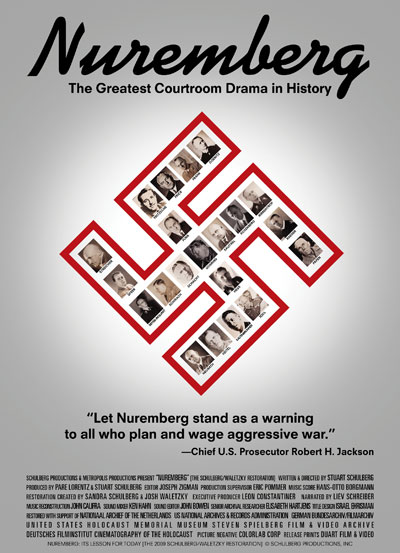
Over the weekend, I had the opportunity to see a screening of the Schulberg/Waletzky restoration of the film, Nuremberg – Its Lessons for Today. The film provides a fascinating insight into the infamous International Military Tribunal, which was held from 1945-1946 in Nuremberg, Bavaria. Many readers will surely have seen brief clips and stills from the movie whose images have, in many ways, shaped the memory of WWII and the Holocaust itself. Here’s the blurb from the film’s site:

One of the greatest courtroom dramas in history, Nuremberg: Its Lesson For Today shows how the four allied prosecution teams — from the United States, Great Britain, France, and the Soviet Union — built their case against the top Nazi leaders. As documented in the film, the trial established the “Nuremberg principles,” laying the groundwork for all subsequent prosecutions, anywhere in the world, for crimes against the peace, war crimes, crimes against humanity, and genocide…

…The original film was written and directed by Stuart Schulberg, and edited by Joseph Zigman, under the aegis of Pare Lorentz, chief of Film/Theatre/Music at the U.S. War Department, and completed by Schulberg in 1948, under the aegis of Eric Pommer, chief of the Motion Picture Branch of U.S. Military Government in Berlin.

The film makes extensive use of footage from The Nazi Plan and Nazi Concentration Campsevidentiary films compiled under the supervision of Budd Schulberg, that were presented at the Nuremberg trial.

If you have the chance to see a screening of the film, I encourage you to do so. If you’re lucky, producer Sandra Schulberg (whose father Stuart wrote and directed the film) will be there to answer questions and give insights into the film’s creation. I thought I would share three particularly fascinating tid-bits of information Schulberg shared with the audience. While this site is dedicated to the politics of international criminal justice, the examples clearly demonstrate that there is much to be said about the politics of recording and depicting international criminal justice.

For decades after it was made, the film wasn’t shown in the US. Many believe this was because by the late 1940s, when the film would have been screened in America, the US government did not want to be seen to be cooperating with the USSR (which it did at the Nuremberg tribunal). In the context of the emerging Cold War and the onset of the red scare, showing a film which depicted the US and the USSR as allies working together as the keepers of international law would have gone against the prevailing political winds in America of the USSR as enemy number one. Others believe that Konrad Adenauer, the first democratically elected German Chancellor post-WWII, made a personal plea to the US not to show the film given that it does a particularly poor job distinguishing between Nazis and Germans. Still others maintain that the film wasn’t shown as a result of opposition from high-level US military officials who had opposed the trials from their conception because they prosecuted military officers. Continue reading

Posted in Film, Holocaust, Nuremberg, Nuremberg Trials | Leave a comment

Changing of the Guard: Bensouda In, Ocampo Out

Former Nuremberg Tribunal Prosecutor, Ben Ferencz and new ICC Prosecutor, Fatou Bensouda (Photo: CICC/Solal Gaillard)

Fatou Bensouda has officially replaced Luis Moreno-Ocampo (who is off to FIFA!) as the Chief Prosecutor of the International Criminal Court. With dozens of writers and observers scrambling to publish their thoughts on what Bensouda’s tenure will and should focus on, I figured I would add a collection of thoughts as well.

African Savior of African-ICC Relations?

There is no point in denying that Bensouda became Prosecutor in large part because she is African. Very early in the process of selecting a new Prosecutor, the African Union (AU) insisted that an African had to be selected. The AU subsequently met little to no resistance and endorsed Bensouda for the job last year. With that said, Bensouda was, in many ways, the perfect candidate. Her resume is sterling, allowing her – and her supporters – to rightfully argue that her record made her an ideal Prosecutor. She thus satisfied both the merit-based and political criteria for the position. Moreover, the sense of continuity she brings to the position after being Moreno-Ocampo’s Deputy Prosecutor may turn out to be a subtle but crucial aspect of her selection.

Yet, it would be wrong to suggest that just because Bensouda is African she will immediately restore relations with those African states who have increasingly criticized the Court for its perceived bias in Africa. As I have argued elsewhere, I believe that the animosity of some African states toward the ICC is a result of the Court’s increasingly close relationship with key powers on the UN Security Council, a relationship that has reaffirmed rather than transcended the global power asymmetries that African states have long sought to undermine and make more equal. It is not surprising that the most vociferous critiques of the Court have come in the wake of UN Security Council referrals of Sudan and Libya to the ICC (as well as the ICC’s investigations in Kenya, which the Prosecutor opened on his own volition). After all, who wouldn’t be disappointed and angered with a Court that appears more interested in catering to the interests of a powerful non-member state, the US, than the thirty-plus member states from Africa without whom the Court would quickly slip into irrelevance?

Of course, this doesn’t mean that the fact that Bensouda is African won’t have important implications. It will, especially in how the Court is perceived. Bensouda’s heritage will undoubtedly make it more awkward and difficult for members of the AU to say the Court is against Africa. After all, she is their selection!

Moreover, we are likely to see a diplomatic dance between the African Union and Bensouda for the next little while as African states get a feel for her and the direction she intends to take the Court. Rather remarkably, Bensouda was invited to the African Union summit in July, already indicating a level of engagement that was impossible in the last years of Moreno-Ocampo’s tenure.

In short, there is an opportunity to improve relations between the Court and African states, but Bensouda shouldn’t be seen as a silver bullet in this context. Whether the relationship is truly transformed will depend on what Bensouda does – and not who she is or where she is from. As the chairman of the Nigerian national human rights commission, Chidi Odinkalu, exclaimed:

“Will she wave a magic wand and cure all the difficulties that exist at the ICC at the moment? No. Can she bring positive disposition over time to transforming the polluted atmosphere in which the institution has been operating in Africa? Absolutely.”

Stand up to the Security Council

One thing that Bensouda could do that I believe has the potential to transform relations between the ICC and African states, as well as boost the legitimacy of the Court, is to be tougher on the Security Council. The Council has instrumentalized the Court, nowhere so clearly as in the case of Libya. It remains a distinct possibility that the intervention in Libya will leave the ICC with a large bill, no one in the dock, and a debilitating controversy over ICC staff members.

Will the ICC, under Bensouda’s leadership, stand up to key powers on the UN Security Council?

Of course, standing up to the Security Council is no easy task. After all, the Court clearly gets a sense of legitimacy from gaining jurisdiction into non-member states. As I have written before, the Court is stuck between a rock and hard place in terms of its relationship to the Council. But being more vocal about its disappointment in the Council’s lack of political and material support for the Court’s mandate would be a healthy start. Some, including the former President of the ICC’s Assembly of States Parties, have even suggested that if the Council were to refer another situation to the Court such as Syria, the ICC might do well to simply say: “no thank you.”

On this matter, I have my doubts that the Office of the Prosecutor is ready to take a strong stance. Bensouda recently said that she views the ICC as a “tool” of the Responsibility to Protect (R2P) which, of course, can only be invoked by the UN Security Council.

Sexual and Gender Crimes

It has been widely suggested that investigating and prosecuting gender and sex-related crimes will be a major focus of Bensouda’s tenure. This would be a welcome development. Gender and sex crimes have largely escaped attention at the ICC. Earlier this year, she discussed her views on the matter: Continue reading

Posted in African Union (AU), Fatou Bensouda, Human Rights, ICC Prosecutor, International Criminal Court (ICC) | 1 Comment

ICC Staff Locked up in Libya: An Unfolding Debacle

Zintan brigade

A member of the Zintan Martyr Brigade in September, 2011 (Photo: Eric Feferberg/AFP/Getty Images)

It isn’t getting any better for anyone involved. Many will already be aware of the arrest of four ICC staff by a militia in Zintan, Libya, on allegations of spying. The controversy it spawned revolves around Melinda Taylor, an Australian defense lawyer at the ICC who, it is alleged, passed on “dangerous” documents and was found with spying devices when she met with Saif al-Islam Gaddafi last week in a visit approved by Libyan authorities. Her interpreter, Lebanese-born Helene Assaf, is being considered an “accomplice”. Two other ICC staff members, a Spaniard and a Russian, are voluntarily staying with Taylor and Assaf, an act of remarkable solidarity and integrity.

Yesterday, the team was transferred from a guest-house in Zintan to a Libyan prison, on the behest of the Libyan Prosecutor General, for a forty-five day detention period. It is not clear which prison they are being held at, although AFP journalist Maude Brulard told me earlier that, according to members of the militia, the prison is under control of Libya’s defense ministry.

After arriving on Sunday, officials from the ICC were finally granted a visit by Libyan authorities to the four staff members in Zintan today. However, they found themselves unable to reach Zintan after being held up at a checkpoint. According to Marie-Louise Gumuchian,

In scenes that summed up the chaos and instability in Libya since a revolt last year ousted and killed Gaddafi, when the ICC delegation arrived at a checkpoint outside Zintan, militiamen told them no one was being allowed in because of clashes with a rival tribe nearby.

The 7-vehicle convoy parked up near the checkpoint but over an hour after arriving they were still waiting to go into Zintan, even though the visit had been approved by authorities in the capital, Tripoli…

…The clashes were happening about 50 km (30 miles) south of Zintan, well away from the route being used by the ICC delegation.

“I believe there is a problem, fighting. We weren’t told, we were just given orders not to allow any cars in,” said one man, dressed in military fatigues and carrying a Kalashnikov rifle at the checkpoint.

At the same time, a particularly controversial statement was made by NTC spokesperson, Mohammed al-Hareizi, in an interview with the Australian Broadcasting Corporation (ABC). Al-Hareizi suggested that Taylor was being held, not for any particular violation, but because the government believed that they could bargain her freedom for knowledge of Mohammed Ismail’s whereabouts. Ismail is considered a close friend, confidante and, some say, “henchman“, of Saif. It has been alleged that Taylor gave “coded” letters from Ismail to Saif during their meeting. Al-Hareizi is quoted as saying:

“We want this guy. It is very important to catch this guy because this guy is very, very, very danger(ous) for us…

…We don’t have anything against this woman. Just we need some information from her, after that she will be free.”

This is particularly damning evidence against any possible case that Libya has in detaining and investigating Taylor and Assaf. If al-Hareizi’s words reflect the attitude of the NTC, then it is clear that Taylor and Assaf’s arrest have nothing to do with the law or justice and everything to do with leveraging the freedom of ICC staff for political gain. Incredibly, this was admitted while Libya is attempting to convince ICC judges that it is able and willing to try Saif domestically. As I argued earlier this week, that seems an increasingly remote possibility. Of course, holding and investigating the two ICC staff members is problematic regardless of the NTC’s or the Zintani militia’s intentions behind doing so.

Melinda Taylor ICC

Melinda Taylor, who was detained with three other ICC staff members while visiting Saif al-Islam Gaddafi last week.

Like others, I am flabbergasted with how quickly some have suggested that the ICC team is guilty and that, if they broke the law, they should be investigated in Libya. This is hugely problematic. First of all, while the allegations are certainly serious, no real evidence has been presented that any laws were actually broken. We simply do not know the truth about what transpired.  Continue reading

Posted in Defense Counsel, International Criminal Court (ICC), Libya, Libya and the ICC | Tagged , , , | 7 Comments

The End of Amnesty: Whither “Peace Versus Justice” in Northern Uganda?

Former LRA rebel

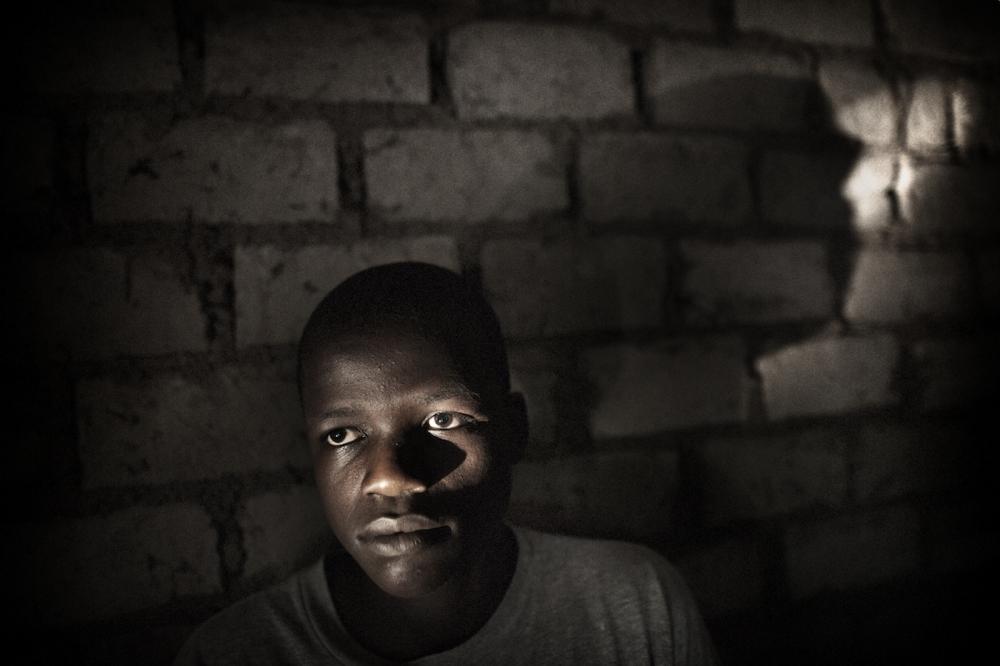
A former member of the LRA who escaped a year and four months after being abducted in 2008 (Photo: Marcus Bleasdale)

I couldn’t resist contributing to the discussion that Mark Schenkel has begun with his fantastic post on the expiration of northern Uganda’s Amnesty Act. Readers shouldn’t let the fact that the story hasn’t been widely covered fool them into believing it isn’t of tremendous importance or that its implications aren’t significant. As Mark has shown, it is and they are.

I wanted to highlight just how remarkable it is that not only has the expiration of Part 2 of the Amnesty Act come as a surprise to many observers, but it has subsequently been met with barely a murmur – almost as if it wasn’t all that important. This is noteworthy in its own right. When the ICC intervened in northern Uganda in 2004 and subsequently issued arrest warrants for LRA leader Joseph Kony and four other senior rebel commanders, the “peace versus justice” floodgates opened. The debate was pervasive and polarizing. Much of it revolved around the over-simplified but potent question of whether rebels should be forgiven via amnesty or punished via the ICC. A legion of local and international voices declared that peace could only be achieved if LRA rebels could be guaranteed that they would not be prosecuted if they left the bush. This view was premised on fears that the threat of prosecuting rebels would leave them with no option but to continue fighting. They consequently called on the ICC to back off and give peace through forgiveness a chance. Of course, the ICC warrants stayed in place. However, thousands of LRA combatants received amnesty certificates following their defection from the rebel ranks.

Just years later, the “peace versus justice” debate has virtually disappeared. Take, for example, the prosecution of Thomas Kwoyelo, the former senior LRA commander who was detained by the Ugandan forces (UPDF) in 2009. True, the controversy around Kwoyelo’s prosecution  has concerned whether he should be issued an amnesty. But the debate has almost exclusively been a legal debate, centering around whether or not he is eligible to receive an amnesty under Ugandan law (answer: absolutely) and whether receiving an amnesty is in contravention of Uganda’s international obligations (answer: I don’t think so). What the debate hasn’t been about is whether granting Kwoyelo amnesty would risk undermining the progress northern Uganda has made towards order and stability.

Charles Banya, a former LRA rebel (Photo: Marcus Perkins)

Consider too the example of Caesar Achellam, the LRA rebel commander who was recently “captured” by Ugandan military forces. Again, there exists no palpable concern that arresting Achellam and possibly putting him on trial jeopardizes peace in northern Uganda. Interestingly, the Achellam story has received significantly more international coverage than the Kwoyelo trial. But it received attention primarily because of Invisible Children’s ‘KONY2012’ campaign. As I noted previously, virtually every story about Achellam’s “capture” cited KONY2012 and the now world-famous “hunt for Joseph Kony”.

Moreover, in my experience interviewing individuals involved in the northern Ugandan peace process, including government ministers, religious and civil society leaders, as well as delegates from the peace talks, there remains almost little to no concern that the ICC or any form of trial justice risks undermining peace. In short, it really does appear that northern Uganda has moved beyond the “peace versus justice” debate. Continue reading

Posted in Amnesty, Peace Processes, Transitional Justice, Uganda | Tagged | Leave a comment

The Path Towards Prosecution: An End to Amnesty in Northern Uganda

Mark Schenkel joins us for this insightful and thought-provoking guest-post on the expiry of Uganda’s Amnesty Act and its implications for transitional justice in northern Uganda. Mark is a Dutch journalist based in Kampala, Uganda. He covers developments in East Africa for various media in The Netherlands and Belgium. Enjoy!

Amnesty Commission

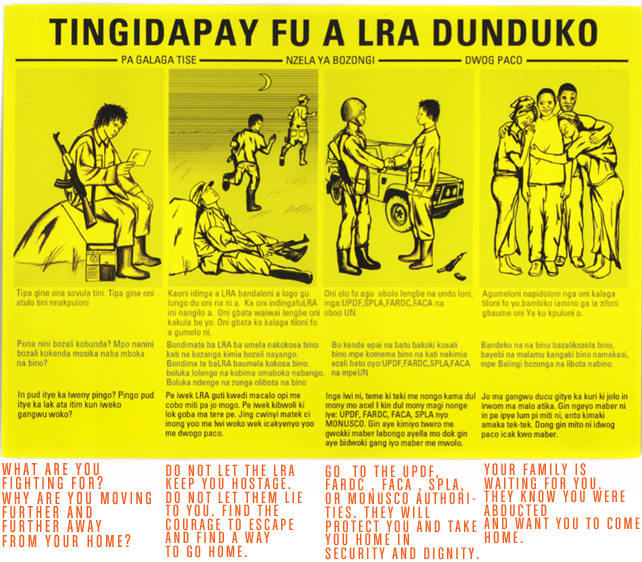
A pamphlet from the Ugandan Amnesty Commission encouraging rebels to defect from the LRA and return home in exchange for amnesty (Photo: Resolve)

The recent expiry of Uganda’s long-running amnesty provision for armed rebels has taken quite a number of observers by surprise. On May 23rd, the centerpiece of Uganda’s twelve year old Amnesty Act, whichprovides blanket amnesty to anyone who denounces armed rebellion, lapsed despite media reports and statements by politicians suggesting that the entire Act was going to be renewed. The expiry of the essential part of the Act clearly has far-reaching implications for the debate about whether to forgive or prosecute members of the notorious Lord’s Resistance Army (LRA).  

Uganda has taken a new and major step on the path away from amnesty and towards prosecution of LRA rebels. But first let us look at how the confusion and surprisement surrounding the Amnesty Act’s partial ending came about.  

The expiry of Part 2 of the Act – the one dealing with the actual amnesty – was reported on Monday May 28th in the government-owned newspaper New Vision. It was a brief piece, on page 3. As it turned out, minister of Internal Affairs Hilary Onek had used his mandate to renew only the three other parts of the Act, dealing mainly with resettlement and re-integration of former rebels. The various elements of the Act, which was put in place in 2000 during the height of the LRA insurgency to encourage rebels to lay down their weapons, can be renewed every six months.  

The independent newspaper, Daily Monitor, apparently wasn’t aware of the developments yet. On Tuesday the 29th, it still carried a story about whether or not Ceaser Acellam is eligible for amnesty. Acellam, a high-ranking LRA-commander, had fallen into the hands of the Ugandan army in mid-May (some sources say Acellam surrendered and wasn’t ‘captured’, as the army insists). The Monitor didn’t refer to the lapse of Part 2 of the Amnesty Act the week before, whereas the lapse’s logical consequence is that Acellam is in no way eligible for amnesty (it has, to my knowledge, nowhere been officially declared that Acellam had applied for amnesty before the lapse of Part 2). Only on Sunday, June 3rd did the Monitor report about it. In the meantime, Uganda Radio Network had caught up on the news, just like several foreign media (Radio Netherlands Worldwide and the UN-subsidized IRIN).  

Truth be told, initially I myself thought that the Amnesty Act would be renewed in its entirity. Journalists, legal observers, members of Uganda’s general public – most people were under the same impression. One possible explanation is that back on April 16th, Deputy Speaker of Parliament Jacob Oulanyah was quoted as saying that the Amnesty Act was going to be renewed. Oulanyah spoke in the Northern Ugandan town of Gulu, in front of thousands of people who had showed up for the public screening of KONY2012.  

Another explanation for the widespread expectation that the Act was going to be renewed may lay in the government’s decision to let part of the Act lapse without parliamentary approval – technically, this approval is not required. The decision wasn’t debated among the Ugandan people’s representatives. In its own statement on the website of the Ugandan media centre – posted several days after the expiry of the Act’s part 2 – the government didn’t explicitly say that amnesty is no longer in existence.

Recently “captured” senior LRA commander, Caesar Achellam (Photo: AFP)

Lastly, an explanation may be that during the days before part 2 expired, the Directorate of Public Prosecution (DPP), the Amnesty Commission as well as lawyers were publicly debating Ceaser Acellam’s eligibility for amnesty. When I contacted them after the expiry had come to light, both the DPP and the Amnesty Commission said that at the time of their public comments, no decision on the (partial) renewal of the Amnesty Act had yet been made. They simply discussed Acellam’s situation under the then-applicable rules – meaning an Amnesty Act still intact. Continue reading

Posted in Amnesty, Kwoyelo Trial, Transitional Justice, Uganda | Tagged , | 3 Comments