Self-Referrals and Lack of Transparency at the ICC – The Case of Northern Uganda

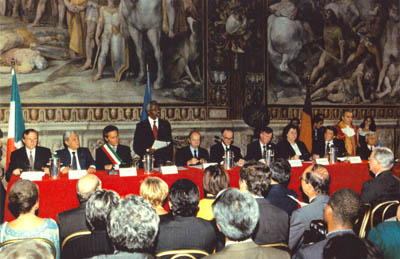
Press conference during the Rome Conference at which the ICC Statute was adopted

Nobody could know for certain how the International Criminal Court would work in practice when the Rome Statute was adopted in 1998. The first surprise was the speed at which the Statute was ratified by the 60 states necessary for the treaty to enter into force. The required number of states parties was reached already on 11 April 2002. Another surprise was how fast the ICC was confronted with its first cases and the way these cases were referred to the Court. The first three situations in Uganda, the Democratic Republic of Congo and the Central African Republic were so-called self-referrals; they were referred to the Court by the respective states themselves. The Rome Statute is not explicit about the possibility of these self-referrals (see Article 14). The modus operandi for state referrals foreseen in the Rome Statute was rather one of states parties referring cases of other states parties to the court. For a helpful discussion of the legal issues arising from these self-referrals please refer to this article by Payam Akhavan.

The emergence of self-referrals as an unexpected trigger for ICC investigations has led to some problems. This is particularly true as the Chief Prosecutor encouraged these self-referrals to obtain state cooperation. The fact that a state invites the ICC to investigate crimes committed on its own territory might raise questions concerning the ICC’s independence if these investigations are not handled extremely carefully. After all, why should a state invite the ICC to investigate if this entails negative repercussions for the very government which invited the Court? The suspicion that the government in question has cut some kind of deal with the ICC is quite natural for those who do not trust the independence of international institutions. Unfortunately, Uganda is a case in point for the problems that arise from self-referrals.

First of all, the Chief Prosecutor took the unfortunate decision to announce his investigations in Uganda side by side with the Ugandan President, Yoweri Museveni, despite the national army and the government being accused of having committed atrocities during the Lord’s Resistance Army conflict in northern Uganda. This led to immediate doubts about the independence of the ICC among the local population. Many thought that the ICC was indeed a tool for the Government of Uganda to mobilise international support against the LRA. The Chief Prosecutor quickly declared that he is independent in his investigations and would investigate all parties in Uganda, a statement that did not convince the local population.
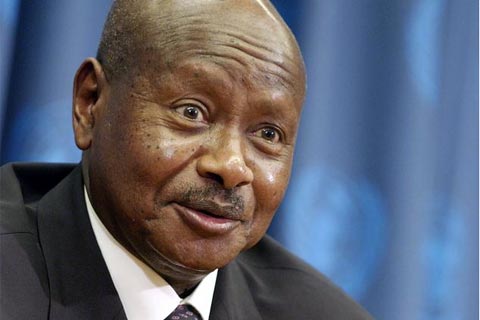
Uganda's President Museveni took the decision to refer the LRA conflict to the ICC. UN Photo / Mark Garten

The initial mistake of announcing investigations at the side of one of the conflict parties could have been redeemed in the course of the investigations by showing that the ICC is committed to thoroughly investigate both parties. Unfortunately, the Office of the Prosecutor (OTP) has so far largely failed to convincingly demonstrate that it has indeed investigated allegations against the Uganda People’s Defence Forces (UPDF) and the Government of Uganda. To be fair, the situation in northern Uganda is highly complicated and it is not an easy task to carry out independent investigations that satisfy the local population in this context. First of all, some of the most serious atrocities the UPDF is accused of having committed took place in the late 1980s, when the UPDF was still the National Resistance Army (NRA). There were extensive human rights violations in northern Uganda when the NRA moved to the north in pursuit of the remnants of Milton Obote’s army, after taking power in Kampala. Additionally, there were reports of extensive cattle rustling, extrajudicial killings, beatings, rape, torture and some massacres committed against the civilian population that was seen as being supportive of the former army chased out of Kampala by the NRA. The most notorious massacre attributed to NRA forces during that time is the Mukura Massacre during which the NRA allegedly herded civilians into train wagons which they later set on fire. It has taken the ICC a lot of work to explain to the local population that the Rome Statute only allows investigations of crimes committed after July 2002 and that those massacres can thus not be investigated by the ICC (see Mark’s earlier post on this). Continue reading

Posted in Human Rights, ICC Prosecutor, International Criminal Court (ICC), Justice, Lord's Resistance Army (LRA), Uganda | Tagged , , , | 3 Comments

Handcuffed by Statehood: Justice and Palestine

Palestine statehood

(Photo: AP)

Observers have watched with keen interest as Mahmoud Abbas took the politically risky, some say courageous, move to seek UN recognition of Palestine as a state. At the very center of Abbas’ polarizing decision is the International Criminal Court and the possibility of opening an investigation into alleged crimes in Palestine. To think that the ICC would be so integral a player in the challenge of peace in the Middle East would have been unimaginable just a few short years ago. Just as remarkable is the demonstrated centrality of statehood in the pursuit of global justice, something that surely keeps the dreamers of international criminal justice up at night.

It really wasn’t supposed to go this way. The ICC was meant to be a shining star in the liberal cosmopolitan trajectory which instructed the peoples of the world that no one could hide behind state sovereignty anymore. What mattered in global politics and ethics wasn’t still supposed to be states over all else. Slowly, but surely, the post-WWII global conscience was intended to wither away the rigidity of statehood as the primary unit of international politics and replace it with “the human”. The most important association was no longer supposed to be a state or a territory or religion. These were to be secondary, displaced by a “consciousness of being a citizen of the world, whatever other affiliations we may have.” Citizenship of state was to become secondary to citizenship of a “worldwide community of human beings” who shared a universal ethical code and which represented and protected all those who counted themselves as human. We were to be universal individuals. Rights were ours as individual people but shared by all. These individual rights were to be protected but we were to care about them everywhere. It is out of this liberal cosmopolitan trajectory that we have a human rights regime, a doctrine of Responsibility to Protect and the International Criminal Court. It is in the name of our common, universal citizenship in “humanity” that these institutions and regimes were established.

The Office of the Prosecutor has been busy, no doubt. But after two years, they remain mum on the question of Palestine (Photo: AP Photo/Evert Elzinga)

The ICC, in particular, is an acknowledgement that “cosmopolitan norms of justice accrue to individuals as moral and legal persons in a worldwide civil society,” and the creation of “protections for individuals as human beings.” “[W]hat advocates of the International Criminal Court aspire to, above all, is the creation of a universal moral and judicial community” to replace power politics. Central to the establishment of the Court was the notion that individuals – and not states – are responsible for violations of international humanitarian and human rights law, reflecting a view “that thinking of human rights violations as perpetrated by monolithic and abstract entities called states, and holding only states responsible…stood in the way of human rights enforcement”. As Kirsten Ainley writes, there is a palpable and “increasing focus on the individual, rather than the state, as the key agent in international politics,” the “result of the rise of cosmopolitan liberalism.”

To return to the case of Palestine, what is remarkable is the centrality of statehood, and by extension state sovereignty, in the capacity of Palestinians to pursue international justice. Surely, to many readers this will be unsurprising – the ICC’s Rome Statute, after all, was negotiated by states. Nations only come under the Court’s jurisdiction if they refer themselves, are referred to the Court by the member states of the UN Security Council or ratify the Statute. In other words, the Court continues to privilege statehood, at most marking a negotiation between state politics and the liberal cosmopolitan protection of human rights. However, with the case of Palestine the importance of the state-based power-politics has come only more forcefully into light.

Continue reading

Posted in Human Rights, International Criminal Court (ICC), Israel, Justice, Middle East, Palestine, Palestine and the ICC, United States | Leave a comment

(Ab)using International Law: Over-Extending the use of Crimes Against Humanity

Abhimanyu George Jain is a graduate of the National Law School of India University (NLSIU), Bangalore, India where he developed a strong interest in public international law. In this post,  Abhimanyu shares with us his thoughts on the expansion of the use of “crimes against humanity” in the context of the Anders Breivik case and the possibility of prosecuting the Pope. 

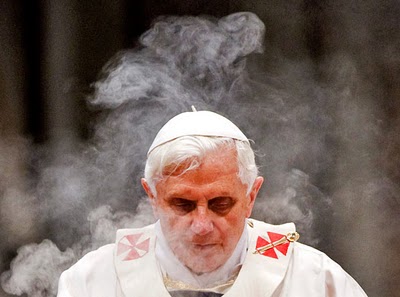
Should the pope be charged with crimes against humanity?

(Ab)using International Law: Over-Extending the use of Crimes Against Humanity

Exhorting his generals to all sorts of depravities against the people of Poland, Adolf Hitler, once famously said, “who…speaks today of the annihilation of the Armenians?”

Fortunately for us, we live today in a world where we do “speak of the Armenians”. Today we talk in real terms of the possibility and desirability of prescribing and enforcing individual responsibility for the most shocking human acts; we talk of engineering the reunification of shattered societies into organic wholes through transitional justice.

As with any other developing skill and ability, however, familiarity breeds contempt, and contempt, misuse. The misuse I speak of is the inappropriate stretching of the concepts of international criminal law to situations and actions where they have no real role. In particular, I refer to two recent proposals concerning the application of crimes against humanity as defined under the Rome Statute – the first, in the case of Mr. Anders Behring Breivik, the Norwegian militant extremist; the second, in the case of he Vatican, as recently suggested by the Centre for Constitutional Rights (CCR). To be clear from the outset, neither of these proposals has even a reasonable chance of success. They do, however, represent the thoughts and actions of some academics and practitioners, and represent to some extent current understandings of these concepts.

I shall first briefly discuss these proposals, and then explain my grouse against them.

The Proposals

In the case of Mr. Breivik, news reports have suggested that Norwegian prosecutors were contemplating charging him with crimes against humanity for his recent militant actions. For certain obvious reasons, chiefly, the complete inapplicability of the international concept of crimes against humanity, this proposal was abandoned. First, the international concept of crimes against humanity as defined in Art. 7 of the Rome Statute of the ICC requires a ‘widespread or systematic attack’, which these attacks were not. Second, Art. 7 requires the perpetrator to be acting pursuant to an ‘organisational plan or policy’, which again was not the case. For an excellent analysis of this proposal, see William Schabas’ blog post, here.

The third concerns the not particularly novel suggestion that Vatican officials be tried under international criminal law for their role in covering up instances of sexual abuse by Catholic priests. In the latest such attempt, the CCR, acting on behalf of the Survivors’ Network of those Abused by Priests (SNAP), has requested the ICC’s Prosecutor to exercise his propriu motu authority under Art. 15 of the Rome against high-level officials at the Vatican. Again, this does not meet the definitional requirements of crimes against humanity. Post facto concealment, while definitely deplorable, does not meet the requirement of being ‘an attack directed against any civilian population’, ‘pursuant to or in furtherance of a State or organizational policy to commit such attack’. It seems quite clear that there is a definite requirement of overt involvement and control. This very basic objection is supplemented by reasonable questions concerning the authority of the ICC over the Vatican, a non-State entity which is not party to the Rome Statute. For an excellent analysis of the legal infirmities of this move, see Dov Jacobs’ blog post, here.

The Grouse

It might reasonably be asked: so what if it is a stretch? Reasonably, is it such a problem if these concepts are being adopted to the extent that efforts are being made to extend their application to other situations? Doesn’t this in some way represent an incorporation of international legal norms into municipal legal practice and everyday legal concerns, and, to that extent, an internalisation of international law?

Continue reading

Posted in Crimes against humanity, Human Rights, International Criminal Court (ICC), Justice, Norway, Vatican | 4 Comments

The Fallacy of Sequencing Peace and Justice

Peace before justice? Justice before peace? Chicken before egg? Egg before chicken?

A few weeks ago I spoke with a senior transitional justice researcher and aspiring politician from northern Uganda about the trials (if you excuse the pun) and tribulations of achieving peace and justice in the region. He described sentiments familiar to those who have engaged in the “peace versus justice” debate:

“I don’t see it as a debate. It is common sense that in situations of what we have been experiencing, strategically we should be sequencing these issues, prioritizing and looking at what is best in the short-term and what is best in the long-term. It is very legitimate in any process that we must create an enabling environment that can guarantee justice can be done…If you start asking for justice even before you create that enabling environment, it is not even a debate, it is foolery…We must sequence them.”

I subsequently challenged him on the effectiveness of his argument to which he responded that Argentina was the ideal example of a state which had successfully sequenced peace and justice.

The “sequencing argument” has become a popular feature in the rigid and harshly dichotomous “peace versus justice” debate. The argument is attractive because it represents an attempt to find ground between the polarizing views that there is “no peace without justice” and “there is no justice without peace.” While the sequencing argument is closer to the latter in suggesting that justice may have to follow peace it largely acknowledges that justice is necessary in the long term. Unlike scholars of a realist bent who are sceptical of any attempt to achieve justice in conflict and post-conflict contexts, the point is not to reject accountability and reconciliation but to create an environment in which pursuing justice enforces rather than destabilizes peace.

The sequencing argument is rather nuanced and intuitive. It weaves together the two major strands of thinking on peace: positive peace and negative peace. Negative peace, the cessation of large-scale, direct violence, is required before justice can be pursued. If justice is sought prior to the “silencing of the guns”, then it risks prolonging the conflict. However, once a negative peace is secured, justice should be pursued. Only by identifying and rectifying past wrongs – including human rights abuses – can a more encompassing, positive peace be achieved. In short, the sequencing argument suggests a trajectory of:

violent conflict –> negative peace –> justice and accountability –> positive peace

Ugandan President Yoweri Museveni and former Libyan leader, Muammar Gaddafi. In both Libya and Uganda there has been a debate about whether to sequence justice and peace.

Proponents of the sequencing argument have, however, not thoroughly scrutinized how their theory translates into practice. On the ground, the sequencing argument presumably looks a little like this: in order to achieve a cessation of violence, parties enter inclusive peace negotiations to achieve a power-sharing agreement and peaceful transition. The parties discontinue active conflict while even the most brutal and unsavoury of leaders are guaranteed amnesties as an incentive to cease violent activity. Once stability is assured and the time for accountability is ripe, those amnesties are revoked and the leaders of the conflict are brought to account, ushering in positive peace and justice.

But just how many times could that possibly work? No dictator, tyrant or rebel leader would ever accept an amnesty that he or she believed would subsequently be revoked! It is for this reason that premeditated sequencing has no history in practice – surely something that proponents of sequencing peace and justice should acknowledge. Continue reading

Posted in Amnesty, Argentina, Human Rights, Justice, Latin America, Peace Negotiations, South America, Transitional Justice, Uganda | 6 Comments

Conflicting Impulses: The Debate on Amnesties in the Case of Uganda’s Thomas Kwoyelo and Beyond

Judges at Uganda's Constitutional Court have ordered Thomas Kwoyelo to be granted amnesty and set free (Photo: Michele Sibolini, AFP)

This past summer, Uganda did something it had never done before: it put a rebel from the notorious Lord’s Resistance Army (LRA) on trial for international crimes. The trial of Thomas Kwoyelo marked yet another fascinating twist in Uganda’s experience of confronting past atrocities. The government’s Directorate of Public Prosecutions alleged that Kwoyelo was guilty of 12 charges of grave breaches of the fourth Geneva Convention and 53 counts of violating Uganda’s penal code. Last week, however, judges deemed prosecuting Kwoyelo unconstitutional and ordered him to be set free.

The primary obstacle to trying any former rebels in Uganda is the state’s Amnesty Law (2000) which was passed with the backing of powerful local northern Ugandan leaders. It effectively guarantees that any individual who either escaped or was captured and subsequently renounced rebellion can be granted reprieve from any prosecution. The trial of Kwoyelo raised, once again, unresolved issues about the use of amnesty laws in societies emerging from violent political conflicts characterized by widespread atrocities.

During three months of research, I had the opportunity to attend much of Kwoyelo’s trial and speak to many of those involved and affected by his case. From its inception, there was always something peculiar and uncomfortably political about the proceedings. The case opened, quite literally, to the tune of a marching band.

While rather clumsy in their approach – much to the chagrin of the presiding judges – Kwoyelo’s defense team argued that prosecuting their client was unconstitutional. Because other former combatants, including some who were senior to Kwoyelo, had been granted amnesty, trying Kwoyelo constituted an infringement of his right to fair treatment and equality before the law. Not being able to decide on the constitutionality of the case, the ICD referred it to the Constitutional Court, which agreed with the defense and ordered Kwoyelo to be granted an amnesty and be released:

“We are satisfied that the applicant has made out a case showing that the Amnesty Commission and the Director of Public Prosecutions have not accorded him equal treatment under the Amnesty Act. He is entitled to a declaration that their acts are inconsistent with Article 21(1) (2) of the Constitution and thus null and void. We so find.

We order that the file be returned to the court, which sent it with a direction that it must cease the trial of the applicant forthwith.”

Kwoyelo speaking with one of his lawyers, Caleb Alaka, a former LRA delegate in the Juba peace negotiations (Photo: Arne Doornebal)

The importance of the Kwoyelo trial, both legally and politically, is rather obvious. Had Uganda successfully tried and convicted Kwoyelo (and they still might), it would have given the government a plank upon which to build a complementarity challenge to the ICC’s jurisdiction, something the government had expressed interest in doing. However, the spectre of a successful trial also instigated fears in northern Uganda. Former senior rebel commanders explained their uneasiness of potentially becoming the Government’s next targets for trial if Kwoyelo was denied amnesty. The instability incurred by revoking thousands of amnesties would be absolutely devastating to a region and people eager to move forward.

Of course, the granting of an amnesty and the defeat of the government’s case against Kwoyelo is equally as controversial. International human rights groups sent representatives to monitor the trial and provide assistance to government lawyers. Predictably, Human Rights Watch argued that amnesties “for crimes such as war crimes and crimes against humanity run counter to international law and practice.” In the wake of the Kwoyelo verdict, Amnesty International released a statement which declared that:

“What we are witnessing here is simply pervasive impunity for serious crimes and human rights violations…Neither Thomas Kwoyelo, nor others accused of committing war crimes should be granted amnesty.”

Human rights groups and fervent human rights advocates and scholars have been engaging in what amounts to talking amnesties out of reality. They claim not only that it is morally and legally wrong to grant amnesties but ominously warn that doing so is to risk ever becoming a functioning, liberal democracy.

Continue reading

Posted in Uncategorized | Leave a comment

JiC’s 100th Post

Dear readers and friends,

This marks JiC’s 100th post. Looking back, I am still amazed at how far this project, which began with such humble expectations, has come. I hope that you have enjoyed reading our posts as much as we have writing them.

On behalf of Patrick, myself and JiC’s editor, Elke Schwarz, thank you, from the bottom of our hearts and from the top of our minds, for your support and readership.

This is a good opportunity to get some feedback from you, as readers and as the lifeblood of JiC. What would you like to see more of at JiC? Are there issues or angles that we haven’t grappled with that you would like us to in the future? We are always open to constructive criticism and welcome your views. Of course, we take compliments too!

Here’s to a few hundred more!

Mark

Posted in JiC News | 2 Comments

Gaddafi: Our Best Enemy (Film)

“Realpolitik led the West to believe that Gaddafi’s dictatorship would go on forever and Gaddafi, convinced that rapprochement with the West would guarantee his survival, underestimated the wrath of his own people.” – Antoine Vitkine

Over the past weeks and months, I have expressed concerns over the relationship between Western states and Gaddafi’s regime and what it meant with regards to achieving justice. Most recently, I wrote a piece on the subject at Opinio Juris. In this context, I thought it would be appropriate to share a recent documentary with readers.

The French docmentary by Antoine Vitkine, entitled Gaddafi: Our Best Enemy, delves into the precarious and messy historical relationship between key Western states (especially the UK, France and the US) and Gaddafi. It is a remarkably insightful film and includes tremendous interviews with key figures, including Condoleezza Rice and Tony Blair, as well as various high-level political advisers.

Vitkine’s documentary is particularly useful in its elaboration of the events and decisions which resulted in Gaddafi – responsible for sponsoring international terrorism and oppressing his own people for decades – being rehabilitated to become an economic, political and military partner of the West. Our Best Enemy also reveals the complex but shrewd political games in which Gaddafi engaged and how Western states consequently propped up his regime by helping him regain both internal and external legitimacy.

I have posted the video, which is available on YouTube, for your viewing pleasure. Enjoy!

Posted in Film, Libya, Libya and the ICC, The Tripoli Three (Tripoli3), UN Security Council, United Kingdom, United States | Leave a comment

An Arab Fling: The West and International Justice in Libya

The following piece is a guest-post at Opinio Juris where I have been honoured with the opportunity to guest-blog for the next two weeks. All pieces will also be cross-posted here. Enjoy!

US President Barack Obama and Gaddafi greet each other warmly just a few months prior to Gaddafi's brutal crackdown (Photo: AP)

An Arab Fling: The West and International Justice in Libya

It was so promising. Everyone appeared to be on board when, last February, the international community decided that the situation in Libya should be investigated by the International Criminal Court. Not only did the UN Security Council refer the situation in Libya to the Court, but it did so unanimously. However, despite hefty rhetoric about the importance of bringing the Libyan leader to justice, Western states have been happy to instrumentalize the Court in order to isolate Gaddafi and have just as keenly abandoned their interest in bringing the Libyan tyrant to The Hague. Their initial and overwhelming zeal for international justice also obscured their complicity in sustaining Gaddafi’s regime and its crimes against the Libyan people.

Readers of the UN Security Council Resolution 1970 will note that the resolution imposes a temporal limit on the ICC’s jurisdiction. While the Rome Statute declares that the Court can investigate events since July 1, 2002, the ICC was instructed to only investigate alleged international crimes in Libya since February 15, 2011. In addition, the referral explicitly removes citizens of non-state parties from the jurisdiction of the Court. Despite the questionably legal nature of such restrictions, the referral was celebrated as marking a new chapter in international justice and the relationship between the ICC and the Security Council. Yet, ironically, as the intervention in Libya began to succeed and Gaddafi became increasingly isolated, commitment to achieving international justice waned.

That Western states sought to prohibit the Court from investigating any Libyan crimes prior to February 15, 2011 is unsurprising. Doing so would have exposed a litany of instances in which Western states propped up the Gaddafi regime and were complicit in systemic and systematic human rights violations.

It doesn’t take much research to discover the extent to which Western states and Libya developed a remarkably cozy political, military and economic relationship. Virtually every major Western state had significant dealings with Gaddafi and his regime. Despite protestations from human rights groups and Gaddafi’s victims, he was no longer the “criminal” tyrant who presided over a “reign of terror”, as described by Ronald Reagan. Instead, he was convinced to take responsibility for Lockerbie, renounce sponsorship for international terrorism and become a partner in the fight against radical Islam, and dismantle his nuclear and weapons of mass destruction programmes. Justified by realpolitik, Gaddafi became a “friend”, an “ally” and “one of ours”. It was a remarkable transformation and one which ushered in a wave of bilateral deals which helped keep his police state in power and his people oppressed.

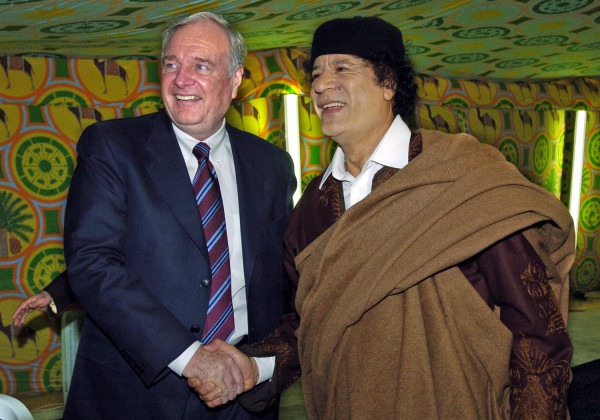
Former Canadian Prime Minister Paul Martin with Gaddafi in 2004, shortly after Gaddafi was rehabilitated as a legitimate international leader. Gaddafi called Martin his "friend" while Martin called Gaddafi a ‘‘philosophical man with a sense of history’’ (Photo: Globe and Mail)

Getting Gaddafi on the right side of terrorism and nuclear proliferation was necessary and the concessions achieved by restoring Gaddafi’s image were surely worth it. However, as Stephen Glover has argued: “What is not defensible is the subsequent indulging of this horrible man, and treating him as though he were a normal leader of a normal country.”

Continue reading

Posted in Canada, France, Human Rights, International Criminal Court (ICC), Justice, Libya, Libya and the ICC, The Tripoli Three (Tripoli3), Torture, UN Security Council, United Kingdom, United States | Leave a comment

Kwoyelo Granted Amnesty and Set Free But Questions Remain

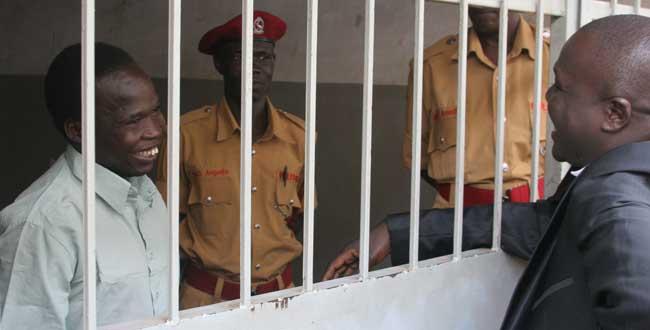
Thomas Kwoyelo: Out of Shackles Now (Photo: HRW)

As many readers will know, both Patrick and I have been writing about the trial of Thomas Kwoyelo in recent weeks (see here, here and here). Earlier this year, Kwoyelo became the first rebel commander of the Lord’s Resistance Army to be put in the dock in Uganda. The LRA fought the Government of Uganda for 25 years in a brutal conflict characterized by vicious human rights violations. Today, Kwoyelo was set free.

Kwoyelo’s defense successfully argued that putting their client in the dock was unconstitutional. An Amnesty Act, passed by the Government in Uganda in 2000, was intended to entice LRA rebels out of the bush by offering them protection from prosecution for all rebel-based activities. To be granted an amnesty, rebels only had to apply and denounce rebel activities. Kwoyelo did both. In Kwoyelo’s case the Director of Public Prosecutions (DPP) decided that Kwoyelo could not receive amnesty, but refused to specify why.

Other senior commanders had been granted amnesty and, according to Kwoyelo’s lawyers and Uganda’s Constitutional Court, putting Kwoyelo on trial would have violated his right of equality before the law. Here’s an excerpt from the ruling:

“We are satisfied that the applicant has made out a case showing that the Amnesty Commission and the Director of Public Prosecutions have not accorded him equal treatment under the Amnesty Act. He is entitled to a declaration that their acts are inconsistent with Article 21(1) (2) of the Constitution and thus null and void. We so find.

We order that the file be returned to the court, which sent it with a direction that it must cease the trial of the applicant forthwith.

Indeed, in terms of section 3(2) of the Act, the applicant, as a reporter “shall also be deemed to be granted amnesty…” once he declared to the prison officer that he had renounced rebellion and declared his intention to apply for amnesty under the Act…

The DPP on his part shirked his obligations under the Act. We think it is rather late in the day for the learned DPP to claim his constitutional independence, using the applicant.

He has failed to furnish any reasonable or objective explanation why the applicant should be denied equal treatment under the Amnesty Act.”

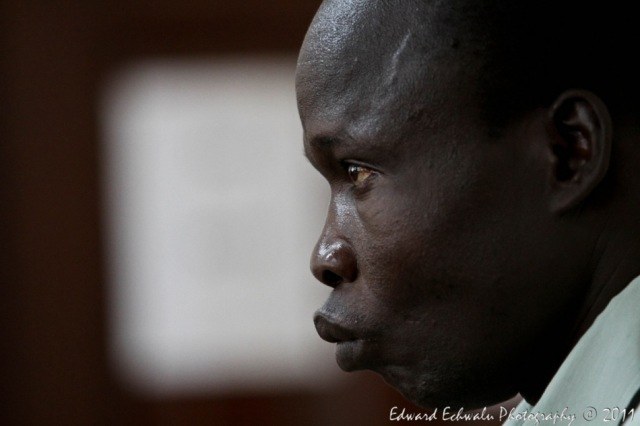
Thomas Kwoyelo while on trial in Gulu, northern Uganda (Photo: Edward Echwalu)

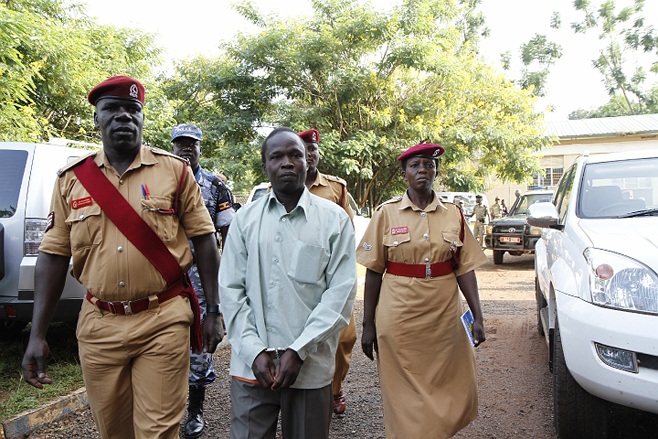
Despite the verdict, numerous questions remain. Kwoyelo will be released and is likely to return to live with his family in Gulu. However, he has spent years in jail and may now have the opportunity to sue the government. Regardless, in the eyes of many, he will always be guilty. Hundreds of Ugandans have seen him paraded to Court in shackles, to the sound of an orchestra.

Will Kwoyelo be subjected to traditional justice mechanisms? Traditional justice, especially ‘mato oput‘, has been a popular way of pursuing reconciliation in Acholiland, northern Uganda. There will be social pressure on Kwoyelo to participate in a mato oput ceremony, but it’s worth noting that never before has an LRA rebel been subjected to the justice of the courts and then to traditional justice. It is not obvious how these two approaches can work in tandem in a single case.

Continue reading

Posted in Amnesty, Human Rights, Justice, Kwoyelo Trial, Lord's Resistance Army (LRA), Traditional Justice Mechanisms, Transitional Justice, Uganda | 4 Comments

The Hypocrisy of Demanding Justice Without Enforcing It

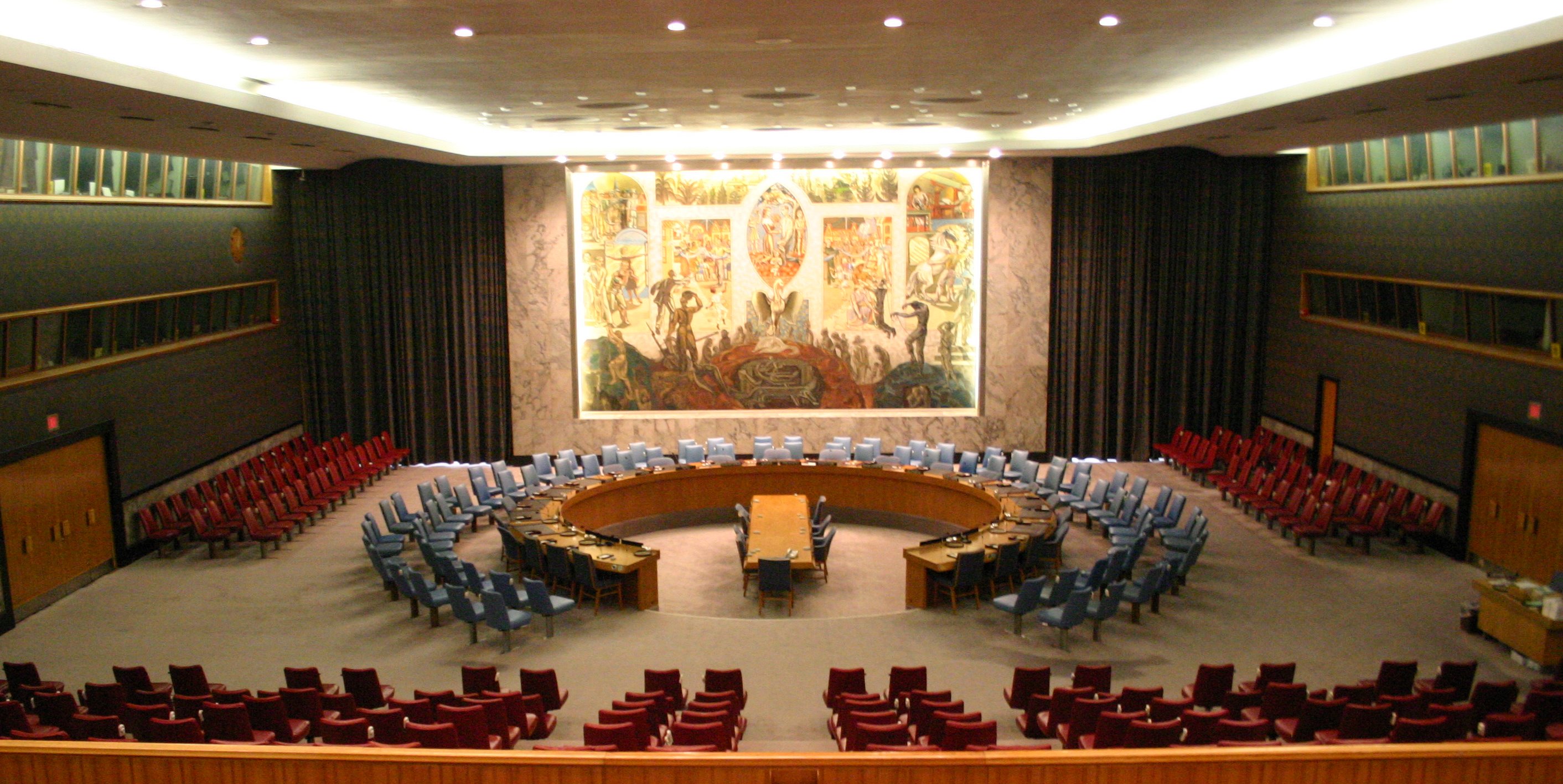
Where justice and politics meet, the United Nations Security Council

In questions of justice in conflicts authors have often described a marked divide between the interests of Western countries and the needs of the local populations directly affected by the conflict on the ground. Two prominent examples are Roy Licklider, who has argued that:

‘We are not just engaged in academic debates now; we are talking about other people’s countries and other people’s lives. And we do not know, in such a manner as to persuade others, what is true, what will work […]’

Adam Branch accuses the ICC of experimenting with African populations in their quest to bring justice to conflicts. As has been argued in various posts published in this blog there are always vested interests in questions of justice during conflicts. For example, in the case of the ICC’s investigations of the Lord’s Resistance Army, traditional leaders have been very vocal in their demands for traditional justice because their traditional authority is at stake. But how much truth is behind the view of a clash of international and local interests in pursuing justice in conflicts beyond the different interests at play?

The case of the ICC warrants against the President of Sudan over war crimes and alleged genocide committed in Darfur serve as a valuable case study to answering this question. The international pressure on Sudan over the Darfur conflict had been mounting for several months before the ICC was brought into play by the United Nations Security Council. Even the US decided to implicitly endorse the referral of the situation in Darfur to the ICC despite their concerns about the court by abstaining and not vetoing Resolution 1594 on 31 March 2005. Throughout the whole conflict verbal condemnations and pressure, especially by France, the US, UK and Canada, had been mounting. This tendency continued after the ICC referrals and culminated in a coordinated international campaign to pressure China, as the main supporter of the GoS, during the 2008 Olympics in Beijing. Human rights organizations like Amnesty International and Human Rights Watch have also consistently been pushing for accountability in Darfur. Additionally, the US applied unilateral sanctions under strong civil society pressure at various points during the conflict.

Save Darfur rally in Central Park, NYC

Yet, this verbal engagement has not been followed up by deeds in any way. The African Union Mission in Sudan (AMIS) was accepted by Sudan in October 2004. It was endorsed by the UN Security Council as its deployment meant that Western states could dodge pressure to become active in Darfur by pointing at the AU. Yet, AMIS failed to stabilize the situation amongst a lack of vital equipment and payment delays for the soldiers stationed in Darfur. The international community never supported the mission to a sufficient degree. In early 2008, after months of stalling by the Government of Sudan and a lack of commitment by Western states, the AU mission was finally replaced by a UN/AU hybrid mission called UNAMID. Yet, history is repeating itself with UNAMID. In 2010 the deployment progress of the mission was still at little over 50 per-cent and vital transport helicopters that are needed to operate effectively in the vast savannahs and deserts of northern and western Darfur were still missing.

Continue reading

Posted in African Union (AU), Darfur, IDP, International Criminal Court (ICC), Peace Negotiations, Sudan | Tagged , , , , , , | Leave a comment