
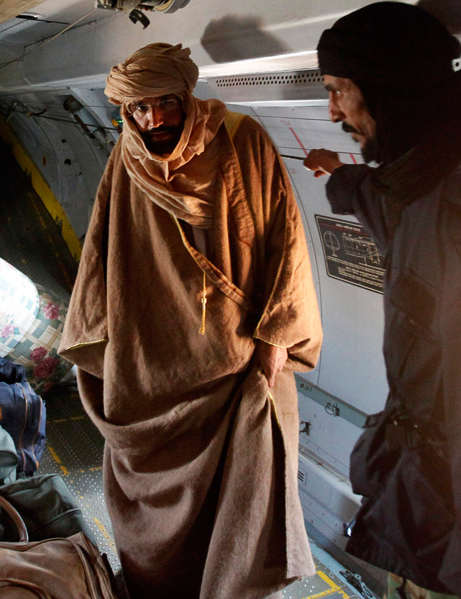
Saif al-Islam Gaddafi on the plane to Zintan after being captured (Photo: Getty Images/AFP)
Last Friday night, Saif al-Islam Gaddafi, dressed in the traditional garbs of the Tuaregs, was detained whilst on the run, likely to neighbouring Niger. With the death of his father, Colonel Muammar Gaddafi, Saif al-Islam had become the most wanted man in Libya and one of the most wanted men in the world. Now, bearing injuries from a NATO air raid this past October, he is cowering in some detention facility in Zintan, a few hours outside of Tripoli. So what now for justice in Libya?
Journey to the ICC: Over before it Began?
Just a few weeks ago, Saif al-Islam made international headlines with reports suggesting he was trying to flee Libya and was willing to hand himself over to the International Criminal Court (ICC). In the wake of the nauseating treatment of Colonel Gaddafi following his capture, it only made sense that Saif al-Islam would want to prevent a similarly brutal fate.
What’s more, the ICC chief Prosecutor, Luis Moreno-Ocampo, maintained that the Court had been in contact with Saif’s “intermediaries” to discuss his surrender to the Court in The Hague.
To date, there has been little more than speculation as to whether any of the above actually happened. The conflict in Libya has spewed a lot of hearsay and rumours, reminding us of the all-too-true adage that “in war, truth is the first casualty.”
Indeed, it is interesting that when asked about having spoken to the ICC about potentially surrendering by a Reuters correspondent following his capture, Saif, who had said little to that point, remarked: “It’s all lies. I’ve never been in touch with them.”
Whether or not Saif did get in contact with ICC officials or not, the chances that Saif al-Islam will ever reach an ICC court room are zero-to-none.
There are rumours that the Libyan National Transitional Council (NTC) will hold a vote to decide where Saif al-Islam Gaddafi should be tried. While this would be a sensible and democratic approach, it virtually guarantees that Saif will be tried in Libya.
Observers are right to point out that, under international law and Resolution 1970, Libya has an obligation to arrange the transfer of Saif to The Hague. However, it seems unlikely that much will be made of this obligation amongst international diplomats and leaders.
In this context, the remarks by UK Prime Minister David Cameron were telling, but for what they didn’t say:
“It is a great achievement for the Libyan people and must now become a victory for international justice too…
…Britain will offer every assistance to the Libyan government and the International Criminal Court to bring him to face full accountability and justice for what he has done.
The Libyan government has told us again today that he will receive a trial in line with international standards, and it is important that this happens.”
Cameron neglects any mention of the obligation to bring Saif to the ICC and like other comments on the issue and much of the rhetoric regarding international justice in Libya, suggests that Libyan authorities will be in the drivers’ seat when it comes to deciding Saif’s fate.
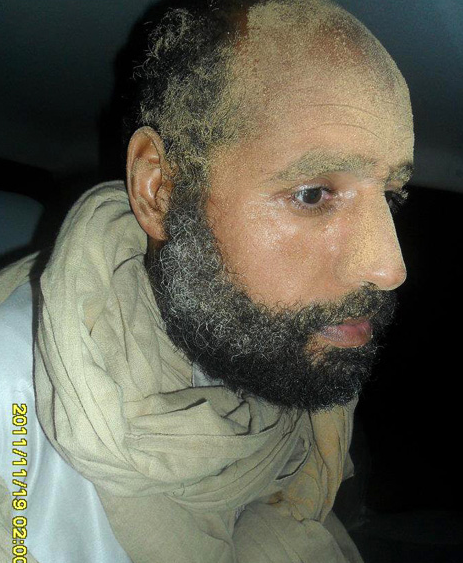
Photo of Saif al-Islam Gaddafi shortly after his capture (Photo: Getty Images/AFP)
What (International) Justice will be served?
Despite protestations by the NTC that Saif al-Islam will get a “fair trial”, there are significant potential dangers to having a trial in Libya. Beyond the fact that there has never been a functioning independent judiciary for at least four decades, it is not clear what domestic legal paradigm could be used in trying Saif al-Islam, nor whether international law would be respected in key regards. Continue reading






 Justice in Conflict