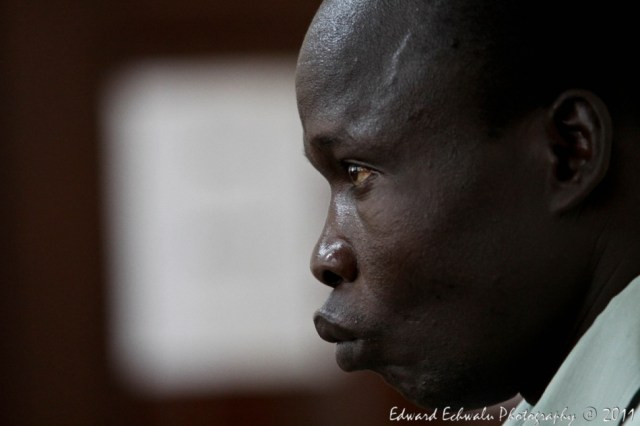
Thomas Kwoyelo during his second hearing at the International Crimes Division of the High Court of Uganda, Gulu (Photo: Edward Echwalu)
An LRA Commander on Trial. But Should He Be?
Even before it started, the trial of former LRA commander Thomas Kwoyelo was controversial. His “day in court” was delayed for months; his application to the Government for amnesty was never answered; the claim that he had committed crimes in the context of an international conflict seemed at best unclear and at worst legally dubious, at least to some observers. But could Kwoyelo’s trial finally bring clarity to the amnesty question in northern Uganda?
There is little doubt that the single issue to cause the most controversy has been the question of amnesty. After being captured by government forces, Kwoyelo applied for amnesty under Uganda’s 2000 Amnesty Act. In brief, the Act was passed as a result of pressure from local civil society groups in northern Uganda in order to provide rebel fighters with an incentive to come out of the bush. The hope is that the promise of forgiveness through amnesty rather than punishment – legal or otherwise – can lure perpetrators back into society. Since its inception, thousands of combatants have received amnesty certificates although the number has dwindled to little more than a trickle in the past three years.
Fueling controversy in Kwoyelo’s case is the fact that the government’s Amnesty Commission has never provided Kwoyelo with an answer as to whether he can or cannot receive amnesty. Instead, his application is “pending”. Making matters worse – and more legally precarious – the same organization, the Directorate of Public Prosecutions (DPP) is both in charge of deciding whether Kwoyelo receives amnesty and prosecuting Kwoyelo. The conflict of interest is palpable.
As explained in a previous post, Kwoyelo’s lawyers believe that the prosecution has violated Kwoyelo’s constitutional right to equality before the law. Other LRA commanders of a similar rank have received amnesty and if Kwoyelo is tried, so too should other LRA commanders who have returned from the bush.
Last week, in the second, jam-packed hearing of Kwoyelo’s case at the International Criminal Division of the Ugandan High Court in Gulu, northern Uganda sided with the defense. After, by all accounts, less than pretty machinations by the defense team, the judges agreed that the interpretation of the Amnesty Law should be referred to the Constitutional Court.

An Internally Displaced Persons Camp in northern Uganda (Photo: FBaroni06)
Ugandans have been rather quiet about the Kwoyelo trial and their opinions about his fate. Many follow the case with keen interest but expectations aren’t particularly high and there is an ever-present skepticism about the trial.
If Kwoyelo is successfully tried and thrown in the can for the rest of his life, most Ugandans I have spoke to wouldn’t be surprised. But many won’t see it as justice because of the amnesty question. The word “scapegoat” and phrase “used as an example” are often used.
If Kwoyelo isn’t tried and walks free, many say that justice too will not have been served. Even some of those who see Kwoyelo as a scapegoat will argue, in the next breath, that at least someone is in the dock and that just seeing Kwoyelo in cuffs is a relief to victims and survivors.
But in a twist of irony, the Kwoyelo case may yet give Ugandans a gift: finally sorting out the country’s amnesty law – who it applies to, who it doesn’t apply to, and why.
Amnesty in International Law: Crystalizing but not Crystalized
While human rights organizations bemoan the use of amnesty laws, their standing in international criminal law remains unclear. Rather than a crystalized duty requiring all perpetrators to be prosecuted, many of these organizations are in the midst of what might be described as talking norms into reality.
With the creation of the International Criminal Court, it is often argued that amnesties for “those most responsible” are a violation of international law. But it’s worth noting that even the ICC’s Rome Statute is silent on the issue of amnesty laws, something which did not escape its authors.
Continue reading →









 Justice in Conflict