
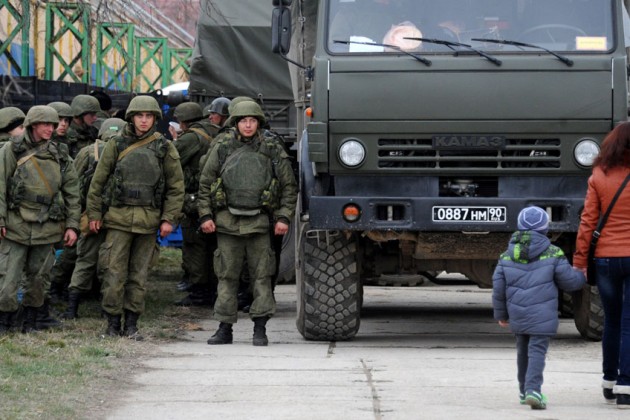
Troops stand near a Russian-made military truck in Feodosiya, Crimea (Photo: Viktor Drachev / AFP / Getty Images)
Russia is increasingly using the language of the Responsibility to Protect (R2P) in order to justify its intervention in Crimea, Ukraine. Just yesterday, Russian President Vladimir Putin stated that any use of armed force in Ukraine would “coincide with our interests to protect the people with whom we have close historical, cultural and economic ties. Protecting these people is in our national interests. This is a humanitarian mission.”
In an op-ed article in the Globe and Mail, I argue that this use of R2P-type rhetoric is misplaced and that it exposes the ongoing challenge of clarifying what R2P is (and isn’t) and where it should (and shouldn’t) apply. Here’s an excerpt:
The invocation of R2P in the context of a Russian invasion of Ukraine, however, appears to be a cynical ploy to justify actions which have little or nothing to do with humanitarian imperatives. It also brings to light the continuing challenge of clarifying what exactly R2P is – and what it isn’t…
But R2P is also a language and as such is a double-edged sword, susceptible to being used and abused. What counts as R2P depends on who’s speaking. R2P was intended to provide the space wherein humanitarian action and inaction would be justified. But it also allows states to abuse the concept by applying it selectively wherever they see fit…
By misappropriating and abusing R2P language to justify intervention, Russia also weakens the very concept of R2P. It confuses rather than clarifies where R2P should and shouldn’t apply. It exposes R2P’s Achilles heel: the fact that it remains unclear precisely what it is.
R2P was intended to place the human experience at the very heart of decision-making in international relations. It was anything but a modest proposal: the boundaries of intervention were to be redrawn, sovereignty was to be redefined.
But R2P cannot ultimately be successful in making intervention more humanitarian if there is no consensus as to what it is or where it applies. Insofar as it is a language, R2P remains a conversation. Russia needs to be part of that and ‘the West’ needs to listen to its concerns. But the cynical appropriation of R2P-style rhetoric for interventions that have little-to-nothing to do with humanitarian imperatives only weaken an already fragile concept.
You can find the rest of the article here.


 Justice in Conflict
Would be hard to find a better example for the uncertainty of this concept
Its quite fascinating. Seems to pose an escalation of the old former Yugoslav dilemma of “why should I be a minority in your state when you can be a minority in mine?” With a shake of R2P, the argument is no longer grounded solely in some sort of elemental necessity but lent an aura of international law respectability.
Pingback: Debate Map: Ukraine/ Crimea | Public International law
Russia has no legal motives of R2P Ukrainians. Ukraine is an independent, sovereign, democratic, social and secular Republic; the principle governing the Republic is ‘government of the people, by the people and for the people.
Let people be free!
Me HAVUGIMANA Ignace