
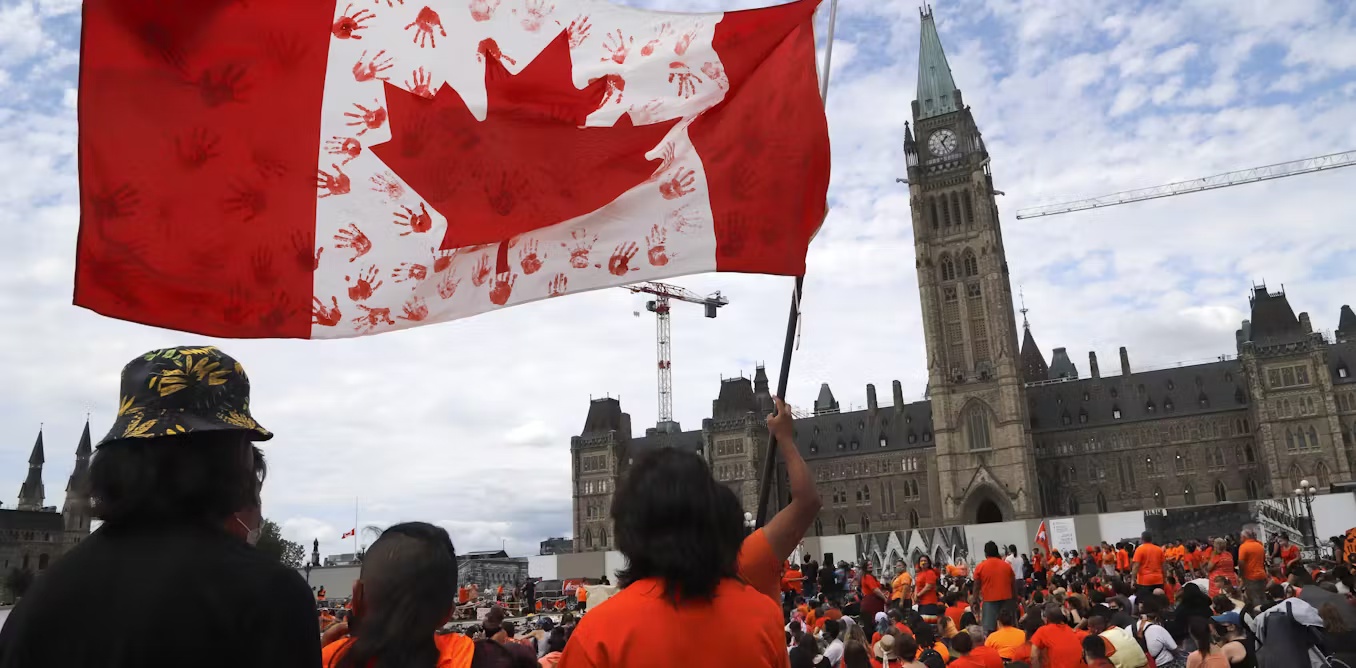
It might sound bizarre to some. Canada referring itself to the International Criminal Court (ICC) for crimes against humanity? Isn’t the ICC supposed to be going after the likes of Vladimir Putin? Who would they even investigate? Is this all just a ploy for attention?
No. Hear me out. There is a case to be made that Canada should ask the ICC to investigate alleged atrocities committed by Canadian authorities in the Indian Residential School System. That case was put forward by Kimberly Murray, the Special Interlocutor for Missing Children and Unmarked Graves and Burial Sites associated with Indian Residential Schools, in her final report. It has since been endorsed by national chief of the Assembly of First Nations Cindy Woodhouse Nepinak.
As some readers will know, I was involved in writing the Special Interlocutor’s Report, working for Murray’s office from 2022-2024. The proposal for Canada to refer itself to the ICC deserves serious consideration, and not the all-too-common dismissal we see whenever Indigenous communities ask that actual, meaningful accountability be delivered for Residential School crimes and atrocities committed against Indigenous Peoples in Canada more generally.
The fact is that some crimes committed at Residential Schools may fall within the ICC’s jurisdiction.
The Court has jurisdiction over the crime against humanity of enforced disappearances. This crime occurs when a person’s liberty is deprived – via arrest, abduction or some other kind of force – by agents ordered or supported by the state. They are placed outside of the protection of the law. Whether the person survives captivity or not, they disappeared. Those responsible then conceal their fate, leaving relatives to wonder what happened to their loved ones, whether they are dead or alive, and if they will ever return.
All of these things happened to the Indigenous children, on a widespread and systematic scale. As a matter of Canadian policy, the children were taken by state agents – often the RCMP – and forced into Residential Schools where they weren’t permitted to leave. Thousands never returned home. Thousands perished. Thousands are buried in unmarked graves. Their disappearances have still not been addressed.
This is the crime against humanity of enforced disappearances.
Still, the ICC only has jurisdiction over crimes committed after it became a functioning institution, on 1 July 2002. So, how could the Court investigate the disappearances of children if the last Residential School closed in 1997?
The answer lies in a unique feature of enforced disappearances: they are considered continuous offences. No statute of limitation applies. They are ongoing offences only resolved when the fate or whereabouts of the disappeared person is established. Moreover, given how they are aimed at harming and terrorizing the disappeared person’s loved ones, families and relatives too are considered victims of enforced disappearances.
The upshot is this: if the ICC accepts that enforced disappearances committed against thousands of Indigenous children is a continuing crime against humanity, then it is as much a crime against humanity today as it was in the decades when the children disappeared. And it is the relatives of the disappeared children to whom justice is owed.
The argument that a crime against humanity can be continuous and therefore may cross into the jurisdiction of the ICC is not new for the Court. The Rohingya people of Myanmar were forcibly displaced by the military forces of Myanmar (which is not a member-state) into Bangladesh (which is a member state). Because the atrocities committed against the Rohingya are a continuous crime that is committed partly on the territory of Bangladesh, judges at the ICC have accepted that the Court can exercise jurisdiction.
In relation to Canada, then, the argument is that this continuing crime persists not across territorial jurisdiction, but temporal jurisdiction. And again: these arguments deserve to be treated seriously, studied, and tested. No international court has ever adjudicated the crime against humanity of enforced disappearances. It is therefore neither feasible nor fair to suggest that the ICC simply cannot investigate enforced disappearances that were initially perpetrated prior to the 1 July 2002, and which continue to this day.
But why the ICC? Can’t Canada do this itself?
The answer is it could, but it won’t. Canada has done everything possible to ensure that Indigenous peoples have no recourse to addressing enforced disappearances. The Special Interlocutor’s Report calls Canada out for the existence of a “settler amnesty” and culture of impunity. It is marked, among other things, by the following: Canada refuses to sign the International Convention for the Protection of All Persons from Enforced Disappearance; it won’t include enforced disappearances in its own national laws on crimes against humanity; and it rebuffs the conclusion (including twice from the Senate) that it should sign the American Convention on Human Rights and accept the jurisdiction of the Inter-American Court on Human Rights, which has repeatedly adjudicated enforced disappearances – including of Indigenous peoples.
If Canada won’t do it, where else are victims and affected communities supposed to go? The answer cannot be nowhere.
Finally, who would the ICC target? After all, Canada’s first prime minister and architect of the Residential School system, John A. Macdonald, has been dead a long time.
That would be for the Court itself to answer. But who to investigate should not overshadow a positive finding of crimes against humanity by an international tribunal. As the Special Interlocutor notes, the ICC has previously declined to investigate crimes against humanity in the context of Australia’s offshore migrant detention centers, while still acceptingsuch crimes were committed. The ICC might do the same in Canada: decline to investigate specific persons but accept that crimes against humanity were committed against Indigenous children. That would offer a moment of truth, which, as the late Murray Sinclair often said, is a precondition to reconciliation.
Referring itself to the ICC isn’t a condemnation of Canada. It would be a sign confidence and commitment to accountability. It could also help spur Canada to finally make avenues of accountability for enforced disappearances available while (finally) forcing the government and Churches to turn over all records of their involvement in atrocities in the Residential School System.
When it comes to finding the missing and disappeared children, no effort should be spared – even if that requires asking for help from outside of Canada.


 Justice in Conflict
Hi Mark – an interesting article. One question, though – wasn’t there already an attempted referral under Article 15 by a group of Canadian lawyers, which was declined by the ICC? I believe this was just after the Kamloops investigation and exhumation. On principle, I agree with you – but it appears the OTP does not.
Without the Canadian government’s goodwill (or so it would appear), AND without the ICC’s willingness to open a preliminary examination to look into this, what options would remain?
Dear Rose,
Many thanks for the comment.
There was indeed a request for the ICC to investigate. However, it did not center or (to the best of my recollection) even mention enforced disappearances as a crime against humanity. This would be the way forward as proposed in the post and the OSI final report, but would require the OTP to accept that enforced disappearances constitute a continuous crime.
In short, I think the argument suggested in the article and the final report has not been tested and merits serious consideration.
Thank you again and all the best,
Mark