
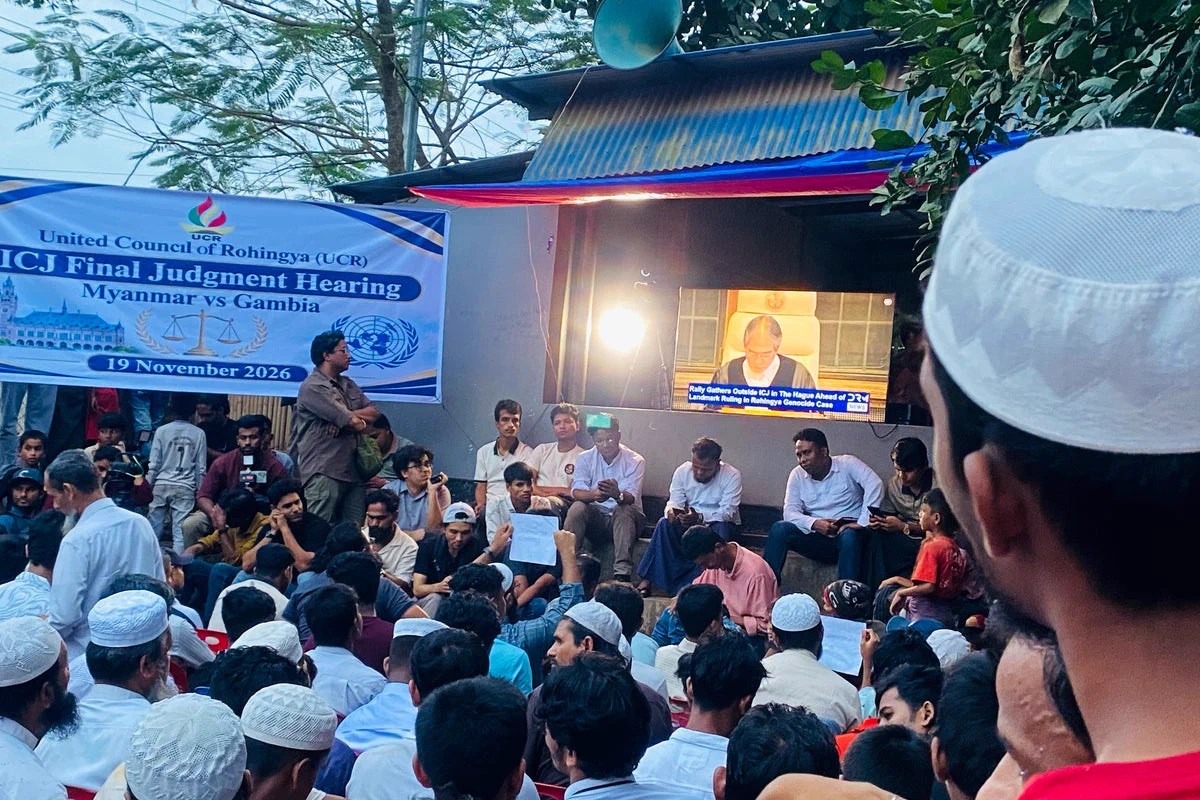
Hundreds of victims and survivors celebrated as Judge Yuji Iwasawa of the International Court of Justice (ICJ) pronounced that Myanmar had committed genocide against the Rohingya. The ruling represented the first time that the ICJ found that a state had committed genocide. So, what does the judgement tell us about how genocide unfolds and how future cases, including over alleged genocide in Gaza, might be decided?
In a 9-6 vote, the majority found that Myanmar had committed three acts of genocide under the Genocide Convention: killing members of the Rohingya, causing serious bodily or mental harm to members of the group, and imposing measures intended to prevent births within the group.
For such atrocities to be considered genocide, they must be committed with the intention to destroy a group in whole or in part. In the absence of a ‘smoking gun’ – an unequivocal statement of genocidal intent – the Court applied the well-established test that genocidal intention can be determined if it is the “only reasonable inference” to explain a state’s actions. Based on all the evidence before it, the ICJ found that no other explanation for Myanmar’s atrocities was plausible. It was genocide.
The ICJ explained that multiple motivations can exist simultaneously with genocidal intent. For example, a state’s military forces can be lawfully engaged in war and desire the destruction of part of a group. The Court added that a state like Myanmar, claiming to be merely involved in counter-insurgency operations, may nevertheless be involved in genocide. Judges were thus unconvinced by Myanmar’s arguments, pointing out that no counter-insurgency campaign could ever justify the slaughter of civilians, including babies and infants.
Genocidal intent can co-exist alongside multiple other motivations: fighting a war, displacing civilians for ‘security’ reasons, counter-terrorism operations, etc. More than one thing can be true at once, and the existence of other motivations does not mean that genocide can’t be occurring. In fact, multiple motivations will almost always operate alongside genocidal violence.
The ICJ verdict made clear that killing is not the only way to commit genocide. Causing serious bodily or mental harm as well as preventing births in the group need not be lethal to be genocidal. We know this from the Genocide Convention and past genocides too: whether through forced labour, a denial of medicine and sufficient calories, or the use of rape to change the biological composition of a group, genocide is waged through both lethal and non-lethal means.
This conclusion is worth emphasizing. Some believe that genocide can only exist if it’s accompanied by the killing of massive numbers of people. This fails to capture the totality of what genocide is and how it is experienced, whether in the Holocaust, Rwanda, or Myanmar. It also ignores the fact, as set out in law, that determining genocide is not a quantitative exercise. The number of victims may be useful in establishing that a genocide has been committed, but, per the ICJ: “there is no requirement of a minimum number of victims.”
Myanmar tried to argue that it could not have committed genocide because there are still Rohingya alive and, if it was truly genocidal, it would have killed them all. The argument is morally bankrupt. Legally, it’s absurd, and the Court rightly rejected it, concluding that “the fact that Myanmar did not take every opportunity it had to destroy members of the Rohingya group does not preclude an inference of genocidal intent.” A state does not have to kill or even want to kill all members of a group to commit genocide. And again, an over-emphasis on killing obscures how genocide is often waged. The verdict will hopefully help pierce forms of genocide gatekeeping and denial.
What does this mean for South Africa’s case against Israel over alleged genocide in Gaza? A lot. Similar claims as Myanmar’s – ‘it’s a war of self-defence, not genocide’; ‘it was a response to terrorism, not genocide’; ‘if it was genocide, there wouldn’t still be Palestinians alive’ – will almost certainly be found to be legally irrelevant, and rightfully so.
It should never have come to this. As Israeli international law scholar Eliav Lieblich writes in relation to the implications of the ICJ judgement on the Gaza case: “Even if you disagree with the majority opinion on every legal point, no reasonable country should even come close to the territory where it would fall short of the standards set by the majority opinion.”
We must remember: the Genocide Convention obliges all states to prevent genocide when there is a serious risk of its perpetration. That risk has been obvious in Gaza for years. It shouldn’t take an international court to tell states like Myanmar and Israel to treat human beings with dignity. The fact there are cases of genocide before the ICJ is a success of international law and a vindication of victims. But the fact that so many failed for so long to act to prevent genocide is also a failure of our humanity.


