
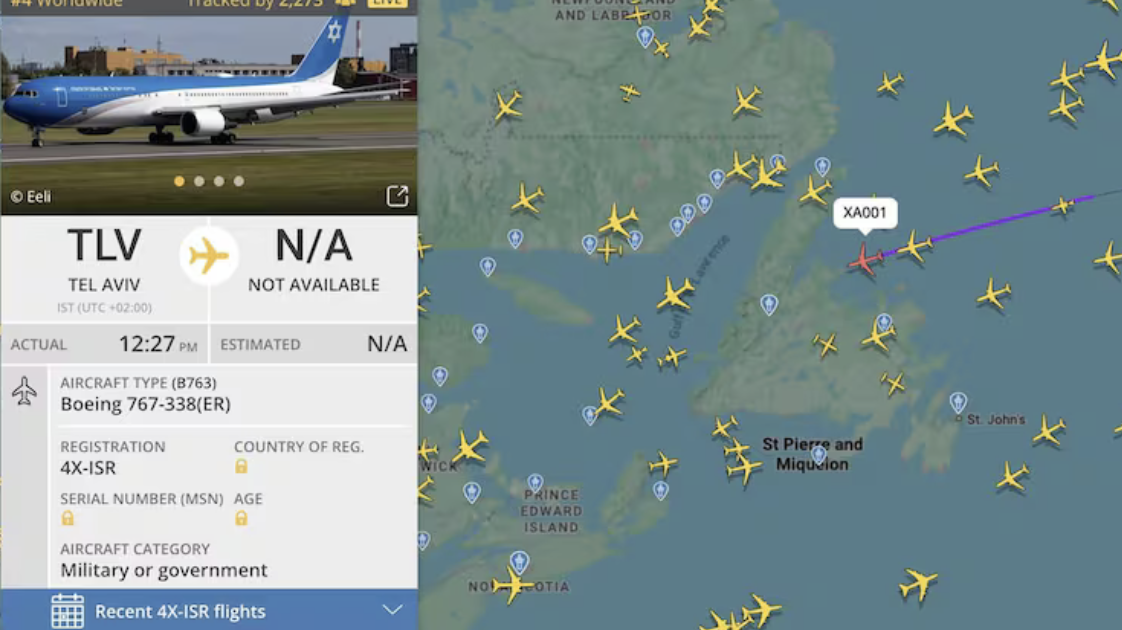
In late July, Israeli Prime Minister Benjamin Netanyahu travelled to the White House with a mission: get America to continue its war against Iran and to support him in his forthcoming election campaign. On his way to Washington, the aircraft carrying Netanyahu, the Wing of Zion, flew over multiple member-states of the International Criminal Court (ICC): Greece, Italy, France, and Canada. It was not the first time in recent months that the Israeli leader had entered the airspace of these states. But as late as September 2025, Netanyahu had been forced to take a more circuitous route to the U.S. What hasn’t changed over that time the ICC arrest warrant Netanyahu faces.
Do states have an obligation to enforce warrants in the air above them? The European states that allowed Netanyahu to cross their airspace have thus far been silent on their reasoning. According to Canadian officials responding to reports that Netanyahu’s flight over two Canadian provinces, however, “Canada does not currently link its overflight policy to law enforcement objectives except where an imminent security risk is present. This policy is regularly reviewed.”
This would suggest that states have an obligation to arrest ICC suspects only when they are boots-on the-ground, physically on their land and not if they’re at sea or in the airspace above them. As a matter of law, though, is there really such a carve out?
The most obvious place to look for an answer is the Rome Statute of the International Criminal Court, which, among other things, explains when states are required to cooperate with the Court in enforcing arrest warrants. Under the Statute’s provisions, specifically, Article 89.1, the ICC can request any state to arrest and surrender any individuals wanted by the Court if they are found on that state’s “territory”. The Statute makes no express reference to obligations that might arise in the airspace of states.
But what is “territory”? A basic reading would probably equate it with land, terra meaning land. But not so fast. Nothing in the Rome Statute suggests the drafters sought to define “territory” to the exclusion of coastal waters and airspace. And we know that, by law, state sovereignty exercised over territory extends further than just its landmass and includes coastal waters as well the air above. According to the International Court of Justice (ICJ), in the famous Nicaragua v United States case of 1986 (paragraph 212, bolded for emphasis),
The basic legal concept of State sovereignty in customary international law, expressed in, inter alia, Article 2. paragraph 1, of the United Nations Charter, extends to the internal waters and territorial sea of every State and to the air space above its territory. As to superjacent air space, the 1944 Chicago Convention on International Civil Aviation (Art. 1) reproduces the established principle of the complete and exclusive sovereignty of a State over the air space above its territory. That convention, in conjunction with the 1958 Geneva Convention on the Territorial Sea, further specifies that the sovereignty of the coastal State extends to the territorial sea and to the air space above it, as does the United Nations Convention on the Law of the Sea adopted on 10 December 1982.The Court has no doubt that these prescriptions of treaty-law merely respond to firmly established and longstanding tenets of customary international law.
In brief, then, the airspace above a state is core part of the area over which a state exercises territorial sovereignty.
This understanding jives with that of the ICC’s Office of the Prosecutor (OTP) assessment of territory as well. As Michael Kearney has explained, the OTP responded to a 2019 request to investigate alleged crimes against humanity within the Philippines’ exclusive economic zone and continental shelf by concluding the following:
while the Rome Statute ‘does not provide a definition of the term, it can be concluded that the ‘territory’ of a State, as used in article 12(2)(a), includes those areas under the sovereignty of the State, namely its land mass, internal waters, territorial sea, and the airspace above such areas. Such interpretation of the notion of territory is consistent with the meaning of the term under international law.’
The 1944 Chicago Convention cited by the ICJ, applies mainly to civil aircraft and not those operated by a state’s military or government. But the broader point stands: sovereignty includes a state’s landmass, coastal seas and the air above (up to the edge of outer space). That should mean that even if there are not unassailable and unambiguous obligations to arrest an ICC suspect who enters a member-state’s airspace, it is only and exclusively up to the sovereign state to decide who gets to use its airspace and who doesn’t.
This is not new. Following Russia’s full-scale invasion of Ukraine in February 2022, the European Union and Canada closed their airspace to any Russian-owned, -controlled, or -registered aircraft. They could do so because they had the sovereign right to decide who enter their airspace and decided that wars of aggression and war crimes were sufficient grounds to reject the entry of Russian citizens into their airspace. Now, however, reports indicate that Canada (and perhaps its European allies too) believe it is up to Netanyahu – and not the government – to decide whether to enter Canadian airspace. The logical extension of such a policy is that the sovereignty of states over their airspace is not in the control of states – a position which verges on the legally and politically absurd.
To be sure, mounting an operation to forcible land a plane carrying a government figure wanted by the ICC would be tricky and arguably inadvisable. And perhaps it is not possible to identify a conclusive answer as to whether there is an unambiguously clear obligation to arrest and surrender ICC fugitives flying through the airspace of the Court’s member-states (although I’d still lean towards an answer in the affirmative). But respect for the ICC – and the dignity of the victims of atrocity perpetrators – as well as self-respect for state sovereignty surely demands that states act to prevent suspects from flying over their territory. Even if the likes of Vladimir Putin and Bibi Netanyahu aren’t soon arrested, their world is supposed to get smaller by making it harder to do what they want and go where they want.
European officials have declined to explain why they allowed Netanyahu to fly over France, Greece, and Italy and whether this violated these states’ obligations to the ICC. Despite requiring foreign states to give three days’ notice of their planned entrance into Canadian airspace (referred to, again, as “Canadian territory”), Global Affairs Canada says it “does not comment on which route a foreign state chooses to take.” Neither the EU nor Canada will explain whether the Israeli government informed them of their plans (and thus were approved) or whether the Wing of Zion simply violated the sovereign integrity of their airspace and Ottawa, Paris, Rome and Athens merely shrugged.
That’s not good enough. Citizens of these states deserve to know what is happening in their sovereign territory – on the land, sea, and in the sky. They likewise deserve to know that suspected war criminals won’t enjoy the privilege of flying wherever they want, whenever they want.
Ultimately, letting Netanyahu – or any ICC suspect – enter sovereign airspace is a choice. Those choices by states shape both international law and the way that we view sovereignty. At a time when each is under threat, states should use any opportunity to defend the international rule of law and the sovereign integrity of states, rather than defend those who wantonly violate them.


Important post.
I recommend by the way, the following article (see link hereby) in voelkerrechtsblog (by itself very recommended blog) for distinguishing between the very theoretical definition of territory, and the functional aspects of it (especially when dealing with embassies). This is not so simple as an apple.
And by the way, many intelligence alerts have been received in Israel, for that flight of Netanyahu. The Iranians would be more than happy to take him out (and Trump obviously). So, that is why maybe, there wasn’t any comment from those European states. Maybe.
Here to territory:
https://voelkerrechtsblog.org/is-an-embassy-territory/
Here to dangers in the flight of Netanyahu, under the title:
Fearing an Iranian attack, Netanyahu discreetly departed for the US from Air Force base – report
Here:
https://www.jpost.com/israel-news/article-903944
Thanks