
Juan Carlos Botero and Mateo Merchán join JiC for this contribution to our symposium on ‘Rethinking Peace and Justice. Juan Carlos is Associate Professor at the Department of Philosophy and History of Law at the Pontificia Universidad Javeriana School of Law, Bogota, Colombia. Mateo is an Adjunct Professor at the same school.

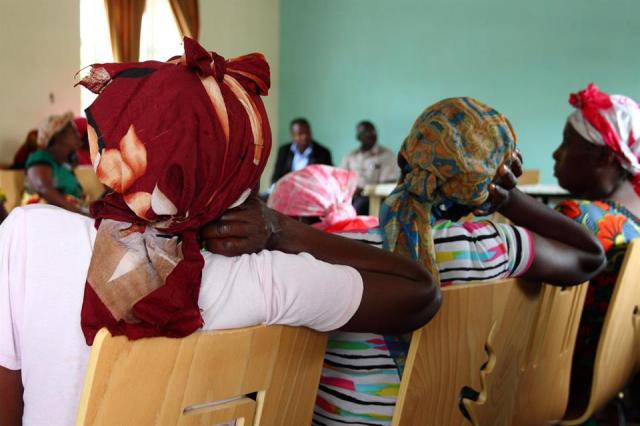
(Photo: Luis Roboyo / AFP)
The liberal version of transitional justice assumes that the central dilemma of transition is how to transform a society that has been subjected to illiberal rule and the extent to which this shift is guided by conventional tenets of the rule of law and the responsibilities associated with established democracies (Teitel, 2006, p.3). However, “[t]here are many misunderstandings and controversies about the nature of transitional justice. Some believe it is simply a form of criminal justice diluted by the need for transaction and compromise—a kind of ‘criminal justice lite’” (Seils, 2015, p.3). Presumably, this ‘light’ form of justice would be justified by the society’s need to ‘turn the page’ after devastating violence, as a means to achieve peace, or because of the practical impossibility of securing full accountability. At a time when the International Criminal Court (ICC) is perceived by many as a ‘walking dead’ (Thakur, 2019; Lee, 2018), it seems timely to ask whether the justice resulting from the Colombian peace process was a disappointing form of ‘light’ justice, or if is it rather a promising new model for international criminal justice in the ‘post-ICC’ era of the XXI century?
The Final Agreement for the Termination of the Conflict and Construction of a Stable and Lasting Peace (Final Agreement), signed by the Government of Colombia and the FARC-EP guerrillas in November 2016, created a transitional justice system that seeks to satisfy the rights of the victims of the armed conflict to truth, justice, reparation, and non-repetition (Art. 1. Legislative Act 01 of 2017), while striking a new balance between the conflicting interests of peace and justice (understanding Justice as accountability, retribution, and punishment for grave crimes).
This transitional justice system, called the Comprehensive System of Truth, Justice, Reparation, and Non-Repetition (SIVJRNR), encompasses three mechanisms: The Truth, Coexistence and Non-Repetition Commission (CEV); the Search Unit for Persons Presumed Disappeared in the context and because of the armed conflict (UBDP) and the Special Jurisdiction for Peace (JEP), the latter being the mechanisms to prosecute and punish those responsible for the most serious crimes committed in the context of the armed conflict (Art. 5. Legislative Act 01 of 2017).
Transitional justice systems, as the Colombian one, often face limitations stemming from the exceedingly complex contexts of violence in which mass atrocities are perpetrated (Duthie and Seils, 2017). In fact, there is no country that has made a transition where each perpetrator of human rights violations has been prosecuted (De Greiff, 2012, p. 35). In this context, the Final Agreement proposes a new balance between the demands of justice and peace through the prosecution of the most serious and massive crimes from a restorative rather than a retributive (punitive) justice approach. Restorative justice encompasses a diverse set of values, aims, and processes that have as a common factor attempts to repair the harm caused by criminal behaviors when victims, community and offenders meet to decide how to repair the damage caused (Hoyle, 2010, p. 9).
“Both retributive and restorative theories of justice acknowledge a basic moral intuition that a balance has been thrown off by the wrongdoing. Consequently, the victim deserves something and the offender owes something. Both approaches argue that there must be a proportional relationship between the act and the response. They differ, however, on the currency that will fulfill the obligations and right the balance. Retributive theory believes that pain will vindicate, but in practice that is often counterproductive for both victim and offender. Restorative justice theory, on the other hand, argues that what truly vindicates is acknowledgment of victims’ harms and needs combined with an active effort to encourage offenders to take responsibility, make right the wrongs and address the causes of their behavior. By addressing this need for vindication in a positive way, restorative justice has the potential to affirm both victim and offender and help them transform their lives.” (Zehr and Gohar, 2003, p. 59). Continue reading






 Justice in Conflict