
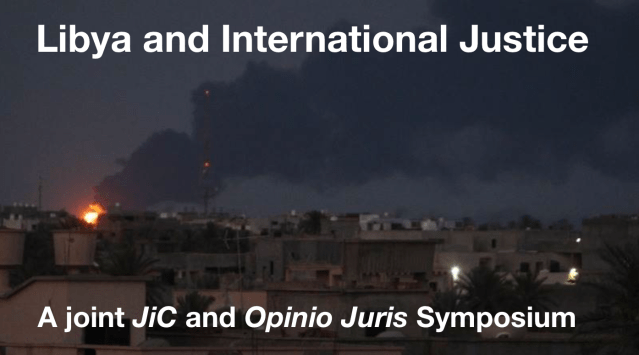
Marieke Wierda joins JiC for this post, part of our ongoing joint symposium with Opinio Juris on Libya and International Justice. Dr. Wierda is the rule of law advisor at the Dutch Ministry of Foreign Affairs and ex-Transitional Justice Advisor to UNSMIL (2011-2015). This blog is written in her personal capacity. Earlier today, Mary Fitzerald’s contribution to the symposium was published at OJ. Be sure to check it out!
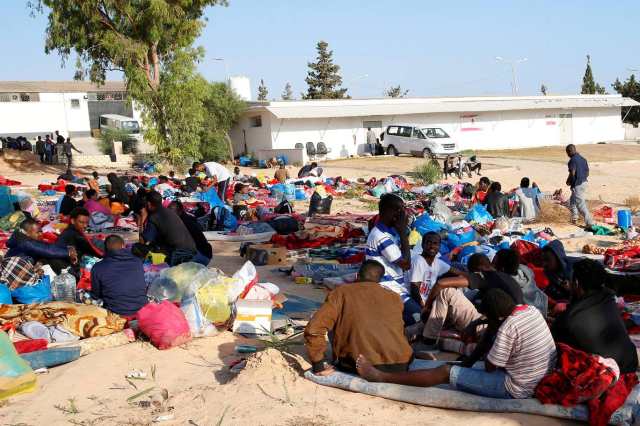 Migrants sit outside of the Tajoura detention camp following an airstrike by militants (Photo: Reuters)
Libya has always been a dangerous place for migrants and refugees. They are often at the mercy of ruthless human traffickers, militias who trade them for money, or abusive state authorities who detain them indefinitely. Now it is more dangerous than ever. On 3 July, an airstrike hit a migrant center in Tajoura, killing 53 and injuring another 150, many of them women and children. The UN’s Libya envoy, Ghassan Salame, called the attack a war crime. In the current chaos, those most vulnerable, such as migrants and refugees, are the first to suffer.
The response of the Security Council to the airstrike is illustrative of how difficult it has been to pursue accountability in the Libyan context. The Council condemned the attack but did not attribute it to any side. The international community remains deeply divided on Libya, and this complicates any efforts to call any of the parties to account for their actions.
It was not always this way. During the Revolution in 2011, the Security Council unanimously adopted Resolution 1970, which sought to protect civilians and to refer the situation to the International Criminal Court. The Resolution also enabled international armed intervention in Libya and eventually helped the revolutionaries to prevail against the regime of Muammar Qadhafi.
The demand for justice was there from the outset and helped to drive the Revolution. Protests from the victims of the Abu Slim massacre in 1996 are what sparked the uprising against Qadhafi. Within two days, over 1,200 prisoners of the infamous prison in Tripoli were mowed down with machine guns. Family members were not informed about their deaths until 2008. The Abu Slim massacre was a hallmark of the repressive nature of the Qadhafi regime and inspired the country’s opposition to rise against Qadhafi in 2011.
When they prevailed, the victory of the revolutionaries quickly seemed complete. In October, Qadhafi himself was captured alive near Sirte. Qadhafi was then tortured and killed. In the aftermath of the killing, around 65 bodies were found executed near the Mahari hotel, civilians mixed with members of Qadhafi’s close protection unit. No one was held to account. Continue reading





 Justice in Conflict