
B. Aloka Wanigasuriya joins JiC for this post on ongoing efforts to achieve justice and accountability for atrocities committed during Sri Lanka’s brutal civil war. This piece coincides with the ten-year anniversary of the end of the war. Aloka is an Australian lawyer and a PhD scholar at the Faculty of Law, University of Copenhagen (Dernmark).
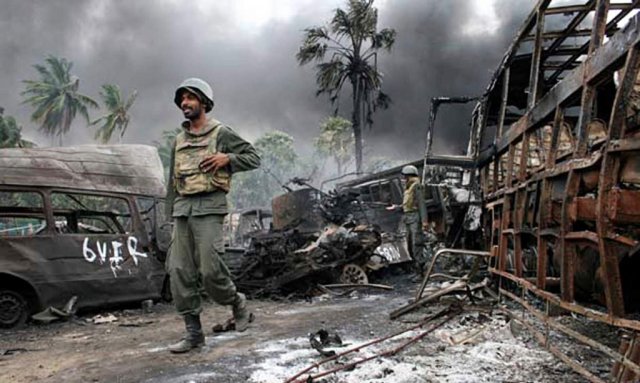
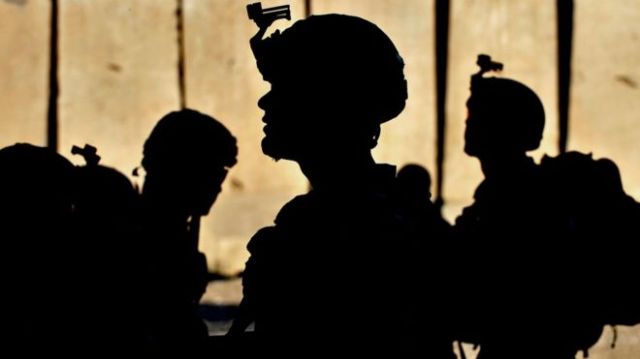
(A Sri Lankan soldier surveys damage during the country’s civil war. Photo: Association for Diplomatic Studies and Training)
In 2009, during the final stages of its nearly three-decade long civil war, Sri Lanka was the subject of much international attention due to allegations of war crimes and crimes against humanity committed by its government armed forces and the Liberation Tigers of Tamil Eelam (LTTE). A UN report estimates that 40,000 civilians perished during the final offensive that lasted from January to May 2009.
Since the end of the war, multiple internationalorganisations have repeatedly called for a UN-mandated international justice mechanism to be established in relation to Sri Lanka. Those efforts have failed. In order to quell both internal and external calls for justice, the Sri Lankan government has engaged in several box-ticking exercises. However, with the 10thanniversary of the end of the conflict falling in May, and in the absence of any viable means through which victims and aggrieved communities can seek justice for the alleged crimes, initiatives to achieve justice and accountability have fallen short of any real attempt at combatting impunity.
International scrutiny
In May 2009, the UN Security Council expressed concern regarding the humanitarian crisis in northeast Sri Lanka, calling for urgent action by all parties to the conflict to ensure the safety of civilians.Earlier that year, the UN Secretary-General (UNSG) recommended establishing an accountability process for any international crimes. The government agreed. However, faced with a lack of concrete action, ayear after the end of hostilities,the UNSG appointed a panel of experts to advise him on the implementation of this joint commitment. The Panel’s report concluded that serious violations attributable to both sides of the conflict had taken place, warranting accountability under domestic and international law. It recommended establishing an international mechanism to carry out independent investigations into the alleged violations, whilst also monitoring and assessing the extent to which the government was carrying out an effective domestic accountability process. The report received a cold reception from the Sri Lankan government.
Calls for setting up a legal mechanism to try the alleged perpetrators of wartime atrocities continued. In 2013, UK prime minister David Cameron urged the Sri Lankan government to hold an independent international inquiry into the alleged war crimes. In March 2014, the UN Human Rights Council passed a resolution on ‘Promoting reconciliation, accountability and human rights in Sri Lanka’ stressing the importance of Sri Lanka complying with its obligations to prosecute those responsible for crimes under international law. Moreover, in September 2015, the United Nations Office of the High Commissioner for Human Rights (OHCHR) released its investigative report on Sri Lanka, recommending the establishment of “truth-seeking mechanisms, investigations, prosecutions … and measures to prevent the recurrence of … abuses”.
Instead of trying the crimes under domestic law, the OHCHR recommended establishing a hybrid accountability mechanism with international judges, prosecutors, lawyers and investigators. The rationale was to provide legitimacy to and instill confidence in the process, particularly among victims who doubted the impartiality of any process given the “politicisation and highly polarised environment in Sri Lanka”. Less than a month afterwards, UN Human Rights Council Resolution 30/1 again echoed the findings of the OHCHR report.Additionally, in his 11 September 2017 opening remarks to the Human Rights Council, the UN High Commissioner for Human Rights, called on Sri Lanka to establish transitional justice mechanisms, urging it to treat its obligations not as a mere“box-ticking exercise to placate the council but as an essential undertaking to address the rights of all its people”. To date, however, very limited action has been taken by Sri Lanka to address impunity.
National action
In terms of establishing an accountability mechanism, the three main steps taken by the Sri Lankan government have been the (i) Lessons Learnt and Reconciliation Commission (LLRC), (ii) Consultation Task Force (CTF) on Reconciliation Mechanisms, and (iii) Office on Missing Persons (OMP).
Of these, the LLRC was criticized in the UNSG Report for failing to meet international standards for an effective accountability mechanism.Instead of being an investigative commission, its mandate was limited. Thereafter in January 2016, following its pledge to the UN Human Rights Council with regard to Resolution 30/1 (which Sri Lanka co-sponsored) the CTF was established. Through conducting consultations with the Sri Lankan public, the CTF was to ascertain the public’s views on the mechanisms for transitional justice and reconciliation proposed in Resolution 30/1. It recommended granting effective remedies (including through criminal justice) to those having suffered harm during the conflict. Outlining the illegality of granting amnesties for international crimes, it also recommended the establishment of a hybrid mechanism consisting of national and international judges. However, its recommendations faced an uphill battle from the outset. Merely days after the release of its final report, the Sri Lankan justice minister opined that he had ‘no confidence’ in the CTF.
Continue reading

 Justice in Conflict