Patryk I. Labuda joins JiC for this guest-post on the publication and dissemination of photos of meetings between the Prosecutor of the International Criminal Court and world leaders. Patryk is a Hauser Global Fellow at New York University.
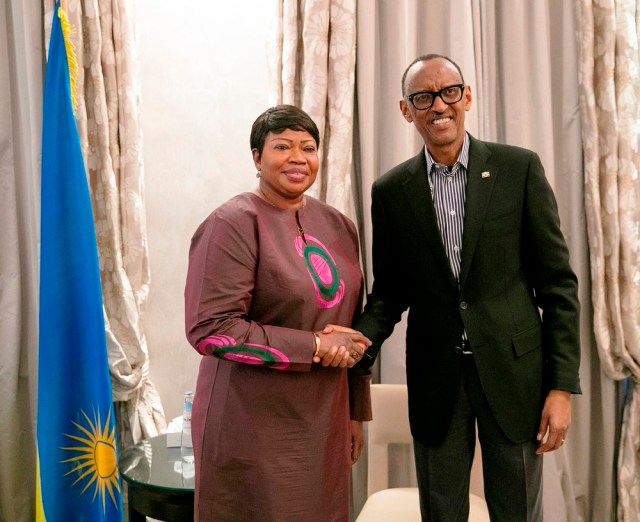
(Photo: ICC Twitter account)
The image is troubling. On 16 February, the International Criminal Court (ICC) tweeted a photo of Prosecutor Fatou Bensouda shaking hands with the President of Rwanda, Paul Kagame. The photo was taken at the Munich Security Conference, an annual gathering whichaims“to build trust and to contribute to the peaceful resolution of conflicts”. Kagame can be seen grinning, while Bensouda sports an awkward half-smile, half-cringe.
As noted by Dov Jacobs, similarly awkward photos exist of the first ICC Prosecutor, Luis Moreno Ocampo, trading laughs with Yoweri Museveni, the President of Uganda. Here is one of the current Prosecutor shaking hands with Museveni a few years ago. And last September, the ICC tweeted a photo of Bensouda meeting with the then ‘President’ of the Democratic Republic of Congo (DRC), Joseph Kabila, at the UN General Assembly.
It is hard not to feel some discomfort looking at these images. To state the obvious: these three men are not known for their human rights credentials. At the same time, it is a fact of life that the ICC relies on states for cooperation. Sois there something inappropriate about these photos? Or is this just (an unpleasant) part of the job? In this post, I argue that the ICC should do a better job of managing public perceptions. It may also want to adopt a policy on non-essential contacts with government officials to avoid public relations mishaps in the future.
Perceptions of (In)-Justice
Why are these photos a problem? When they were announced in 2004, Uganda and Congo’s invitations to the Prosecutor to launch investigations in their territories were quite a surprise. At the time, few expected states would affirmatively encourage ICC scrutiny. Self-referrals, as these invitations came to be known, came under sharp criticism almost immediately, with academics and civil society worrying that the first Prosecutor had cut a deal with the leaders of self-referring countries in exchange for their cooperation.
That criticism has not abated since then. It does not help that fifteen years later the Prosecutor has failed to bring a single case against a sitting government official from any self-referring state (in addition to Uganda and Congo, that includes the Central African Republic (CAR), Mali and Cote d’Ivoire). Not only has there not been a single trial of a sitting government actor – there are no publicly available arrest warrants, which couldmean that the ICC has never even tried toinvestigate government crimes in these contexts. Continue reading