
Shehzad Charania joins JiC for this interview with outgoing President of the International Criminal Court Silvia Fernandez de Gurmendi. Shehzad is the Head of International and EU Law at the Attorney General’s Office and International Law Adviser to the Prime Minister’s Office. Between 2013-16, he was the Legal Adviser and Head of International Law at the British Embassy in The Hague.
This marks the second time that Shehzad has interviewed Fernandez. The first interview was conducted in January 2015 when Shehzad was her first visitor at the Court’s newly opened premises. This time, he interviewed Fernandez as part of her very last engagement before leaving the Presidency and the Court for good. The interview focussed on her legacy, her view of the Court today, and her hopes for the future. It was conducted on 9 March 2018.
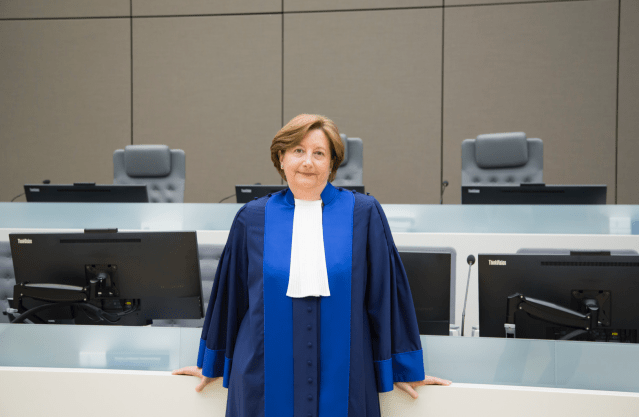
Outgoing ICC President, Silvia Fernández de Gurmendi (Photo: International Criminal Court)
Outgoing President of the International Criminal Court Silvia Fernandez de Gurmendi is in a reflective mood, for obvious reasons. It had been a “moving day”, she says. She has just that morning presided over a ceremony of the swearing-in of six new Judges, while the day before the Appeals Chamber issued four judgments. “We had to work like mad,” she says, “so I haven’t until now had the chance to reflect.”
To add to the sense of finality, while we are speaking the Court issues the President’s End of Mandate Report setting out progress against the priorities she outlined at the start of her term in 2015. She hails the emphasis on expediting and improving the judicial process. “I was so proud that we even managed to have a discussion on it,” she says. Previously, many of the Judges had not wanted to enter into a dialogue around judicial processes, citing judicial independence as the concern. In the end, it has been a collective effort to improve trial procedures, and establish a “more cohesive judicial culture”. By issuing the report, she hopes that the new bench, including the six new Judges, will continue the dialogue. “Much has been done,” she says, “but there is much more to do.”
In addition to the work on the judicial process, Fernandez also picks out the focus on restorative justice in the report and, in particular, her efforts to integrate the Trust Fund for Victims into the work of the Court. “The Trust Fund is a crucial part of the Rome Statute system,” she says. While the Trust Fund zealously guards their independence, she is clear that the “Court needs the Trust Fund and the Trust Fund needs the Court”. She has recently undertaken a trip to Uganda with the Trust Fund to see some of their work being carried out in the field. Fernandez describes it as “one of the highlights of my Presidency”. She says she saw first-hand how much could be done with relatively little resource. “The new leadership should continue the engagement with the Trust Fund,” she advises, “because of the centrality of victims in the work of the Court.” Improving judicial process is key, she stresses, but it is equally important to raise awareness of the plight — and role — of victims, and the work of the Trust Fund.
What if she had another three years, I ask? She is keen to emphasise that, in her view, three years is sufficient for a Judge to hold the Presidency. While it means that there is a limited amount of time to drive through an agenda, it means that you are “truly independent” because you are not spending your time “trying to make friends to ensure your reelection”. It is now time to pass on the torch, to bring in new ideas, she says. During her time, she has had to make hard choices which not everyone has agreed with or been happy about. If she were to have another three years, she would focus on harmonising the system for victims’ applications and participation. But she doesn’t think she could have done much more than she has. There needs to be a greater degree of experience in these areas, she says.
So no regrets, I ask? “I did what I could,” she says, “and maybe I could have done better, but I wanted to be the President because I had a clear idea of what I wanted to achieve.” The biggest challenge had been to bring others with her in her vision for the Court and the judiciary. But, she says sombrely, “there will always be a few individuals who do not want the same thing.”
As President, one of Fernandez’s responsibilities would have been dealing with the politics of the institution and the role of States in particular. The role of the ASP has grown, she notes. She doesn’t think that the extent of the role as it stands today was envisaged in Rome. States Parties in The Hague had in the past a tendency to “micromanage” the Court, she says. While Fernandez notes that she maintained good relations with States, and has no doubt about the key role they have to play, she has tried to persuade them not to interfere with the day to day running of the Court. “We need space to function,” she says, “so we need to find the right balance, because we need the ASP and we must engage with them.” But, she continues, “States need to think about whether they believe in the goals of the Rome Statute as they were envisaged twenty years ago, around accountability and sustainable peace.” If States want these aspirations to become a reality, she says, they have to face down the lack of cooperation and other current disputes, such as around immunities. Continue reading







 Justice in Conflict